
It’s morally indefensible that abortions of viable children could occur while nearby, infants of identical gestational age embrace life in NICUs. Our laws and conscience cannot remain divided on whether the value of a child’s life, or any life, depends solely on whether he or she is wanted or is convenient to others. Any society that adopts such a standard places itself on a slippery slope, where the worth of human life becomes negotiable and the powerless exist only at the mercy of the powerful.
New Jersey abolished capital punishment to spare even the lives of convicted criminals. How can we now contemplate taking viable innocent lives that have committed no crime and have no advocate?
As an adoptive father, I know firsthand that a life once despaired of can become a source of immeasurable love. Countless families are ready to open their hearts if our policies make choosing life as accessible as its alternative.
We’re calling on the New Jersey Legislature to ensure that every public dollar spent facilitating abortion is matched by a dollar supporting life, — housing, prenatal care, adoption support, and childcare assistance for mothers in crisis. Otherwise “choice” is no choice at all.
True compassion defends both mother and child. True choice requires real support.
“While compassion must always embrace the mother, it can never excuse the deliberate taking of innocent life.”
#AOH #ProLife #TrueChoice #NewJersey #DefendLife #SupportMothers
]]>
Honoring Irish America’s Role in Building the United States
In 2026, the United States marks 250 years of independence.
From the very beginning, Irish Americans were there—soldiers in Washington’s army, leaders in politics, builders of cities, and servants of community. The Ancient Order of Hibernians carries that legacy forward in faith, culture, and charity.
Our Story
For generations, Irish immigrants and their descendants helped shape America. They dug canals and built railroads, raised churches and schools, and filled the ranks of the military, police, and fire services. They served in city halls and in Congress, never forgetting their heritage while building a stronger nation.
Today, the AOH continues that tradition—preserving Irish heritage, serving our communities, and forming men in Friendship, Unity, and Christian Charity.
Celebrate America 250 With the AOH
As the nation remembers 250 years of independence, the AOH invites you to celebrate the Irish American contribution. Together, we honor the past, celebrate the present, and build the future.
Honoring Commodore John Barry aboard the USS New Jersey
As America commemorates 250 years of naval service, the Ancient Order of Hibernians and the Ladies AOH proudly honor Commodore John Barry—Irish immigrant, American patriot, and the first commissioned officer of the United States Navy.
About the Exhibit
We have launched a dedicated exhibit aboard the Battleship New Jersey Museum and Memorial that brings Barry’s story to life—his courage in the struggle for independence, his leadership at sea, and his enduring example of faith, duty, and service. The display is slated to run through the end of 2025, with the possibility of extension.
To broaden the impact, the exhibit can also be duplicated in whole or in part by AOH & LAOH Divisions nationwide as a centerpiece of their local America 250 commemorations.
Why Your Support Matters
- Educate — Reach the Navy community and the general public visiting an iconic American battleship.
- Preserve — Sustain the production, upkeep, and interpretive materials of the display.
- Multiply — Enable replicable exhibit assets that Divisions can use locally in 2026.
Make a Donation
For Contributions not seeking a tax deduction please donate here directly to the Commodore John Barry Division AOHDC on this site.
For Contributions over $250 that require a tax deduction please donate here to the Barry Division Charitable Trust.
No contribution is too small—thank you for your generosity.
See the Celebration
Watch highlights from the opening aboard the USS New Jersey:
Watch the Exhibit Opening Video
Together, we honor an Irish-born American hero whose leadership helped secure independence and shape the early United States Navy.
AOH America 250 History Webinar Series
First Program Tuesday, September 23, 2025 · 7:00 PM ET
 Register to join the Webinar on Zoom
Or Watch Live on YouTube
Commodore John Barry: Irish Immigrant and Father of the American Navy
Guest Speaker: Tim McGrath, author of John Barry: An American Hero in the Age of Sail
The life of Commodore John Barry, in the words of Tim McGrath, “reads like a Patrick O’Brien novel.” Born to a Catholic family in County Wexford in 1745, young Barry took to the sea at an early age and arrived in Philadelphia in 1760. A nautical prodigy, he commanded his first vessel at the age of 21 and quickly established himself as a leading merchant ship captain.
When hostilities erupted between the American Colonies and Great Britain, Barry stepped forward to become one of the heroes of the American Revolution and the Father of the American Navy. Join us as we explore the role of this legendary Irishman and adopted son of Philadelphia in the founding of the American Republic.
About the Speaker
Tim McGrath is a two-time winner of the Commodore John Barry Book Award for American Maritime Literature and author of the critically acclaimed biography John Barry: An American Hero in the Age of Sail.
[New York, NY 08/28/2025] – The Ancient Order of Hibernians condemns in the strongest possible terms the horrific act of hate that took the lives of two innocent children and left many others wounded during Mass at Annunciation Catholic Church and School in Minneapolis. No American should ever face violence while practicing their faith. Our first thoughts and prayers are with the families who have suffered the unthinkable loss of their children, and with the parish community of Annunciation, whose sanctuary was violated and desecrated in the very act of worship. This must never happen again.
We note with concern that much of the media coverage continues to stress that the ‘motive remains unclear.’ While law enforcement is bound to pursue evidence before concluding motive, that should not dissuade anyone from naming this horrific act for what it is: a clear and unambiguous attack targeting Catholics gathered at Mass. To hesitate in saying so directly minimizes both the crime and the community that has suffered.
Tragically, this atrocity is not an isolated event but part of a silent epidemic. Since May 2020, the U.S. Conference of Catholic Bishops has documented hundreds of attacks against Catholic churches: arson, desecration of the Eucharist, vandalism of sacred images, and assaults during worship, with over 40 already in 2025. These attacks span 43 states and the District of Columbia, with New York City, Los Angeles, Philadelphia, Denver, and Boston among the hardest hit.
Yet, unlike the immediate condemnations we rightly hear when other faith communities are targeted, too often attacks against Catholics are dismissed as isolated incidents of “vandalism,” “petty theft,” or the actions of a “disturbed individual.” The last is particularly ironic: isn’t anyone who would attack a house of faith by definition “disturbed”?
The media bears its share of responsibility. Too often, Catholics are portrayed through tired, defamatory tropes, their beliefs and sacraments subjected to ridicule and mockery that would never be applied to any other faith community. This casual bias fuels an environment where violence and desecration are downplayed, if not tacitly excused. Accountability by the media is not optional; words shape perception, and perception enables prejudice.
It should not be forgotten that America has a long and sorrowful history of anti-Catholicism—from the days of Colonial Penal Laws, the Know-Nothings, and the Ku Klux Klan to the prejudices of our own time. It was to defend Catholic immigrants and their descendants from such hatred that the Ancient Order of Hibernians was founded over 180 years ago. That mission remains as urgent today.
Attacks against Catholic churches can be a silent epidemic no longer; they must be denounced and confronted by federal, state, and local governments with the same vigor with which they pursue antisemitism and Islamophobia. Religious liberty is not a privilege to be selectively defended; it is a fundamental right for all Americans.
The AOH stands with the victims, families, and parish community of Annunciation in Minneapolis. We mourn with them, we pray with them, and we will continue to raise our voices until they—and all people of faith—can worship in peace and safety.
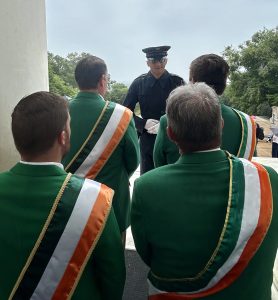
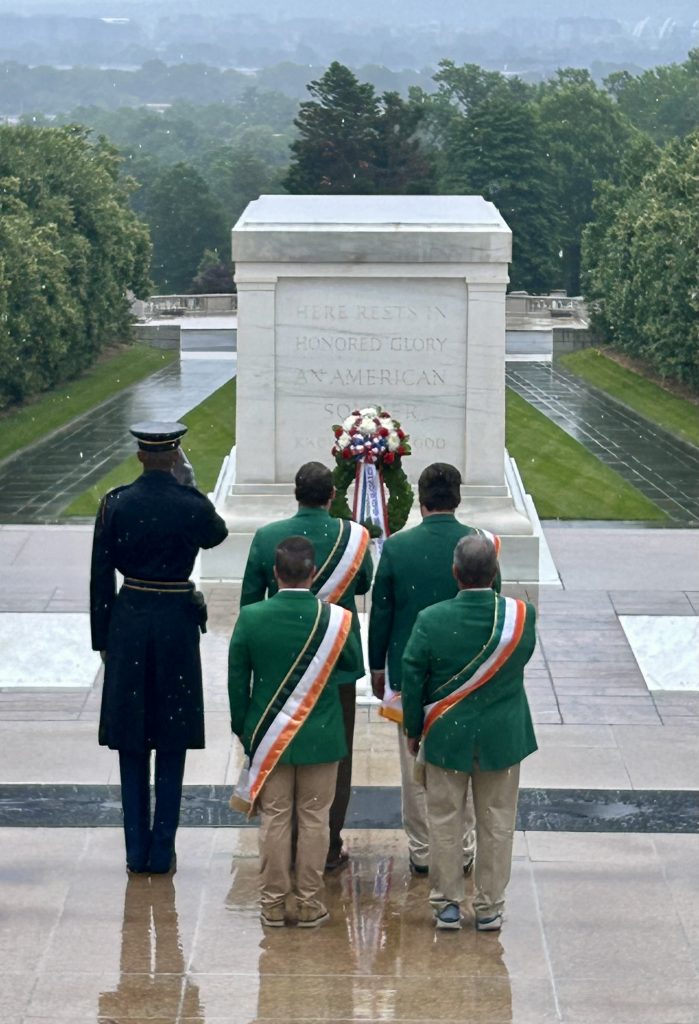
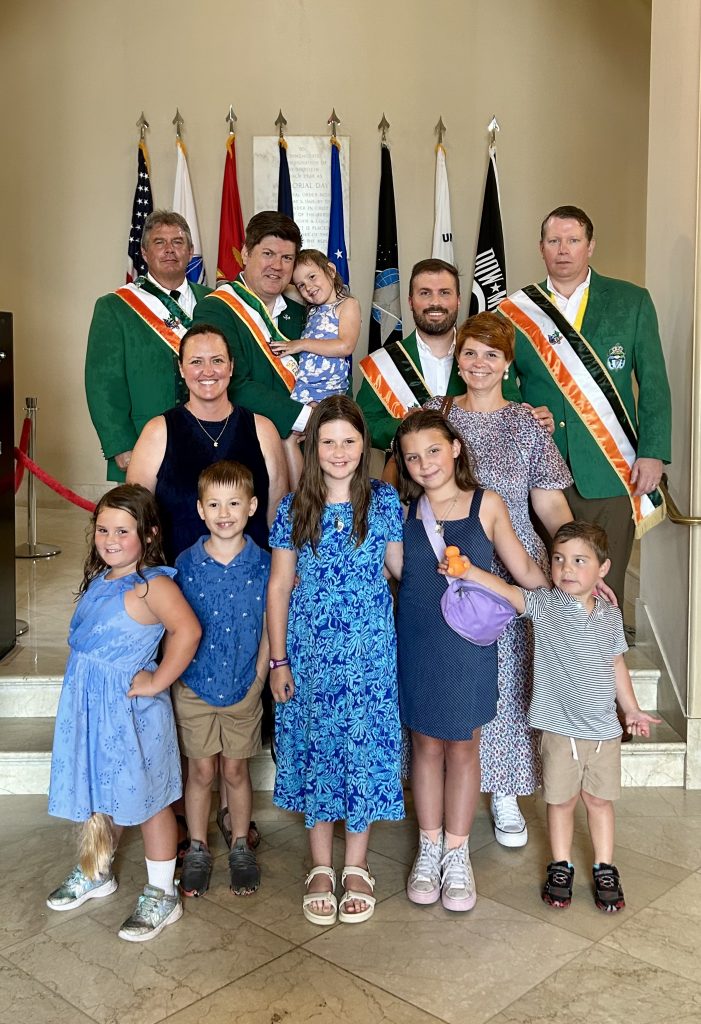
Shortly after Memorial Day, Brothers from South Carolina and Georgia laid a wreath at Arlington National Cemetery’s Tomb of the Unknown Soldier in Washington, DC. The ceremony concluded a weekend (June 6-8th) of family fun and sightseeing that included attendance at Dropkick Murphy’s Rally for Veterans on the National Mall, visits to several Smithsonian Museums, and a private tour of the the White House and US Capitol building coordinated by SC Senator Lindsay Graham’s congressional staff.
To conclude the weekend, the travel party which included State Vice President Greg Buehner, Greenville AOH Man of the Year Joseph Carey, South Carolina State President Kevin Barnes and Georgia State President and National Director Ryan Curry attended Mass at the Basilica of the Immaculate Conception and were joined by Brendan Cooney, Veterans Chair of the Virginia State Board for the Changing of the Guard and the Wreath Laying Ceremony in Arlington, Va. As the AOH contingent stepped out for the wreath laying ceremony, a bout of misty Irish weather did not dampen our spirits, but served as a reminder that Friendship, Unity and Christian Charity is needed now more than ever. As a group we were honored to participate in the wreath laying and in some small way recognize the sacrifices of so many who fought for freedom and the rights we hold dear.
Special thanks to the Barnes and Buehner family, and to Kevin Barnes for coordinating the event and working with the White House, Senator Graham’s staff, and Arlington National Cemetery to make the weekend a memorable one for all involved.
DAIL QUESTIONS
The broadcast began with video of recent remarks by Irish Tánaiste and Foreign Minister Simon Harris on the Sean Brown case, made in response to a parliamentary question asked by Paul Lawless T.D. of AONTU. Harris said he had made it clear to Hilary Benn that the Irish government will only reach an agreement with Britain on legacy, on terms that “were human rights compliant and had the support of victims and their families”. He had told the British Secretary privately and publicly that 87 year old Bridie Brown had shown enormous strength in pursuing justice through every available channel and I intend to pursue it also.”
CLARE BROWN LOUGHRAN

Clare Brown Loughran began with breaking news that instead of complying with court orders directing a Public Inquiry into her father’s murder, and her mother’s appeal to “do the right thing” the British filed papers to take the case to London. Both the Belfast High Court and Court of Appeals had ordered a Public Inquiry, holding that the ICRIR was incapable of providing an independent hearing that met the requirements of the European Convention on Human Rights. The British she said acted with “phenomenal disrespect” for her family by taking this legal action without notifying them or their legal counsel.
Sean Brown had been abducted and murdered as he locked up the Bellaghy Wolfe Tone Gaelic Athletic Club on May 12, 1997. No one has ever been convicted of this sectarian assassination, in which multiple British agents played a part. The murder took place less than a year before the Good Friday Agreement, when the conflict was nearly over. He was not politically active. The murder was committed shortly after DUP member Willie McCrea lost his Westminster seat to Martin McGuinness and threatened that nationalists “would reap a bitter harvest.” The Brown family believes that Sean Brown was targeted “as a warning to nationalists not to rise above their station”.
The Brown family brought civil suits against both the British Ministry of Defense and Chief Constable, winning damages and a formal Court apology for the RUC’s inadequate investigation. They learned additional details from an Ombudsman Report. All legal attempts to answer questions about collusion were stalled by the British.
More than 25 years after the murder, an Inquest hearing began. However the Coroner was forced to close their Inquest when the British blocked information about the role of British agents. The Coroner found that a Public Inquiry would be the only way for the Brown family to get the truth, and made a formal written request to then British Secretary Chris Heaton-Harris. Both the Belfast High Court and Court of Appeals have ordered Hilary Benn to commence an inquiry.
These judgements held that the Independent Commission on Reconciliation and Information Retrieval (ICRIR), created by the ousted Conservatives and continued by the new Labour government was not credible, because it was not independent, did not allow adequate victim participation and gave the British a veto on revealing the role of British agents.
She concluded by saying “all her family wants is the truth”.
100 YEAR BRITISH MILITARY BAN
Roisin Reade’s two uncles were killed at Kelly’s Bar, Springfield Road Belfast on May 13 th , 1972. A third man Thomas McIlroy was shot dead as he ran out to help the bomb victims. Although the gun and bomb attack was carried out by the Loyalist Ulster Volunteer Force, the British released press statements claiming it was an IRA bomb which exploded prematurely, thereby blaming her uncles John Moran and Gerard Clarke for their own murders.
The family had been fighting for decades to get the truth and their application for an inquest was granted in 2014.The inquest was handicapped because the British Ministry of Defense imposed a 100 year ban on military records about the attack.
As the inquest neared completion the family was hopeful of getting the truth. Then on May 1 st last year, the Coroner announced that he was compelled by the British Legacy Act to terminate the Inquest without a judgement.
Roisin said her family was “absolutely gutted” because they had been so close to justice.
The British referred the family to the ICRIR. However the ICRIR would not allow them their own lawyers to apply for discovery and question witnesses on their behalf. Her family had gotten as far as they had only because of their solicitor Padraig O’Muirigh. They would get nothing like that from the ICRIR.
IRISH GOVERNMENT
Ciaran Madden of the Department of Foreign Affairs represented the Irish government. He said that Tánaiste Simon Harris had raised Sean Brown’s case in his very first phone conversation with Hilary Benn, and had raised it repeatedly during meetings and conferences with the British thereafter. Only two days earlier Harris had spoken about the Brown case in the Dail.
The Irish government’s position is that the Brown family must have access to an Article 2 compliant investigation and the only existing way to provide that is through a public inquiry. What the British have now is “not fit for purpose” for the family of Sean Brown or for other victims’ families.
A recent headline in the Irish Independent, which said Taoiseach Micheal Martin and British Prime Minister Keir Starmer had agreed on a joint approach to legacy issues, was inaccurate. The Irish government must discuss legacy issues with the British and a responsibility to try to put proper legacy mechanisms in place, but will not accept anything which does not comply with Article 2 of the European Convention on Human Rights or does not command the support of victims.
Mr. Madden noted the positive impact which Congressional initiatives have and urged Irish Americans to continue their strong support of justice for victims particularly in securing Congressional support.
CAJ
Daniel Holder, of the Committee for the Administration of Justice, had issued a report last November on what it would take to make the ICRIR Commission satisfy human rights requirements under the European Convention. He said although the law is supposed to apply to everyone, during the conflict there were almost no investigations of British military killings and the system seemed designed to evade justice in collusion killings.
Victims’ relatives had brought a series of legal cases in the European Court of Human Rights, and secured a package of measures including Inquests, Ombudsman Reports, and civil actions which were starting to deliver justice.
Boris Johnson’s Conservative government wanted to shut down mechanisms that were working for families. The ICRIR was created to allow the British to remove legal representation for victims’ families and to impose a national security veto on truths which contradicted British versions of events. The Labour government has continued the ICRIR, bowing to pressure from veterans’ groups and the military.
Courts have already struck down the bans on inquests, Civil Actions and Ombudsman Reports but the British have not restored these mechanisms. They have shut down justice in legacy cases for over a year.
PANELISTS
AOH National Freedom for all Ireland Chair Martin Galvin, who served as Moderator for the Panel, said that the families of Sean Brown, John Moran, and hundreds of other families were a continuing inspiration to Irish Americans.
He also commended the Irish government for standing up for Irish victims by bringing the case in the European Court.
National AOH President Sean Pender thanked each of the panelists and noted that by continuing to go to Court 59 times, the Brown family had proven that “the reprehensible British strategy of delay, deny and wait for family to die will never succeed.”
]]>
The late Professor Marshall McLuhan presciently noted, long before the advent of the World Wide Web, that we “live today in an age of information and communication [in which] electric media instantly and constantly create a total field of interacting events in which all men participate.” The contents of entire libraries now reside online, making history accessible from any place, at any time, without the need for even local travel. Even so, there has been a renewed interest in recent years, across many disciplines, in the concept of place. Place, as noted by J. Nicholas Entriken, “presents itself to us as a condition of the human experience” such that “our relations to place … become elements in the construction of our individual and collective identities.”
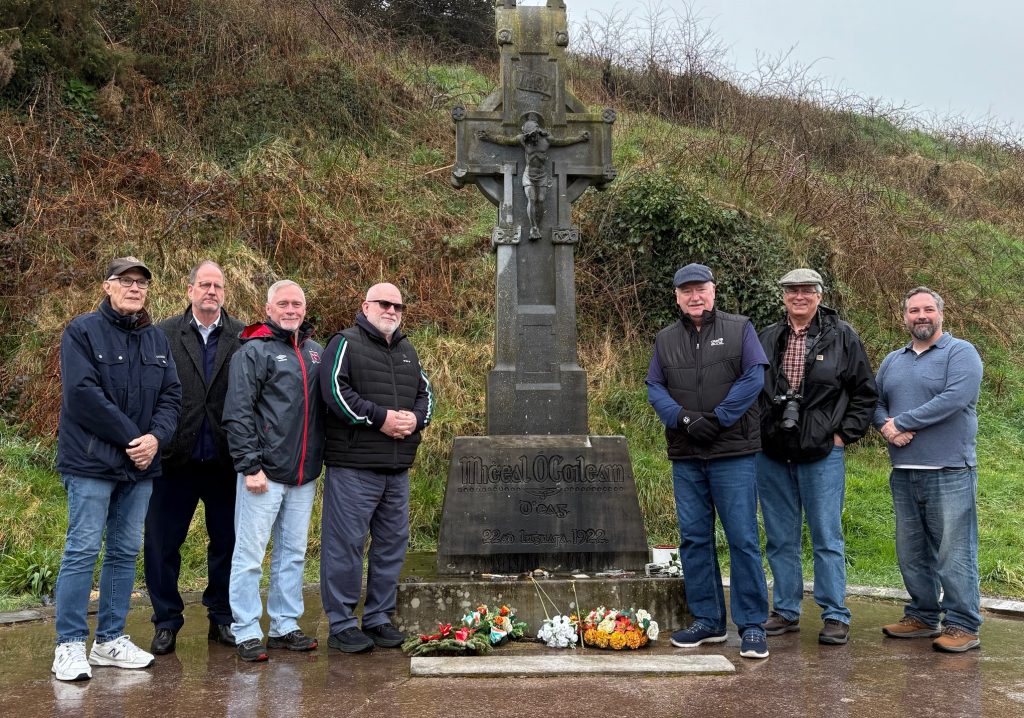
The first stop for travelers on the recent Hibernian History Tour of Ireland, fresh from the Dublin airport, the grave of Theobald Wolfe Tone in the ancient burial ground at Bodenstown, County Kildare, illustrates the significance of place in Irish history. Standing before the ruined church, dating to 1352, that forms the backdrop of Tone’s final resting place, the group contemplated Tone’s legacy as the father of Irish Republicanism and the significance of Bodenstown as a place of annual pilgrimage for generations of Irish patriots. Later that same day, our group stood atop Vinegar Hill in County Wexford and looked out from the base of the historic windmill, which stands, as it did in 1798, a silent, enduring witness to the sacrifices of the common people of Wexford who died, in the poignant words of Seamus Heaney, “shaking scythes at cannon.” The port town of Cobh in County Cork, from which so many of our ancestors embarked on their one-way journey from the land of their birth, proved as significant a place as any on the tour, as we reflected on the horrors of An Gorta Mór and the triumph of those who survived to make a new life in America. The group spent a relaxing two days in beautiful Kinsale, the site of the infamous siege and battle of 1601-1602 in which the Irish forces of O’Neill and O’Donnell could not break through to relieve their Spanish allies, with disastrous results for the old Gaelic Order. Traveling west through County Cork, a roadside stop at the Michael Collins ambush site near Béal na Bláth allowed the group to contemplate the relationship and intertwined legacies of Collins and his erstwhile comrade, Éamon de Valera, at the place where Collins received his mortal wound. The famous Ring of Kerry provided beautiful scenery en route to Derrynane House, the home of Daniel O’Connell, where our travelers took in the beauty of the place while contemplating O’Connell’s great triumph of 1829, Catholic Emancipation, his failed effort to repeal the Act of Union, and his place in the pantheon of Irish heroes. The group stopped at the majestic Rock of Cashel, seat of the Kings of Munster for 500 years, before traveling deep into the past in the Boyne Valley, where the ingenious Stone Age builders of the Newgrange complex showed a strong understanding of the significance of place. Later that day, before travelling on to Dublin, members of the group stood on the Hill of Tara, like the legendary High Kings of Ireland before them, and placed their hands on the Lia Fáil, or Stone of Destiny. The penultimate stop on the tour was the GPO, where our travelers took in the battle scars still extant on the magnificent Greek Revival portico and reflected on the events of Easter Week, 1916, and the tumultuous years that followed. The tour concluded, appropriately, at Glasnevin Cemetery, where we descended into the tomb of O’Connell and stopped to reflect at the final resting places of Parnell, de Valera and Collins, among many others. History is truly at our fingertips in this remarkable age of technology, but there is something special about being in the places that have shaped and informed the Irish identity.
]]>
New York — May 8, 2025 — The Ancient Order of Hibernians in America (AOH) extends heartfelt congratulations and prayerful best wishes to His Holiness, Pope Leo XIV, on his election as the 267th successor of St. Peter. His election marks a special moment for American Catholics as the first pope born in the United States.
“We offer our prayers and support to Pope Leo XIV as he begins his ministry as Bishop of Rome and Pastor of the Universal Church,” said Sean Pender, National President of the Ancient Order of Hibernians.
Ad Multos Annos, Pope Leo XIV.
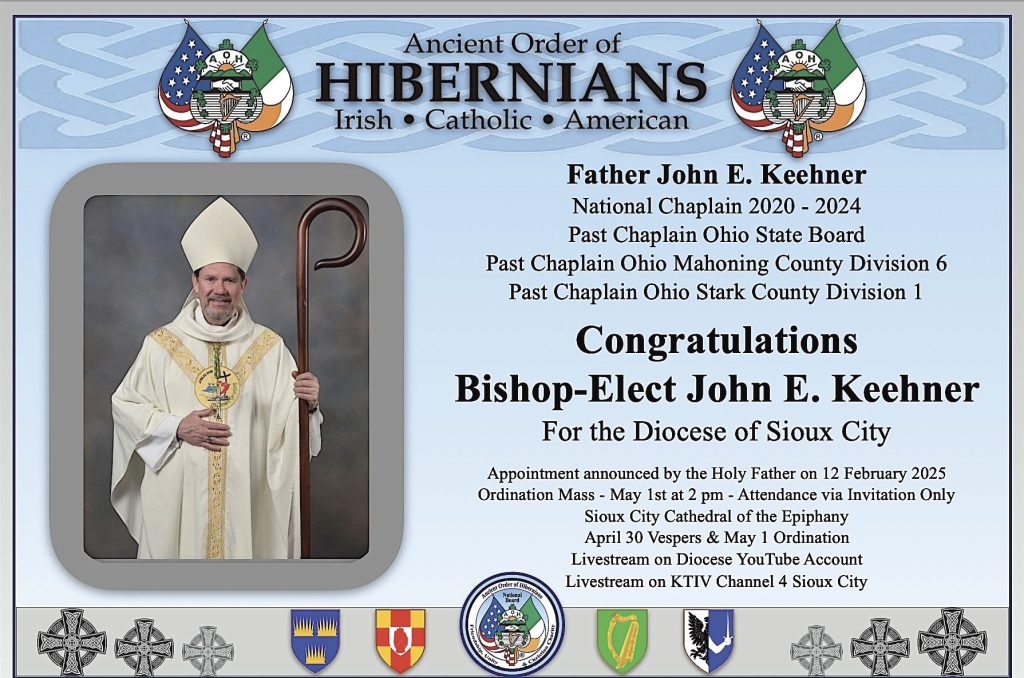
]]>“We look forward to working with Bishop Elect Keehner as he assumes the office of Bishop for the Diocese of Sioux City, Iowa”, said Sean Pender, National President of the Ancient Order of Hibernians President. As our immediate past National Chaplain, I have worked with Bishop Elect Keehner on a number of different projects. Our Brother Hibernians in Ohio have sung the praises of Bishop Elect Keehner. We look forward to working with him now as the Bishop of Sioux City, Iowa in the future.
Immediate Past National President Daniel J. O’Connell echoed that praise, stating, “Father Keehner is a natural leader. His sincerity and wisdom guided the AOH on all levels of our Order. His commitment to our faith and his work ethic is second to none. I am confident in his continued success.”
Father Keehner, 59, is a native of Youngstown, Ohio, and is one of five children. He attended Austintown schools and graduated from Austintown Fitch High School in 1984.
Father Keehner earned a B.A. in English in 1988 from the Pontifical College Josephinum in Columbus, Ohio. He then began studies at Mount St. Mary Seminary of the West in Cincinnati where he earned his M.Div. and M.A. in biblical studies in 1993.
He was ordained a priest in 1993 by Bishop James Malone at St. Columba Cathedral. His first assignment was parochial vicar for St. Charles Borromeo Parish in Boardman, Ohio. Father Keehner began canon law studies at the University of St. Thomas Aquinas (the Angelicum) in Rome and earned a licentiate in canon law in 1999. The priest was then assigned as a judge to the diocesan Department of Canonical Services.
He has served as vice rector and later rector of the St. Columba Cathedral, director of campus ministry at Youngstown State University. He has served as pastor of St. Casimir Parish, St. Christine Parish in Youngstown as well as St. Luke in Boardman, St. Paul in North Canton and Holy Spirit in Uniontown.
The bishop-elect currently serves as dean in Ashtabula County, Ohio, and is pastor of four parishes in the Diocese of Youngstown:
– Our Lady of Peace Parish in Ashtabula, Ohio
– Assumption of the Blessed Virgin Mary Parish in Geneva, Ohio
– Corpus Christi Parish in Conneaut, Ohio
– St. Andrew Bobola Parish in Sheffield, Ohio
Father Keehner served as adjunct instructor of canon law at St. Mary Seminary in the Diocese of Cleveland from 2021-24.
In additional pastoral assignments, the bishop-elect has served on the diocesan board of religious education, priest council, board of mediation and arbitration for the Office of Conciliation, presbyteral council and the priest personnel board. Father Keehner has served as a spiritual director for the permanent diaconate.
The bishop-elect has served as state chaplain and national chaplain for the Ancient Order of Hibernians.
“The National Ancient Order of Hibernians welcomes you to the episcopate!”
“ Beannacht Dé leat agus go gcoinní Dia thú”
Dear Brothers in the Ancient Order of Hibernians, family, and friends,
It is with a sad heart that we learn of the passing of Pope Francis.
Pope Francis’ legacy is one of boundless grace, simplicity, humility, and hope. He demonstrated a gentle spirit, offering solace and guidance to those in need. His words and actions were a testament to the power of faith and the enduring strength of the human spirit.
May he now rest forever in the loving arms of our Savior, Jesus Christ.
Let us quietly pray for the happy repose of his soul:
Our Father …
Hail Mary …
Glory be to the Father …
Fr Martin O’ Reilly
National Chaplain to the AOH
]]>
John Lawrence Sullivan, born to Irish immigrants on October 15, 1858, in Roxbury, Massachusetts, grew into an embodiment of the American Dream for many Irish Americans. His parents, survivors of the Great Hunger in Ireland, instilled in him a profound sense of identity and resilience. Though he was an excellent student and his parents aspired for him to attend Boston College and become a priest, destiny had a different plan for Sullivan. Lured by the raw appeal of professional sports, Sullivan found his true calling in boxing, a sport then shadowed by legal ambiguities and often relegated to “exhibitions” or clandestine bouts.
Sullivan’s rise from local fame to national celebrity was meteoric. In one fight, his opponent failed to show, and to quell the restless crowd, Sullivan issued a challenge that became his trademark, “I can lick any man in the house.” This became not just Sullivan’s trademark but a symbol of Irish-American defiance and determination. Through a series of exhibition matches and high-profile bouts, including a legendary encounter with Paddy Ryan in Mississippi, Sullivan’s fists wrote chapters of boxing history. His victory over Ryan, witnessed by figures as diverse as Oscar Wilde and Jessie and Frank James, cemented his status as a champion of the people.
Sullivan’s reign as the Heavyweight Champion brought boxing to the forefront of American sports, making him the nation’s first sports superstar. Leveraging his “I can lick any man in the house” boast, he made a whirlwind of 200 stops across the United States, showcasing his unparalleled strength and skill, endearing him further to an adoring public. Boxing historian Nate Fleisher has observed, “For the first time in their lives, Americans living in the sticks — nearly four hundred thousand American farmers, miners, lumberjacks, artisans, and clerks — laid down their hard-earned cash to see a real boxer in action. They loved it, and the effect of their gratification on the growth and spread of boxing is beyond calculation today.”
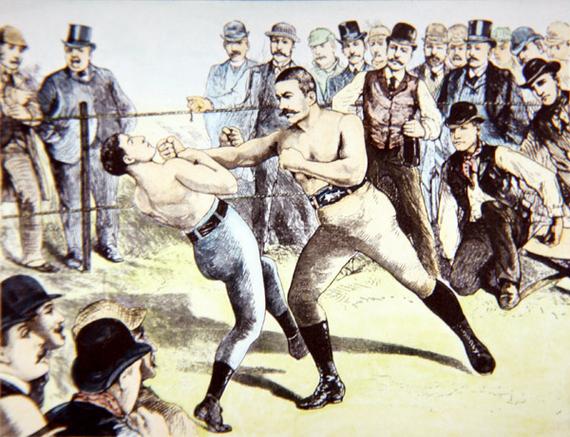
Yet, Sullivan was more than a mere athlete; he was a cultural icon, reflecting the grit and determination of the Irish American community still struggling to overcome prejudice and find their place in American society. Such was his fame that to be able to say, “Shake the hand of the man who shook the hand of John L. Sullivan,” brought its own notoriety.
Sullivan never forgot where he came from. In a story that further enhanced his renown in the Irish community, it was said that he refused to stand for the traditional toast to Queen Victoria while attending a dinner in his honor in Victoria, British Columbia. Sullivan stated he “hadn’t been brought up to seeing Irishmen drinking to the health of English monarchs,” he informed the shocked dinner guests.
However, time and age give athletes no special consideration. Add to this that in a phenomenon we see repeated among many modern athletes, Sullivan liked to party, and it became increasingly difficult for him to get in shape. The fight against “Gentleman Jim” Corbett in 1892 highlighted the end of an era and showcased how far boxing had developed under Corbett. No longer were fights held secretly in the dark backroom of a saloon; this fight was held under the glare of the new electric light and the eyes of over 10,000 spectators and reported worldwide. The aging champion and brute strength brawler Sullivan met his match in the younger, more agile, more scientific Corbett. While clearly past his prime and suffering a broken nose in an early round that constrained his breathing, Sullivan persevered until the last of the 21 scheduled rounds where he was knocked out.
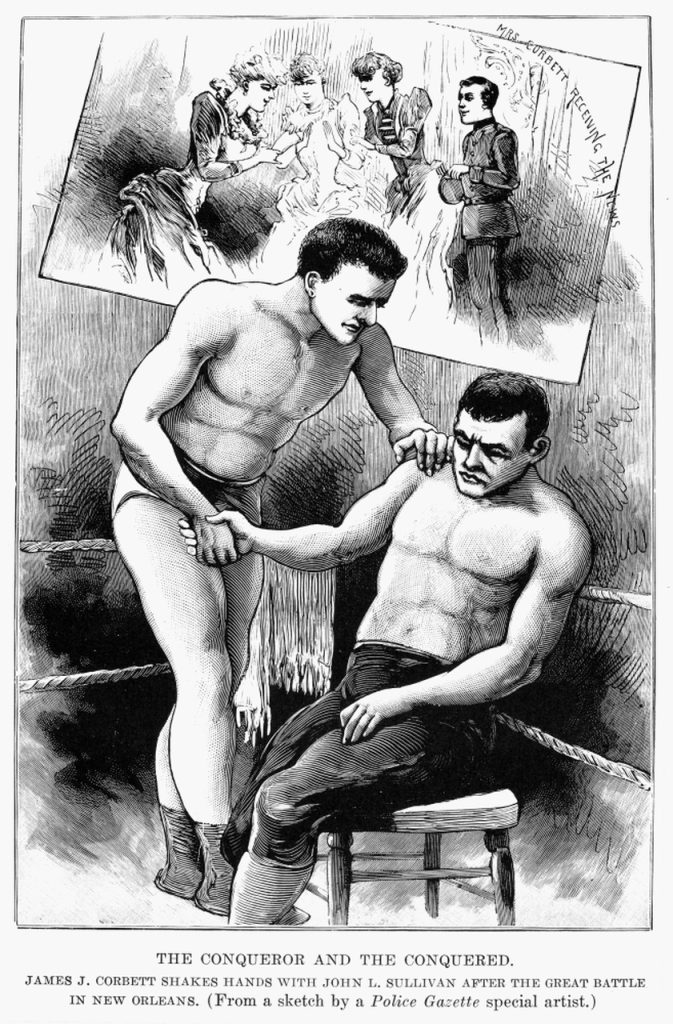
However, even in defeat, Sullivan added to his legacy for the graciousness he accepted, “Gentlemen, all I have to say is that I came into the ring once too often, and if I had to get licked, I’m glad it was by an American.” Sullivan’s grace in defeat, acknowledging Corbett’s victory as a passing of the torch to a fellow American, exemplified his character.
John L. Sullivan’s legacy is not merely confined to his boxing achievements; it is interwoven with the narrative of Irish-American struggle, perseverance, and success. His life story, from the streets of Roxbury to the heights of boxing fame, resonates with the spirit of a community that literally and metaphorically fought to carve out a place in America. Sullivan’s journey embodies the complexities of the American Dream, reminding us that heroes are not defined by their victories alone but by their ability to inspire, persevere, and stand with dignity and pride regardless of the outcome.
]]>
On April 24, 1832, 57 Irish immigrants from the counties of Derry, Donegal and Tyrone boarded the barque John Stamp at the port of Derry to begin their voyage to Philadelphia. They had all taken different roads to arrive at this literal and emotional departure. John Ruddy was just 18 when he hugged his parents goodbye, knowing it was unlikely that he would see them again in this life. Catherine Burns was 29 and had already experienced a lifetime of sadness; she was a widow and traveling with her Father-in-Law, hoping for a better life in America. What united them all was their desperation to leave a homeland that provided no opportunity but poverty for Irish Catholics.
After a three-month voyage, the ship sailed up the Delaware River and stopped at the first quarantine hospital in the United States, the Lazaretto. The deadly disease cholera was raging around the world. At the quarantine station, a doctor would board the ship and examine every passenger and crew member to confirm they were not ill before being cleared to enter Philadelphia; if anyone were sick, they would be quarantined. Despite these precautions, prejudice trumped science in the minds of nativist Americans, and Irish Catholics were frequently blamed for the disease when the origins were closer to home, the disease traveling from Canada down the Hudson to New York and then to Philadelphia. America gave cholera to the Irish, not the other way around.
The 57 Irish immigrants finally landed at Philadelphia’s Washington Avenue Immigration Station, where they were met by a labor contractor Phillip Duffy. To the newly arrived immigrants, Duffy, who himself had emigrated from Donegal, must have seemed the personification of the American dream they had come for. He offered them immediate employment as railroad laborers and Catherine a position as a cook and laundress to the work crew. The work was the hard, backbreaking work of helping to build one of America’s first railroads. Duffy held the contract for Mile 59 of the Philadelphia and Columbia Railroad near Malvern, Pennsylvania. It was one of the most challenging stretches of the route and offered Duffy one of the most lucrative contracts if completed. It was the backbreaking work of filling a natural valley by excavating and transporting rock and soil from an adjacent site, “the cut”; it was the work of moving a valley. It was the brutal work that only the Irish, the lowest rung on the socioeconomic ladder of the time, were willing to do out of financial desperation.
This arduous work was taking place in the heat of July and August. It was natural and inevitable that some of the workers would attempt to alleviate their thirst from the local streams. Soon some of the workers contracted cholera and began to die.
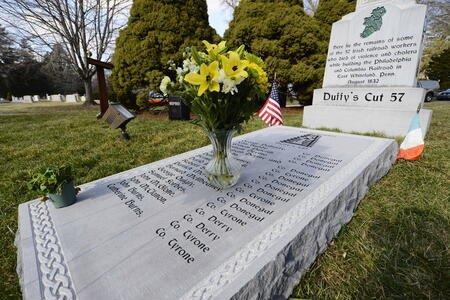
Panic soon gripped the area. Four nuns who were nurses from the Sisters of Charity in Philadelphia were sent to help. The locals turned on the Sisters driven by anti-Catholic sentiment and for fear they too were cholera carriers, forcing the nuns to walk back to Philadelphia. Local vigilantes descended on the camp and killed what remained of the 57 immigrants, the sick and the healthy alike, using clubs, axes, and guns. The bodies were then dumped in unmarked graves as part of the fill that trains would eventually pass over.
The American dream of the John Stamp immigrants ended after just six weeks. The railroad swiftly covered up the incident, burying the story along with the bodies, leaving families in Ireland to wonder about the fate of loved ones they would never hear from again.
In 2002, two brothers, Bill and Francis Watson were going through their late grandfather’s papers. Their grandfather had been an archivist of the Pennsylvania Railroad, the successor to the Philadelphia and Columbia Railroad. Thanks to their persistence and detective work, the site of the graves of the 57 immigrants was located, and their fate properly recorded. Sadly, many of the bodies still cannot be safely recovered as they are buried near active railroad tracks.
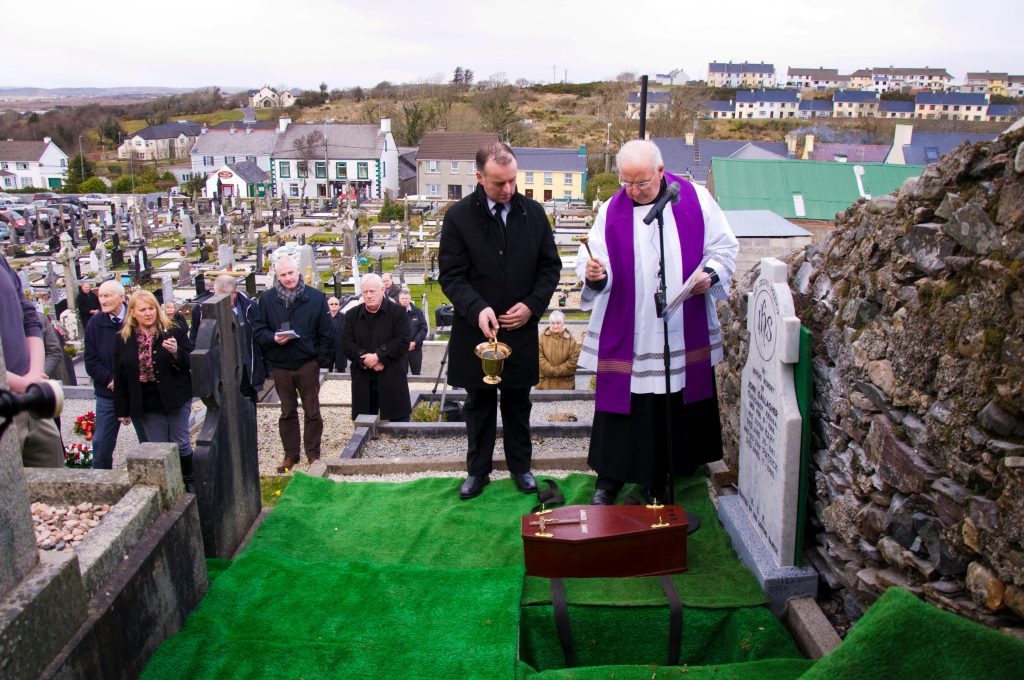
The remains of five men were reburied in West Laurel Hill Cemetery under a memorial that records the name of all 57 immigrants and the Irish County of their birth. Young John Duddy and the widow Catherine Burns’ remains were finally buried with a dignity in Donegal and Tyrone, respectively; they had returned home after 180 years.
It can be truly said that in the case of the 57 John Stamp immigrants, America was built on their sacrifices. Sadly, there are still those who wish to keep the story of what happen at Duffy’s Cut buried, as the struggle and prejudice that Irish immigrants faced is an inconvenient truth, running counter to their narrative that the Irish had it easy once they arrived in America. Their story and sacrifice should be recognized appropriately, elevating them from their current position of anonymous collateral damage to the industrial revolution.
]]>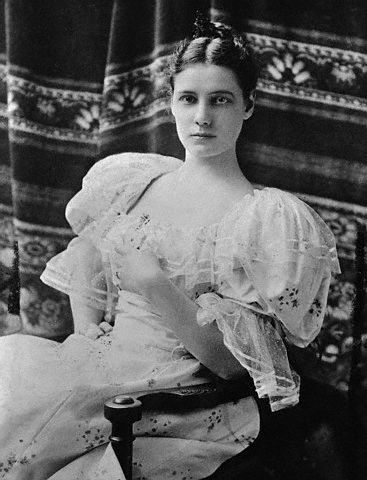
Nellie Bly was born Elizabeth Cochrane on May 5, 1864 in Cochran’s Mills, now part of Pittsburgh, Pennsylvania. Her father, Michael Cochran (Elizabeth would add the ‘e’ to the last name later), was the son of an immigrant from Derry who has started as a laborer and had prospered to the point of buying the local mill after which the town was named. Elizabeth was one of five children Michael had with his second wife, Mary Jane Kennedy. Michael Cochran had ten children by his first wife.
The young Elizabeth’s world suddenly collapsed when her father died when she was six years old without leaving a will. The court directed that his assets be sold and divided amongst the children of both marriages, putting her mother in precarious financial circumstances. Her mother remarried, but the second husband was abusive, resulting in a divorce that further strained the family’s finances, forcing Elizabeth to drop out of school where she had been studying to be a teacher.
Given the experiences she had so far endured in her young life, it was little wonder that a condescending article entitled “What Girls are Good For” in the Pittsburgh Dispatch provoked a fiery response from young Elizabeth, who penned a letter to the editor dramatically signed “Lonely Orphan Girl.” The editor was so impressed with the rebuttal that he ran an ad asking whoever wrote it to come forward and identify herself. Meeting Elizabeth Cochrane and impressed with her spirit, he offered her a job. It was customary for women reporters to write under a pseudonym; the editor suggested “Nelly Bly,” the subject of a popular Stephen Foster song. When it went to print, “Nelly” was accidentally changed to “Nellie” and stuck; Nellie Bly was born.
Showing her spirit for adventure, Bly traveled to Mexico, despite knowing no Spanish, and lived among the Mexican people, sending back reports on their daily lives and customs. However, her streak as a crusader also manifested itself, and she soon had to flee the country before being arrested for criticizing the government of dictator Porfirio Díaz. Her dispatches were later compiled into a book entitled “Six Months in Mexico.”
Despite proving herself as an investigative reporter, Bly soon found herself given nothing more than “domestic topics” to write on despite her protests. One day her editor came into the newsroom to find a note from Bly stating, “I am off for New York. Look out for me.”
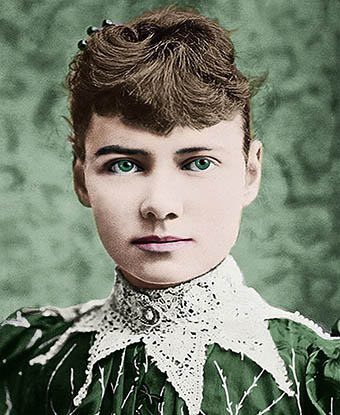
Despite being an experienced reporter, Bly found it nearly impossible to break into New York journalism. Bly eventually talked her way into Joseph Pulitzer’s The World newspaper offices with a proposal to do an investigative piece on New York City’s notorious Women’s Lunatic Asylum on Blackwell’s Island (now Roosevelt Island) by having herself committed as a patient. As events would later prove, this was a hazardous undertaking; it was later admitted that they were not clear on how they would get her out of the asylum at the time.
Bly got into her character with a vengeance. She practiced a “faraway expression in a mirror” and stopped practicing personal hygiene. She dressed in tattered second-hand clothes and checked herself into a boarding house for women, where she began looking for a non-existent trunk and ranting. Within 24 hours, her outbursts had the residents calling the police in fear of their lives. A judge remanded Bly to Bellevue Hospital’s psychiatric ward, where the chief doctor diagnosed her as “delusional and undoubtedly insane.” She was committed to Blackwell Island.
Bly would spend ten days in the hell of Blackwell’s asylum. She would later write of spoiled food, lack of warm clothing and a treatment of ice-cold baths that simulated drowning. The matrons were abusive; some were actually inmates from a penitentiary that shared the island, who regularly beat and choked the patients. Even worse were prolonged periods of social isolation. Bly wrote:
“Take a perfectly sane and healthy woman, shut her up and make her sit from 6 a.m. to 8 p.m. on straight-back benches, do not allow her to talk or move during these hours, give her no reading and let her know nothing of the world or its doings, give her bad food and harsh treatment, and see how long it will take to make her insane. Two months would make her a mental and physical wreck.“
More concerningly, Bly found that many of the women confined at the asylum were sane. One patient was a German woman whose only malady was that she had such a thick accent that she had been diagnosed as speaking gibberish. Some were inconvenient wives whom their husbands had put away. Ominously, Bly dropped her insane act once she had achieved her goal, yet found “the more sanely I talked and acted, the crazier I was thought to be.” It was clear that once a woman was committed, it was virtually impossible to be released.
After ten days, the lawyers for “The World” appeared with a court order for her release. Bly’s expose “Behind Asylum Bars,” which would later form the basis of a book, “Ten Days in a Madhouse,” became a nationwide sensation and Bly a national celebrity. The attention she raised resulted in the appropriation of an additional one million dollars (a tremendous sum in the late 19th century) to the annual budget for the treatment of the mentally ill in New York City.
Bly would not be out of the public consciousness for long. She proposed to Joseph Pulitzer recreating the fictional journey of Phineas Fogg in Jules Verne’s Around the World in Eighty Days and to complete the trip in even less time. Pulitzer resisted sending her. He told her that her gender would make the trip impossible. “Very well,” Bly replied, “Start the man, and I’ll start the same day for some other newspaper and beat him.” By this time, Pulitzer knew it was no idle threat and conceded.
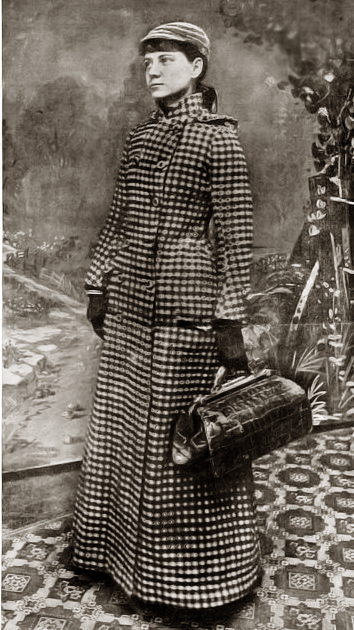
Bly began her trip with but a single carry-on bag. When she reached Paris, she had lunch with Jules Verne, who offered her his encouragement. When she left New York, Bly was unaware that a competing paper had dispatched their own woman reporter in an attempt to beat her; their reporter turned out to be no competition as while she wrote flowery prose about scenery and sunsets, Bly reported on people and their customs. The public followed her daily reports with fascination as she traveled lands they had never heard of.
When Bly arrived in California, she was behind schedule by two days due to storms in the Pacific but found that Pulitzer had chartered train waiting to bring her home. She arrived back in New Jersey on January 25, 1890 completing the trip in just over seventy-two days. Nellie Bly was a national sensation at the age of 25.
Bly continued to be a crusading reporter for several more years, but never equaled the fame of her earlier exploits. She married millionaire manufacturer Robert Seaman, a man forty-two years her senior, and left Journalism. Upon her husband’s death, she took over his Iron Clad Manufacturing Co., which made steel containers. As with all her endeavors, Bly threw all her energies behind it. She obtained several patents in her own name for designing new containers. However, as if coming full circle to her earlier life, finances proved her bane. As biographer Brooke Kroeger noted, “She ran her company as a model of social welfare, replete with health benefits and recreational facilities. But Bly was hopeless at understanding the financial aspects of her business and ultimately lost everything.”
Bly briefly returned to journalism, even covering WW I from the eastern front, before succumbing to pneumonia at the age of 57.
Nellie Bly was a trailblazer of fearless journalism — the kind we need now more than ever. Her story is one of courage, curiosity, and a refusal to be sidelined. An Irish American worth remembering — and emulating.
Neil F. Cosgrove ©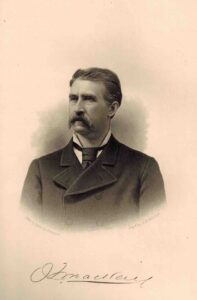
William Shakespeare observed, “The evil that men do lives after them; The good is oft interred with their bones.” It speaks to the ironic tendency for society to notarize, even glorify, the darkest aspects of humanity while ignoring the noble. Nowhere is this clearer than in the case of Irish American John Mackay, the “Bonanza King.”
John Mackay (pronounced Mackee) was born on November 28, 1831, on the outskirts of Dublin in the appalling poverty of pre-famine Ireland. In 1840, when Mackay was nine years old, the family emigrated to New York City, settling in the notorious Five Points section of the city. At first, it seemed that the family was prospering, they were able to scrape together enough that young John was able to attend school at a time when only half of the Irish children living in New York received any formal education. However, disaster struck in 1842 when Mackay’s father died suddenly, forcing young John to quit school to support his mother and sister. Mackay often would remark in later life that his greatest regret was not having completed a formal education.
Mackay started working as a newsboy, at the time a grueling and unsparing job. Newsboys had to buy their papers in advance and could not return any that went unsold, which could quickly erase a day’s work. Fighting for readers was often literal. It would have been particularly hard for Mackay who throughout his life fought a terrible stammer, but the boy developed a habit of letting his hard work speak for him. Mackay eventually secured a position as an apprentice ship’s carpenter; a testament to his determination as the New York shipbuilding industry of mid-19th century rarely employed the Irish.
The event that would change Mackay’s life occurred in 1848 with the discovery of gold in California. Despite the risks and hardships, prospecting for gold offered the chance to go from working for mere subsistence to improving one’s life. Like thousands of other young men of the time, Mackay left New York with nothing but a strong will supported by a strong back.

In the goldfields of California, Mackay developed a legendary reputation for hard work; a fellow miner would later reminisce, “Mackay worked like the devil and made me work the same way.” Nevertheless, after eight years in California Mackay had little to show for his efforts. Word filtered through the camps of a new strike in the Utah territories (present-day Nevada) of the vast silver and gold deposit that would be known as “The Comstock Lode.” With fellow Irishman and future partner Jack O’Brien, Mackay walked over one hundred miles and climbed over twenty-three hundred feet crossing the Sierra Nevada mountains to arrive in the mining camp without a nickel to his name to start again.
Mackay started as a common miner at $4 per day. For several years he crammed two days of backbreaking labor into a single day, working one full shift to earn the money he needed to survive and then a second shift in exchange for “feet,” a share in the mine’s ownership. Through his grueling toil and expertise in mining gained from hands-on experience and hours of study, Mackay gradually amassed some capital and acquired stakes in better and better mines. In 1865, MacKay acquired a majority share of an obscure mine called the Kentuck, which had been written off as unproductive. Mackay believed otherwise. Mackay invested his savings acquired through a life of grueling labor and every penny he could borrow in the Kentuck. After a year of mining the Kentuck with little to show, Mackay was teetering on the edge of bankruptcy, but on New Year’s Day, 1866, he hit a ten-foot-wide vein of gold and silver 250 feet below the surface. Over the next two years, the “unproductive Kentuck” would yield Mackay $1.6 million worth of gold and silver in the day’s currency, approximately $375 million in today’s dollars.
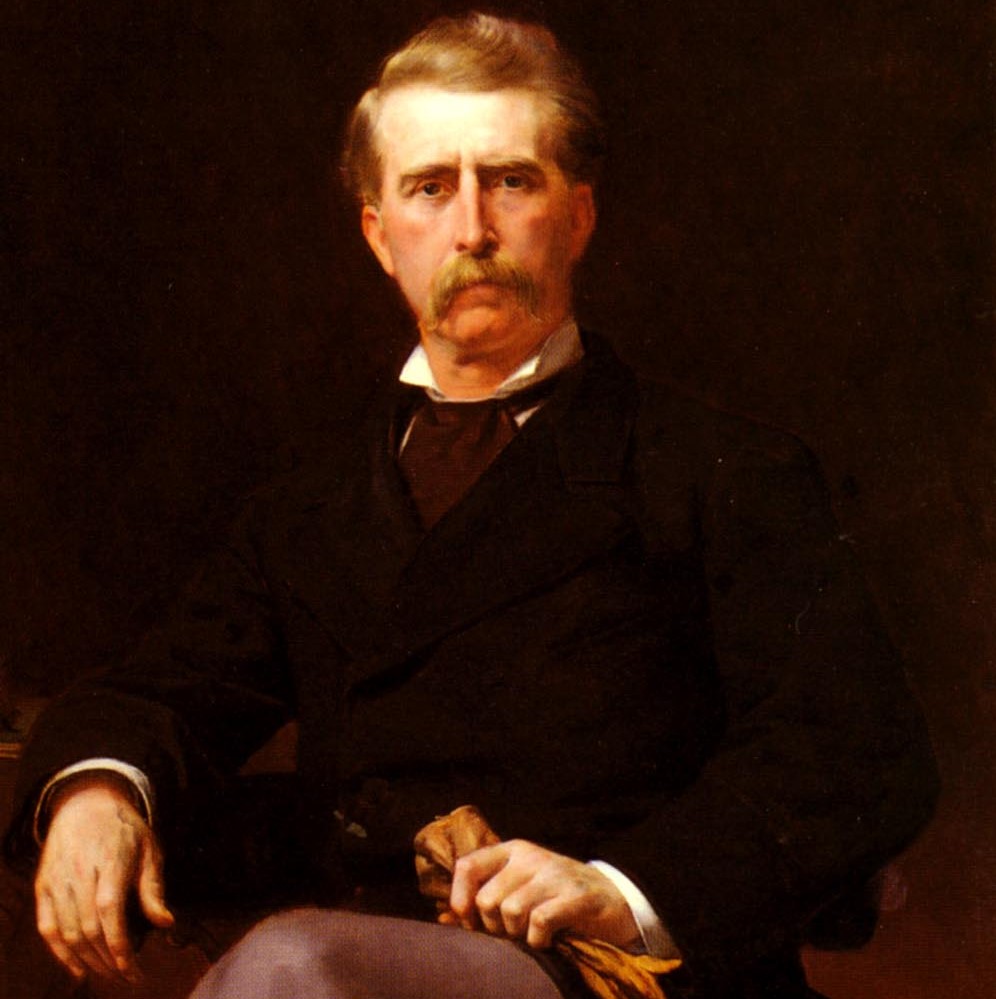
Despite having acquired more wealth than an improvised newsboy from the Five Points could dream of, Mackay still had a love of work and mining. In 1873, Mackay and his three fellow Irish American partners hit “the Big Bonanza” – a strike that still holds the record as the most concentrated ore body in history. In the silver and goldfields of Nevada, Mackay had gone from earning $4 a day to $450,000 per month, making Mackay and his partners the richest men in the world. Mackay was nicknamed “the Bonanza King,” a title the modest McKay shunned.
However, the accumulation of wealth was not an end in itself for Mackay. His miners were the best paid in the world, and he was renowned for always dealing fairly with them. When a depression created a surplus of labor, a consortium of mine owners attempted to exploit the situation by conspiring to reduce the miner’s wages to $3.50 an hour; McKay would have none of it. He stated, “I always received $4.00 when I worked in the mines and when I cannot pay that I will go out of business.” He would continue to drive himself to this mines in a simple one-horse wagon rather than an elegant coach, and in winter was never in too much of a hurry to stop to allow local children to hitch on their sleds so that he could give them a ride up a hill. In the slang of the Comstock miners when something was of exceptional quality it was referred to as “the John Mackay.”
Always a believer in free enterprise, in later life Mackay took on “the most hated man in America” Jay Gould, who had a monopoly on transatlantic telegraph communications for his Western Union company. Mackay broke his monopoly by forming the Commercial Cable Company and laying his own pair of rival transatlantic telegraph cables at tremendous cost. In the process, Mackay incentivized and aided in his employees’ purchase of company stock, one of the first business leaders to do so. When he built the office of his new cable company in New York City at the intersection of Murray Street and Broadway across from City Hall, he had his desk positioned so he could see his childhood home in the Five Points—a daily reminder of how far he’d come..

Mackay’s philanthropy and generosity were legendary, but in keeping with his character done quietly and without pretense. Mackay gave generously to the Catholic Church and endowed the Catholic orphan asylum in Virginia City, Nevada. When former President Grant was nearly penniless due to losing his investments in a Wall Street scandal, Mackay quietly helped him in the same way as he quietly helped so many old miners of his acquaintance. He endowed the school of mines at the University of Nevada
When Mackay died in 1902, The Salt Lake City Tribune said of this one-time improvised Irish immigrant that “of all the millionaires of this country, no one was more thoroughly American than Mr. Mackay, and no one among them derived his fortune more legitimately.”
It’s a grave injustice that the memory of John Mackay has faded—especially when his example is so badly needed today. Unlike the robber barons of his era—Rockefeller, Carnegie, Stanford, Huntington—Mackay didn’t need to endow libraries, universities, and foundations to atone for how his fortune was made. Mackay built his wealth honestly and treated people fairly his entire life. When asked for his advice on success, he always said: “Son, never lose your good name.” He never did.
And that’s worth remembering.
]]>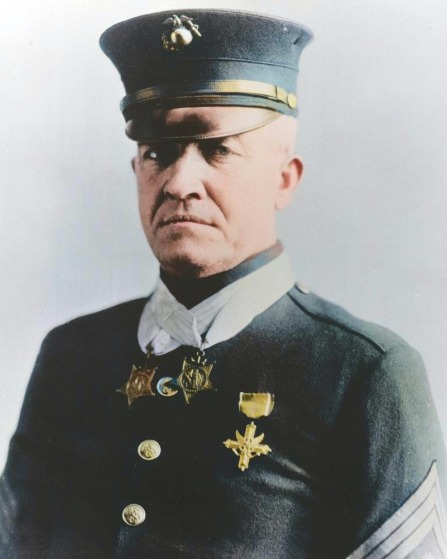
In the history of the Medal of Honor, the United States Highest award for “conspicuous gallantry and intrepidity at the risk of his life above and beyond the call of duty“, only 19 men have been awarded the medal twice. Among them is Marine Sergeant Major Daniel Daly, one of only two Marines to receive the Medal of Honor Twice for separate acts of heroism and nominated for a third.
Daly was born in Glen Cove, Long Island, New York, on 11 November 1873. He was slight of stature, only 5’ 6″ in height and weighing 132 lbs, yet as a youth had a reputation as a fighter, a reputation he would prove more than deserved.
Daly was part of the U.S. Embassy Guard in Peking when the Boxer Rebellion broke out in 1900. In one of the most memorable acts of that war, the Boxers surrounded the compound of the foreign legations in Peking and laid siege to it for 55 days. At one point, when German Marines of the German embassy were forced back, Daly by himself took a position in a bastion on the Tarter Wall and remained there throughout the night. Subjected to sniper fire and numerous attacks, when relieved in the morning Private Daly was still holding his position with the bodies of numerous attackers surrounding his position attesting to his bravery. For this he was awarded his first Medal of Honor.
“Had one squad failed, not one man of the party would have lived to tell the tale. Gunnery Sergeant Daly, 15th Company, during the operations was the most conspicuous figure among the enlisted men.”
Fifteen years later found now Gunnery Sergeant Daly in Haiti fighting against the Cacos. The reconnaissance company of 38 men that Daly belonged to was ambushed by over 400 of the enemy while attempting to ford a river at night. Among the casualties was the mule carrying the company’s machine gun. After getting his men to a secure position, Daly returned, alone and under enemy fire, to the river and searched for the gun. He found it, and was able to bring the gun and its ammunition back to the Marine position. Daly then took command of one part of a three pronged assault on the rebel position, killing 75 rebels and scattering the rest. As one of the two officers present noted, “Had one squad failed, not one man of the party would have lived to tell the tale. Gunnery Sergeant Daly, 15th Company, during the operations was the most conspicuous figure among the enlisted men.” Daly was awarded his second Medal of Honor.
Realizing that to stay where they were would lead to certain death, the now 44 year old Daly, led a counter-attack with a battle cry that has become Marines lore, “Come on, you sons of B——, do you want to live forever?!”
However, Daly was not finished yet; there was still the incident for which he is perhaps best remembered in the Marines. In June 1918, at the battle of Belleau Wood during World War I, the Marines were under a heavy artillery barrage and pinned down. Realizing that to stay where they were would lead to certain death, the now 44 year old Daly, led a counter-attack with a battle cry that has become Marines lore, “Come on, you sons of B——, do you want to live forever?!” Later in the battle, Daly single-handedly eliminated a machine gun nest with nothing more than his 45 pistol and grenades. In the course of the battle he was wounded three times.
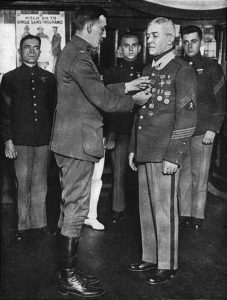
Daly was recommended for a third Medal of Honor, and the NY Times reported it as a certainty. However, petty bureaucratic politics came into play, and a capricious decision was made that the Medal of Honor could only be awarded twice, no matter how deserving subsequent acts of valor were. Daly’s third Medal of Honor was denied solely on this technicality; instead, he was awarded the Distinguished Service Cross, the Navy Cross, and France’s Médaille Militaire.
Perhaps the greatest tribute was paid by General Smedley D. Butler, the other Marine to be awarded two Congressional Medals of Honor for separate acts of valor, who called Daly “The fightinest Marine I ever knew.” Offered promotion several times, Daly once remarked “I would rather be an outstanding sergeant than just another officer“.
Neil F. Cosgrove ©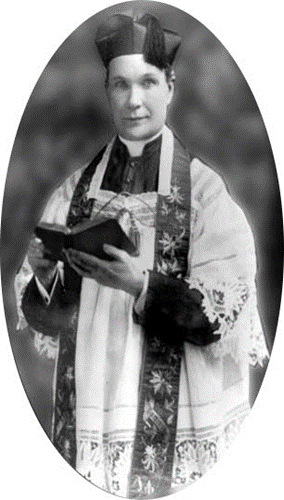
The 1920s marks one of the darkest and least discussed chapters in American history. During this period, the Ku Klux Klan experienced a resurgence, propelled by various factors, including D. W. Griffith’s controversial portrayal of the Klan in “Birth of a Nation” (originally titled “The Klansman”), a complex mix of patriotism and isolationism following World War I, and the adoption of modern marketing techniques. As a result, the Klan transcended its Southern roots, evolving into a nationwide movement with a staggering membership of six million. To sustain its rapid growth and appeal to a broader audience, the Klan expanded its platform of hate. Anti-Catholicism, along with racism, antisemitism and xenophobia, became central to its national identity.
Among the countless victims and perpetrators of this shameful campaign of bigotry and violence, two names stand out: Fr. James Coyle, a martyr for his faith, and Hugo Black, a man who would wear both the robes of a Klansman and a U.S. Supreme Court Justice.
Fr. James Coyle was born in Drum, County Roscommon. He attended Mungret College in Limerick and the Pontifical North American College in Rome and was ordained a priest at age 23 on May 30, 1896. Fr. Coyle would leave his homeland forever, sailing to Mobile, Alabama, whose mines and industry were fueling explosive growth and attracting many Catholic immigrants, including the Irish.
After an initial assignment as an instructor and rector at the McGill Institute for Boys, Fr. Coyle was appointed the pastor of St. Paul’s Church in Birmingham, where he became beloved by his congregation and respected by many of the non-Catholic community. Fr. Coyle quickly became known as a champion for fair treatment for the poor and marginalized of all communities; his personal mantra was “Give, give till it hurts- then and only then is there sacrifice.”
However, the growing Catholic community of Birmingham coincided with growing prejudice and the resurgence of the Klan. Fr. Coyle was quick to respond to newspaper attacks on Catholicism with his own letters deriding the misinformation and ignorance of bigots. Fr. Coyle was often the recipient of anonymous death threats, but that did not dissuade him from publicly defending and espousing his faith.
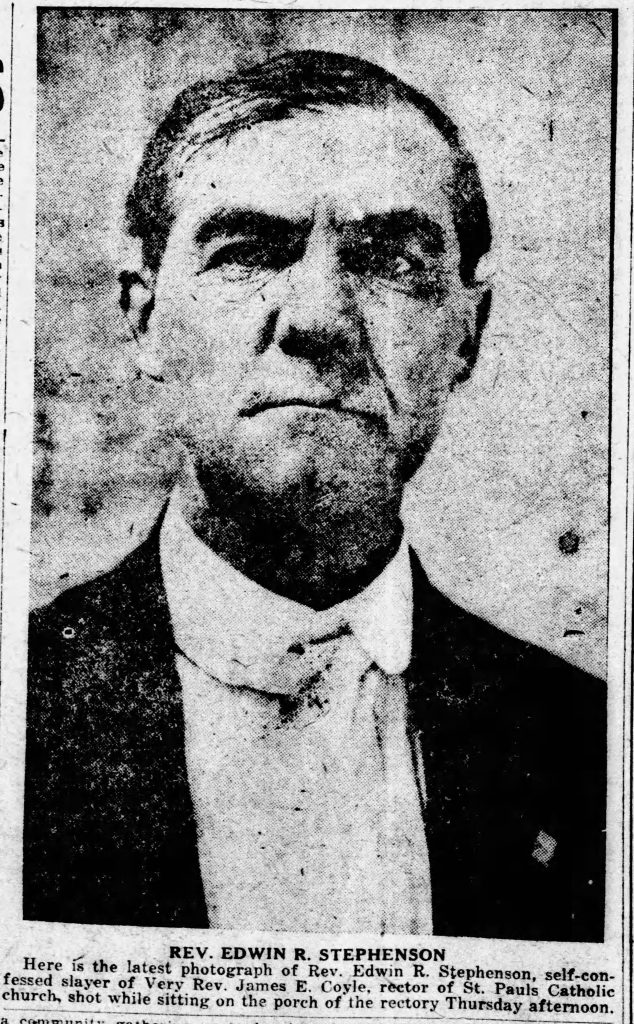
The Klan’s anti-Catholicism was epitomized by another local clergyman. Edwin Stephenson. Stephenson was an ordained Methodist deacon but styled himself as a minister for his occupation of being a “marrying parson” at the Jefferson County Courthouse, which was on the same block as Fr. Coyle’s St. Paul’s. Stephenson was also a member of Robert E. Lee Klavern No. 1, the first Alabama chapter of the Ku Klux Klan. Stephenson described Fr. Coyle as ‘one of humanity’s biggest enemies.’
Stephenson had a daughter, Ruth, who often rebelled against her Father’s rigid rules. Living merely a block from St. Paul’s, Ruth became fascinated by Catholic traditions despite her Father’s vehement criticisms of the faith. When she turned 18, she started secretly attending classes on the Catholic faith and was eventually baptized as a Catholic. When Edwin Stephenson discovered her conversion, he threatened to kill his daughter. Ruth fled her Father’s threat to live with a local Catholic couple. Stephenson went to the Birmingham police chief, a fellow Klansman, to report that Ruth had been “kidnapped by Catholics.” Still considered underage, the police returned her to her Father, where she was beaten with a leather strap after her mother stuffed a rag in her mouth to muffle her screams.
If Stephenson’s aim was breaking Ruth’s independent nature, it failed. Ruth had been hiding another secret: she was engaged to a Puerto Rico man named Pedro Gussman. The couple secretly obtained a marriage license in another town, but finding no priest there, they returned to Birmingham and Fr. Coyle. After carefully inspecting the license, Fr. Coyle performed the ceremony. After the ceremony, Fr. Coyle told Ruth that the first thing she must do is inform her parents.
Three hours after the ceremony, Fr. Coyle was sitting on the porch of his rectory praying his breviary; Edwin Stephenson calmly walked up to the porch, pulled a gun, and shot Fr. Coyle at point blank range in the head, killing him. Stephenson then walked calmly to the courthouse and surrendered to police, saying, ‘It’s all right, gentlemen, I know what I’m doing.‘
What followed was one of the greatest travesties of American justice. Despite the brutality of the murder and the clear evidence of Stephenson’s act, it took weeks for the state to indict him. In response, the Klan hired and paid for his lawyer – future U.S. Senator and Supreme Court Justice Hugo Black.
Stephenson’s original defense team had pleaded not guilty because of temporary insanity. Black entered an additional plea of self-defense even though it was clear that Stephenson had no gun. It soon became apparent that Black’s defense would rest on the Klan’s platform, that Catholics were a threat, and that Stephenson was defending his family. In doing so, Black transformed a murder case that had drawn national attention into a soapbox for the Klan’s anti-Catholic agenda.
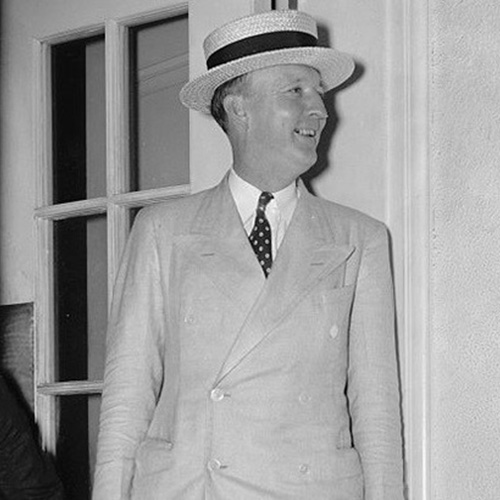
The resulting trial was a farce. The judge, the jury foreman, several jurors, and the key witness, the police chief, were all Klan members. Throughout the trial, Black and the defense team portrayed Gussman as African American, even going so far as to draw the blinds to make him appear darker. When the prosecution described Gussman as being of “proud Castilian descent,” the defense responded, “he has descended a long way.” Hugo Black attacked the only two witnesses that came forward for the prosecution, asking them if they were Catholic (they were) and then calling them “brothers in falsehood, as well as in faith,”
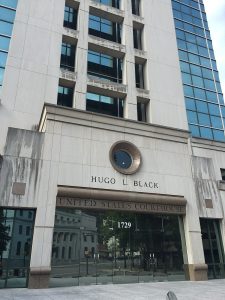
Stephenson was acquitted after the jury deliberated less than a day. For weeks after, he was toasted as a hero, and he lived as a free man in the Birmingham area for another 35 years before dying in 1956. The murder of Fr. Coyle, like the persecution of Catholics by the Ku Klux Klan, is little remembered. Hugo Black would later become a member of the Ku Klux Klan himself, only renouncing his membership when he aspired to a career as a U.S. Senator (but then thanked the Klan for their support when he was elected). Black was later appointed to the Supreme Court, where he is now lionized for his ‘support of civil rights,’ while his lifelong anti-Catholic bigotry is dismissed as ‘a sign of his times,’ his Klan membership as mere political pragmatism, and his bigotry-laden defense of a murderer airbrushed from history. In his biography of his father, Hugo Black Jr. confirmed that Justice Black never renounced his hostility toward the Catholic Church. Yet, a federal courthouse bearing Black’s name stands less than half a mile from where Fr. Coyle was murdered, and in 2022, a monument to Black was erected in his hometown of Ashland, Alabama, attended by many government officials.
The murder of Fr. Coyle is a story of compassion met with cruelty, and of justice denied. We must ask: Why do we continue to honor Hugo Black without reckoning with this history? What does it say about whose stories we remember—and whose we erase?
]]>
John Phillip Holland was born on February 24, 1841 in a small coastal town of Liscannor, County Clare. His mother was a native Irish speaker and young John himself would not learn English until he attended school. Holland’s father was a coastal patrolman for the British Coastguard Service and instilled in the young Holland a love of the sea. Holland aspired to go to sea and walked 5.5 miles each way to attend the Christian Brothers secondary school in Ennistymon, which offered a navigation course. However Holland’s dreams of maritime life were soon dashed by frail health which would plague him throughout his life and poor eyesight.
The family moved to Limerick, where Holland became a student of Brother Bernard O’Brien, a distinguished science teacher and excellent engineer who was a tremendous influence on him. With his father’s death, young Holland began a career as a teacher, and then decided to take his initial vows as a Christian Brother himself. It soon became apparent that young Brother Holland was an inveterate inventor, at one point building a mechanical duck that fascinated his students.
Holland’s poor health intervened again. Falling ill, Holland was sent to an Aunt for treatment and to recuperate. While recovering, Holland was taken by accounts of the ongoing Civil War in America and was particularly fascinated by reports of a revolution in Naval warfare: the battle between the ironclads USS Monitor and the CSS Virginia (Merrimack).
Holland realized that the age of wooden ships was gone forever and that ironclads were the future. As a child who had experienced the dark side of British rule during the Great Hunger, Holland was concerned that England’s industrial strength positioned her to dominate the new technology and increase her hold on the world. Holland wondered “how [other peoples of the world] would protect themselves against those designs.” The course of Holland’s life was set.
Holland returned briefly to the Christian Brothers, but before he could make his final vows illness struck him again causing him to withdraw from the order. Holland decided to follow his mother and brothers who had immigrated to America. Arriving in 1873, Holland took a lay teaching position at St. Joseph’s school Paterson and brought with him plans to counter England’s naval ambitions: a submarine.
Holland initially approached the U.S. Navy to sponsor development of his submarine, but his design was dismissed as impractical. However, Holland’s brother Michael soon found a sponsor for Holland’s work: Clan na Gael, the American branch of the Irish Republican Brotherhood, or Fenians who saw in it a weapon to fight for Ireland’s freedom. After a successful demonstration, the Fenians funded development of a full size submarine that would later be dubbed the ”Fenian Ram”. Holland’s submarine had many of the features that became fundamental to submarine design: it was driven by a combustion engine on the surface, but used battery power when submerged, it was fitted with both ballast and compressed air tanks. In an initial trial, the submarine made 3-1/2 knots on the surface and was able to stay submerged for over an hour and successfully return to the surface.

However, there was one challenge that Holland had not counted on: the classic “Irish split”. Internal fighting within the Fenians and allegations of inappropriate use of the “skirmish fund” resulted in cancellation of funding for Holland’s submarine development. A faction of the Fenians stole the “Fenian Ram” and another prototype. The prototype sank in transit while subsequent attempts by inexperienced crews to operate the “Fenian Ram” resulted in it being impounded as a menace to navigation.
Submarines however were finally gaining the attention of the U.S. Navy. Holland competed for and won a contract to develop a submarine to be named the USS Plunger for the Navy. However, Holland soon realized that the Navy’s shifting design requirements were dooming the project to failure. On his own Holland began developing his own design, the Holland VI. When sea trials came, the USS Plunger proved to be the disaster that Holland had predicted. Holland then demonstrated the Holland VI which in trials exceeded the Navy’s requirements. The Holland VI was commissioned into the U.S. Navy on April 11, 1900 as the USS Holland, the U.S. Navy’s first modern submarine and an order for an additional six more was placed.
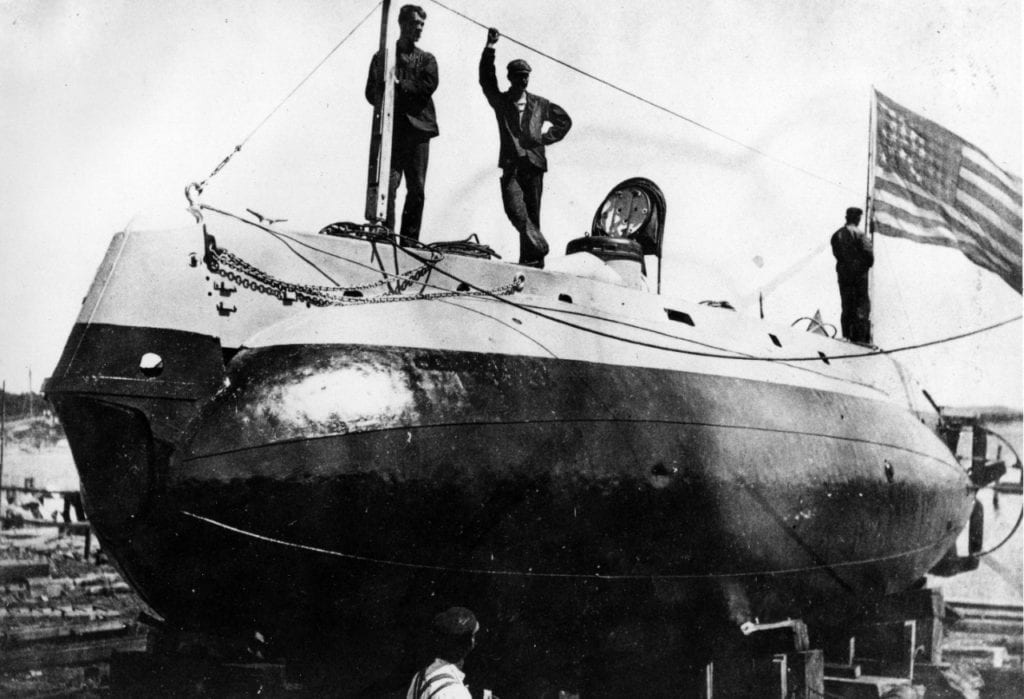
It would be nice if the story could conclude on this triumph as a happy ending, but it cannot. Holland’s vision always exceeded his meager pocketbook and he was near poverty. To continue his work Holland formed a partnership with Isaac L. Rice, a businessman who controlled the manufacture of the storage batteries that were integral to Holland’s design. Holland and Rice formed a new company, fittingly called Electric Boat, which is still in operation today as the leader in submarine design. Holland soon found that his partner began isolating him, forcing him into less and less significant roles within his own company while others took credit for Holland’s ideas as they now rapidly evolved with proper financial backing. Holland left Electric Boat to form his own company, only to be dragged through the courts by Electric Boat who claimed not only ownership of Holland’s patents but even Holland’s own name as applied to submarines. While Holland eventually won in court, the damage had been done, potential investors had been scared off. Holland, broken and bitter, was forced into retirement. John Phillip Holland died at his home in Patterson on August 12, 1914 just as World War I was breaking out in Europe, a war in which Holland’s vision of the submarine would be proven with devastating effectiveness.
The genius of Irish Immigrant John Phillip Holland deserves a kinder fate. Holland’s discoveries and his over twenty patents are still protecting our national security today in the shield that is the Navy’s submarine fleet.
Neil F. Cosgrove ©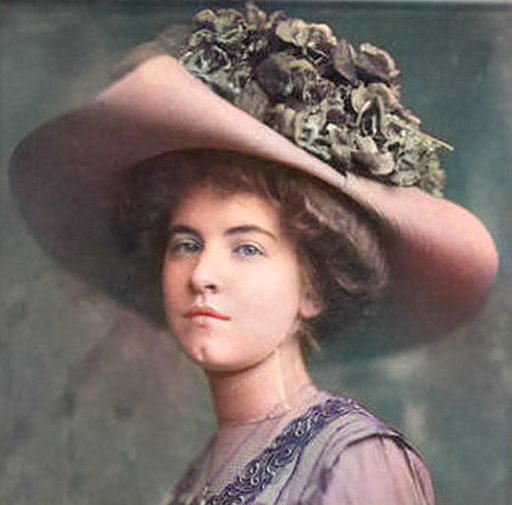
Margaret Tobin Brown, famously known as the “Unsinkable Molly Brown,” is often celebrated in popular culture for her flamboyant personality and heroic actions on the Titanic. However, this portrayal barely scratches the surface of her remarkable life and achievements. While she is invariably portrayed as an outspoken, humorous, flamboyant woman of America’s West, these depictions, though rooted in truth, do a disservice to the complexity and depth of her character and contributions. She is even known to history as “Molly”, a name she never used in life.
Born in 1867 in Hannibal, Missouri, to Irish immigrants John and Johanna Tobin, Margaret Tobin Brown was raised in a small Irish American community that deeply valued freedom, equality, and education. Uncommon for the time, Margaret attended school until the age of 13, receiving what would be considered a high school education by today’s standards.
Upon leaving school, Margaret directly experienced the hardships faced by the working class, enduring long hours, meager pay, and job insecurity in a factory. These challenges were all too familiar to her community and her father. Like many young people of her era, she was drawn westward in search of better opportunities. Yet, the values instilled in her by the Irish Catholic community of her childhood fueled a lifelong zeal for personal development and active engagement in societal issues.
Margaret traveled to Leadville, Colorado, where she met and married James Joseph (J.J.) Brown. J.J.’s journey mirrored Margaret’s own. Born of Irish immigrants, he taught himself geology through self-study and was recognized for his “special genius for practical and economic geology.” J.J. built a reputation for locating profitable mines. Utilizing his geological knowledge and innovating new mining methods, J.J. discovered vast quantities of high-grade copper and gold, making one of the most significant gold strikes ever recorded.
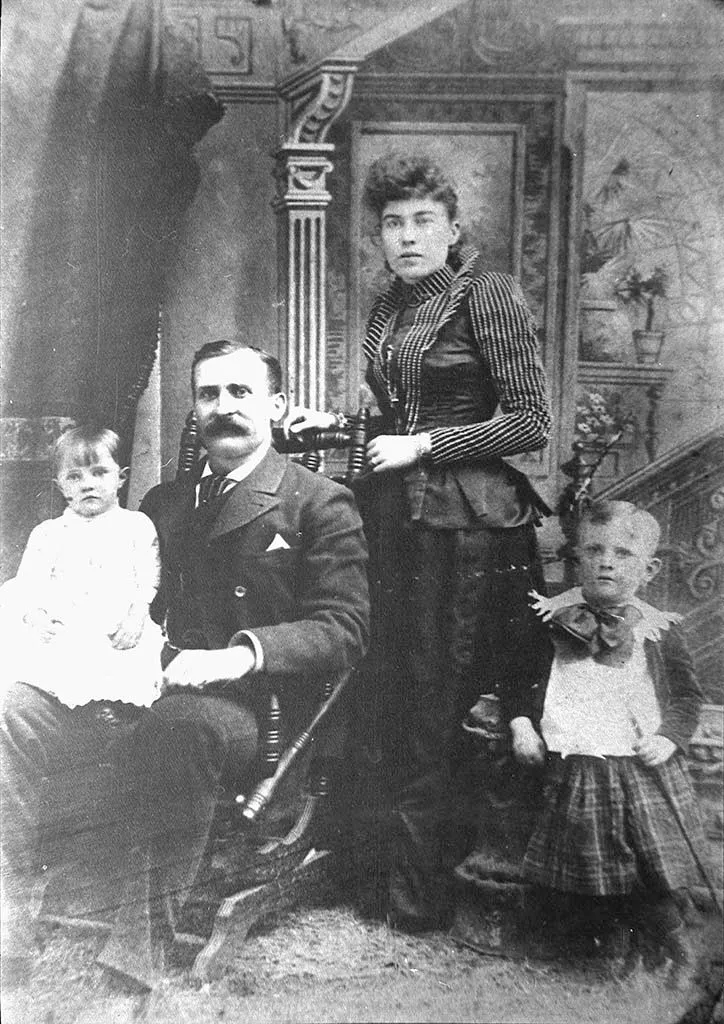
As multimillionaires, J.J. and Margaret bought a new, stately home in the rapidly developing city of Denver. However, their newfound wealth and Irish Catholic heritage did not smooth their entry into Denver’s social circles. The self-appointed gatekeeper of Denver society, Louise Hill, and her “Sacred Thirty-Six” never accepted Margaret, prompting her to label Hill as “the snobbiest woman in Denver.”
If Margaret Brown was stung by these elitists, it didn’t show for long. She founded the Denver Woman’s Club, which, instead of playing bridge like the “Sacred Thirty-Six,” advocated for education, suffrage, and human rights. In 1911, she raised funds to build the Cathedral of Immaculate Conception, St. Joseph’s Hospital, and several Catholic and public elementary schools. She also worked with Judge Ben Lindsey to establish the first juvenile court in America, a model that was adopted nationwide. Additionally, she became fluent in French, German, Italian, and Russian.
Sadly, J.J. did not share Margaret’s growing interests, and the couple drifted apart after 23 years of marriage. They signed a separation agreement, though they never divorced, and remained very close throughout their lives.
Margaret embarked on a tour of Egypt, Rome, and Paris. While on tour, she received news that her grandson had become seriously ill. She immediately booked passage on the first available ship, the Titanic.
The story of the tragedy of the Titanic need not be repeated here. Upon the collision with the iceberg, Margaret immediately began organizing and assisting her fellow passengers into the lifeboats until a crewman took hold of her and, with the words “you are going too,” was dropped four feet into the lowering lifeboat #6.
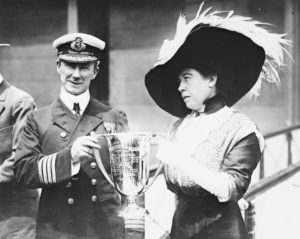
Despite Lifeboat #6’s capacity of 65, it departed from the Titanic with only 24 people aboard, including 21 women, two men, and a boy. Despite threatening the coxswain to “throw him overboard” if he did not turn around and pick up more survivors, her threat went unheeded as he feared the boat would capsize as those in the water tried to get in. Margaret and the rest rowed tirelessly for hours until rescued by the ship Carpathia. Exhausted yet undeterred, Margaret utilized her multilingual skills to comfort non-English speaking survivors and helped organize the distribution of essential supplies to those in need. Margaret spearheaded a fundraising campaign among the first-class passengers, amassing $10,000 to aid the less fortunate survivors before arriving in New York.
Margaret became an international celebrity. She was dubbed “The Unsinkable Molly Brown” by the press, though she had never used the name ‘Molly’ in her life. In character with her life, Margaret used her fame not for herself but for others. She was an advocate for striking miners fighting for better pay. She worked to secure the vote for women and even ran for the Senate, where several papers favored her chances, but she quit her campaign with the outbreak of WW I to focus on aiding the people of devastated France, earning the French Legion of Honor for her activities.
Margaret Brown died at the age of 65 in 1932 after experiencing enough to fill several lifetimes. It is very sad that this remarkable Irish American woman who lived a true rags-to-riches story but never forgot where she came from nor turned her back on those less fortunate is remembered chiefly on the basis of Hollywood caricatures. This is why we have Irish American Heritage Month, to learn the rest of the story.
]]>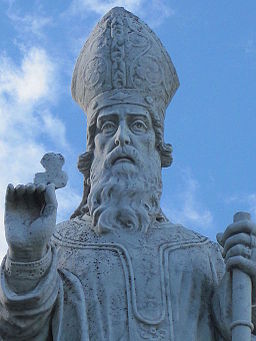 Each year around March 17, the name of St. Patrick appears in every major publication in the civilized world – sometimes with honor and sometimes with scorn – often due to the conduct of those who celebrate his memory at affairs which bear his name. Of the many things written about this holy man, some are true, some misleading, and some false. St. Patrick was Italian; St. Patrick drove the snakes from Ireland; St. Patrick was the first to bring Christianity to Ireland – all of these statements are false!
Let’s take them one at a time. Some claim St. Patrick to be Italian because he was born in Roman occupied territory, and his name was Patricius. Sadly, the mists of time have clouded the exact location of his birth, but what is concluded from available evidence is that he was born somewhere in Wales around 386 AD. Patrick himself wrote that the scene of his youth was Banavem Tiburniae (possibly the town of Tiburnia near Holyhead in western Wales), where his father was a member of the governing body. Other Welsh sources suggest southern Wales near the Bristol Channel at the mouth of the Severn River. Although Wales was part of the Roman Empire at that time, it was a Celtic country and its people were one race with the people of Ireland, Scotland, Brittany, Cornwall, and the Isle of Man. As for his Italian sounding name, it was given to him when he was consecrated Bishop and assigned to the mission in Ireland. Before that time, our patron Saint’s name was Succat, a Celtic name meaning victorious. There is, therefore, more evidence to suggest that Patrick was Celtic than any other nationality. He even identified himself as such in his letter to the British prince, Corocticus.
As for the snakes, although a popular legend, it is scientifically known that there never were any in Ireland, to begin with. His connection with that legend stems from the Viking misinterpretation of his name. Paud in the old Norse language meant a toad, and when the Vikings heard of a Saint called Paud-rig, who had lived in Ireland before their coming, they concluded it meant toad-expeller. That was only the beginning, because the legend was reinforced by the Church’s representation of the Devil in the form of a serpent, and statues of Patrick driving the Devil out of Ireland in that form. The fact that there were no snakes led to the question, “what happened to them,” and the answer was easily found in St Patrick’s traditional statue. However, Patrick is more revered for what he brought to Ireland than what he drove away. Yet he was not the first to bring Christianity . . . he was, however, the most effective.
The story began when Patrick was about 16 years old, and Ireland’s High King, Niall of the Nine Hostages, sent warriors to raid the coast of Wales for slaves. Among the hostages taken was the youth, Succat. According to tradition, he was taken to Mt. Slemish, Co. Antrim, where he tended the flocks of either a Druid or a Chieftain, according to Ludwig Beiler’s The Life and Legend of St. Patrick. After six years, Succat escaped following a voice that he heard in his dreams. He fled to Wexford, found passage, and eventually returned to his family. There he received his vocation for missionary work in Ireland in three separate dreams – the most notable was one in which the voice of the Irish called to him, “Holy youth, come again and walk among us.”
Succat received religious training at monastic settlements in Gaul, Italy, and the islands of the Tyrrhene Sea. He was ordained a Deacon by Amator, Bishop of Auxerre about 418 AD, and was consecrated Bishop – receiving the name Patricius – in 432 AD. At the time, there were a few Christians already in Ireland, but without a central authority and in such isolated areas as an island in Wexford harbor where St. Ibar had established his church and school.
In any case, it is certain that Patrick was in Auxerre in 431, when St. Germanus selected Palladius, a contemporary of Patrick’s, as the first Bishop of Ireland, but that mission was short-lived. According to the memoirs of Tirechan, a cleric in Meath about 690 AD, Palladius died or left within a year. Patrick was assigned to replace him in 432. Working to his advantage was the fact that Patrick knew Irish customs and language from his years in captivity and the fact that he was a Celt. Patrick never condemned the Irish as idolatrous pagans but appealed to their pride. He explained their traditions in terms of Christianity and was eventually accepted as one of their own. He converted key people among the nobility and recruited a native clergy.
He began his missionary work in Ulster, built his first Church at Saul, two miles from Downpatrick, and from there journeyed across the  land. Patrick’s own writings and the writings of his contemporaries show him to have been a missionary of extraordinary zeal, energy, and courage, careless of his own safety in his fervor to `spread the nets for God’. In his own writings, he mentions this `divine impatience’ as well as describing himself as one of the Irish. For 29 years, Patrick labored among his beloved Irish, converting and baptizing them by the thousands until his death on March 17, 461 AD. Tradition establishes that he was buried at Downpatrick where he shares the same grave with Saints Bridget and Columcille who were later interred with him to protect their remains from Viking raiders. He was recognized as a saint in the 17th century by the extension of his feast day to the universal Church calendar.
However, by all accounts, the most momentous part of his legacy is the form of Christianity he left in Ireland for it inspired a life of sacrifice for the sins of man. That sacrifice, which became known as ‘white martyrdom’ included prayerful solitude, fasting, tedious transcription of sacred documents, abstinence from worldly pleasures which to some meant dressing in coarse garments and sleeping on hard beds with stone pillows, and most importantly, missionary activity. It was this devotion which led to Ireland becoming the Isle of Saints and Scholars, the University of Europe and the Lamp of the West; and it was his fervor to spread the nets for God that led future generations of Irish monks to travel the continent as missionaries, bringing the light of learning back into the abyss after the Dark Ages and saving civilization.
This then is the man – the Saint – that we honor in March, and it our duty to see that nothing but praise and reverence are attached to his name. We may celebrate his memory with joy, but remember his love for the Irish, the tremendous gift of faith that he bestowed upon us and the inspiration he provided which benefitted civilization, and celebrate with reverent joy. We can begin by replacing all references to Paddy’s Day with the proper name of Saint Patrick’s Day for the difference between Paddy’s Day and St. Patrick’s Day is the same as the difference between the office Christmas Party and Midnight Mass.
Additional Misconception: “St. Patrick Was Not a Saint”
Since the publication of this article, a new misconception, often circulated for “mouse clicks”, suggests that St. Patrick was never made a saint. This claim is based on the fact that the formal canonization process as we know it today did not exist during St. Patrick’s time in the 5th century. However, as the author of this article Mike McCormack meticulously details in his other article “St. Patrick IS a Saint!“, his sainthood was recognized through the Solemn Translation of his relics in 1186, conducted under the authority of Pope Urban III. This act, equivalent to canonization at the time, affirmed St. Patrick’s status as a saint within the Church.
Thus, just as the myths of St. Patrick’s nationality and snake-banishing endure, so too does this modern revisionism—one that ignores the history of Ireland’s patron saint for sensationalism.
]]>
William G. Walsh was born on April 7, 1922, in Maine to a young mother who gave the child to her grandmother to raise. When the grandmother herself fell ill, she entrusted the baby to her friend Mary Walsh from Roxbury, Massachusetts. Mary, who had emigrated from Ireland in 1898, was no stranger to adversity. She had been married to Dennis Walsh, himself an Irish immigrant, who had been killed in a building collapse while fighting a fire as a Boston firefighter in 1915 just a few days before Christmas leaving her with two children and a third on the way. Mary Walsh provided for her family by working as a housekeeper, cook, waitress and by taking in borders, a model of Irish strength and grit. Despite Mary’s own struggles, she still took in the infant William and, when his grandmother died, adopted him.
Young William was quickly christened “Red” in the neighborhood due to his sandy red hair. He developed a reputation as both an athlete and a natural leader; in baseball, he was a catcher known for being able to manage his pitchers. When the Japanese attacked Pearl Harbor on Sunday, December 7, 1941, he and his entire baseball team went to the closed Federal Building in Boston and slept outside on benches to be first in line when the recruiting office opened Monday morning.
Enlisting in the Marines, William Walsh volunteered for the elite Marine Raiders and saw extensive service at Guadalcanal, Bougainville, Tarawa, and the Russell Islands. He was nominated for non-commissioned officers school, promoted to platoon sergeant and assigned to the G Company 27th Marines, 5th Marine Division, when his unit took part in the invasion of Iwo Jima.

On February 27, Sargent Walsh and his men were tasked to take a strategic ridge vital to the capture of Motoyama Airfield 2. Despite heavy shelling and bombing, as soon as the Marines moved forward, the Japanese defenders reoccupied defense which had been constructed to put any attacker in a murderous crossfire and was pre-sighted for artillery and mortars. Walsh’s unit was pinned. Realizing that to stay was to die, William shouted, “Hell, we can’t stay here! Let’s hit them again!” Walsh’s Marines charged again only to be met with machine guns and grenades. Men began to scramble back, but Walsh had taken cover in a crater with some wounded men and refused to leave them. A Japanese grenade was thrown into the hole and Walsh without hesitation, threw himself on the grenade giving his life for his men. William Walsh was awarded the Medal of Honor.

However, this would not be the last medal presented to the Walsh family. Dennis Walsh, the child that Mary Walsh had been carrying when her husband was killed as a Boston firefighter, had joined the Franciscan Order taking the religious name Cormac. When the Korean War broke out, Fr. Cormac Walsh joined the U.S. Army as a chaplain, where he was awarded four Silver Stars and a Presidential Citation for his care of the wounded while under fire; Fr. Walsh was the most decorated chaplain of the Korean War. After his career with the Army, Fr. Walsh served for eighteen years as the prison chaplain at the maximum-security Clinton Correctional Facility in Dannemora, New York. An inmate at the prison stated, “He created a legend of goodness and left us a legacy of love.“
In Boston, there is a memorial plaque with the name of Firefighter Dennis Walsh’s inscribed for his sacrifice as a firefighter. In Dorchester, there is a park named for Gunnery Sargent William Walsh, and there is a bridge named for Fr. Cormac Walsh. There should equally be a monument to Mary Walsh, who, like so many Irish women, silently lead a life of dedication and fortitude in the face of adversity while never losing her Christian Charity.
There are many, many stories like the Walsh’s; many of us have similar stories in our own families. As we celebrate St. Patrick’s Day, let’s do more than march—let’s share these stories and ensure their legacy endures.
Neil F. Cosgrove,
Note that with deep regret and despite best efforts, I was unable to locate a photo of Mary Walsh.
]]>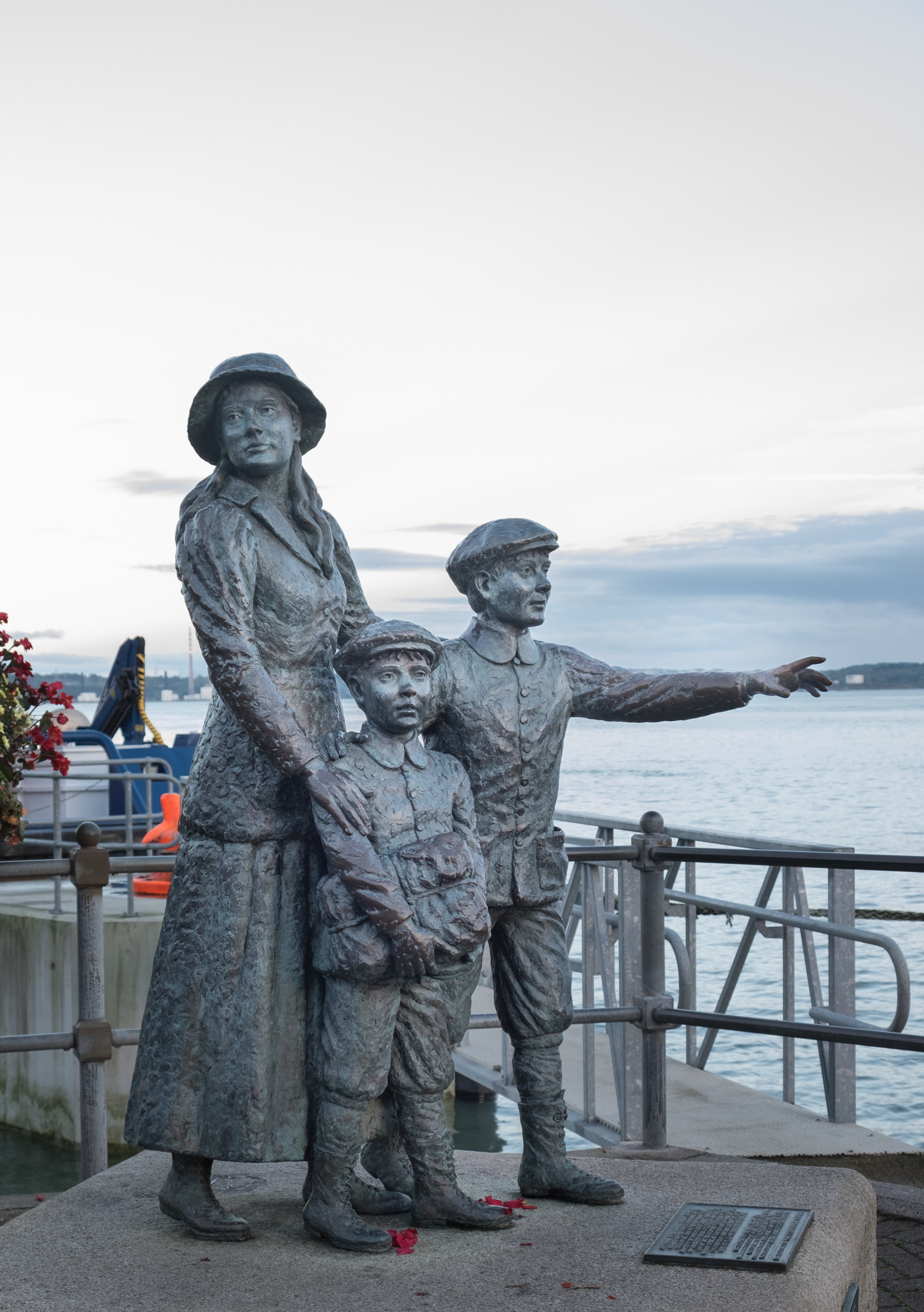
During its period of operation from 1892 till 1954, over 12 million immigrants entered through the immigration station at Ellis Island, a name that was to become synonymous with the “Golden Door” and the “American Dream”. It is estimated that today over forty percent of the United States population can trace their ancestry to an immigrant that entered Ellis Island.
On New Year’s Day Morning 1892 on the deck of the steamship Nevada stood three adolescents, Annie Moore and her brothers Phillip and Anthony. They were perhaps staring at another recent immigrant from France, the Statue of Liberty. The children had made the twelve-day voyage from Cork in the claustrophobic conditions of steerage to be reunited with their parents and older siblings who had traveled on ahead to make a new life in America two years earlier. In addition to the natural apprehension of starting a new life in a strange land, the children had no doubt heard that they would be subject to a series of examinations at the immigration station; they would be checked to ensure they were healthy and then interrogated to ensure they were neither a threat or likely to become “a public charge”. A slight malady or a wrong answer could result in them being returned to the Nevada and a trip back to Ireland alone. It therefore must have been with some anxiety that Annie realized that she would be the first to go down the gangplank.
It must have been quite a shock when Annie found herself caught up in what we would now call a PR event surrounding the opening of the new immigration station. The New York Times was there and described Annie as “a little rosy-cheeked Irish girl… fifteen years of age.” (Actually, Annie was closer to seventeen years of age. The children’s ages were all misstated on the manifest, perhaps an attempt by their parents to save money on their passage.) Instead of an anonymous immigration agent, Annie was officially registered by the former private secretary to the secretary of the treasury. The Times continued “When the little voyager had been registered Col. Weber presented her with a ten-dollar gold piece and made a short address of congratulation and welcome. It was the first United States coin she had ever seen and the largest sum of money she ever possessed. She says she will never part with it.” This moment was later commemorated in the song “Isle of Hope, Isle of Tears” popularized by the Irish tenor Ronan Tynan.
Sadly, there would be no fairy tale ending to the life of Annie Moore, her brief moment of notoriety would be a shining moment in a hard and trying life. The statement that Annie would never part with the ten dollar gold piece was likely an invention of a romantic reporter; the coin probably never lasted the day when Annie was reunited with her family who was eking out an existence on her father’s longshoreman salary. She would spend the rest of her life living in a series of tenements near the Fulton Street Fish Market. She would marry the son of a German immigrant who was employed as a bakery clerk. They would have 11 children, but would bury five of them. Annie herself would die at the early age of 47 in 1924; burned out by a life of poverty and struggle.
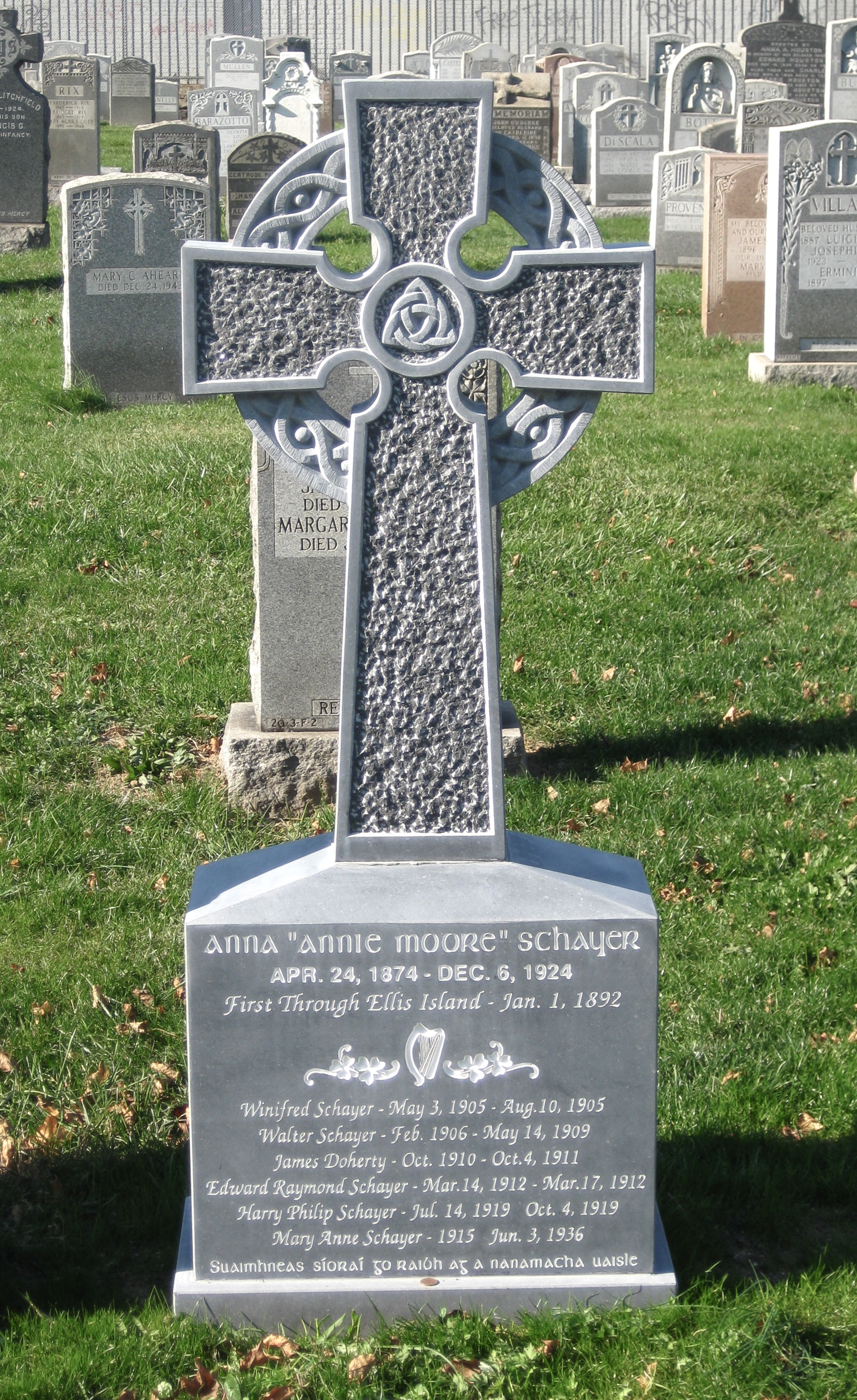
Annie Moore was initially buried in an unmarked grave in Calvary Cemetery, Queens until it was rediscovered in 2006. Through the efforts of the Irish American community, the grave was marked by a Celtic Cross of Irish Blue Limestone. Some cynics questioned the elaborateness of the memorial given the grim reality of Annie’s life. However, in honoring Annie Moore we honor all the other anonymous Irish men and women who came to this country and sacrificed their present for future generations’ tomorrow while at the same time building America. It is reported that many of the current descendants of Annie’s surviving children are successful and respected members of the community.
It is right and proper that we remember the many great Irish American men and women who gained well deserved distinction in government, the military, the arts and sciences. However in remembering Annie Moore we remember the countless other anonymous Irish Americans who loaded our ships as Annie’s father did, built our railroads, fought our fires, patrolled our streets and taught in our schools.
Annie Moore is a reminder that the success of Irish America comes from sweat, sacrifice, and tears and not “the luck of the Irish”. It is time we reclaimed the struggle and successes of Irish America from the unmarked grave where it currently lies buried in our school’s curricula. She is also a reminder that the “Golden Door” that she once walked through is now unjustly closed to Irish immigrants as it freely swings open to others; a challenge to complete her memorial by seeking a fair and just immigration policy for today’s Annie Moore’s.
Neil F. Cosgrove ©