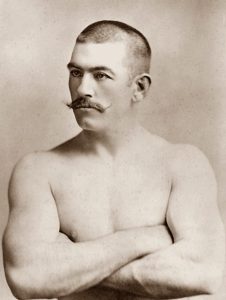
John Lawrence Sullivan, born to Irish immigrants on October 15, 1858, in Roxbury, Massachusetts, grew into an embodiment of the American Dream for many Irish Americans. His parents, survivors of the Great Hunger in Ireland, instilled in him a profound sense of identity and resilience. Though he was an excellent student and his parents aspired for him to attend Boston College and become a priest, destiny had a different plan for Sullivan. Lured by the raw appeal of professional sports, Sullivan found his true calling in boxing, a sport then shadowed by legal ambiguities and often relegated to “exhibitions” or clandestine bouts.
Sullivan’s rise from local fame to national celebrity was meteoric. In one fight, his opponent failed to show, and to quell the restless crowd, Sullivan issued a challenge that became his trademark, “I can lick any man in the house.” This became not just Sullivan’s trademark but a symbol of Irish-American defiance and determination. Through a series of exhibition matches and high-profile bouts, including a legendary encounter with Paddy Ryan in Mississippi, Sullivan’s fists wrote chapters of boxing history. His victory over Ryan, witnessed by figures as diverse as Oscar Wilde and Jessie and Frank James, cemented his status as a champion of the people.
Sullivan’s reign as the Heavyweight Champion brought boxing to the forefront of American sports, making him the nation’s first sports superstar. Leveraging his “I can lick any man in the house” boast, he made a whirlwind of 200 stops across the United States, showcasing his unparalleled strength and skill, endearing him further to an adoring public. Boxing historian Nate Fleisher has observed, “For the first time in their lives, Americans living in the sticks — nearly four hundred thousand American farmers, miners, lumberjacks, artisans, and clerks — laid down their hard-earned cash to see a real boxer in action. They loved it, and the effect of their gratification on the growth and spread of boxing is beyond calculation today.”
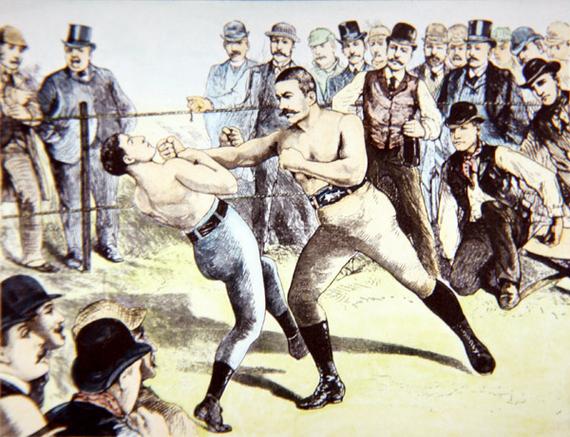
Yet, Sullivan was more than a mere athlete; he was a cultural icon, reflecting the grit and determination of the Irish American community still struggling to overcome prejudice and find their place in American society. Such was his fame that to be able to say, “Shake the hand of the man who shook the hand of John L. Sullivan,” brought its own notoriety.
Sullivan never forgot where he came from. In a story that further enhanced his renown in the Irish community, it was said that he refused to stand for the traditional toast to Queen Victoria while attending a dinner in his honor in Victoria, British Columbia. Sullivan stated he “hadn’t been brought up to seeing Irishmen drinking to the health of English monarchs,” he informed the shocked dinner guests.
However, time and age give athletes no special consideration. Add to this that in a phenomenon we see repeated among many modern athletes, Sullivan liked to party, and it became increasingly difficult for him to get in shape. The fight against “Gentleman Jim” Corbett in 1892 highlighted the end of an era and showcased how far boxing had developed under Corbett. No longer were fights held secretly in the dark backroom of a saloon; this fight was held under the glare of the new electric light and the eyes of over 10,000 spectators and reported worldwide. The aging champion and brute strength brawler Sullivan met his match in the younger, more agile, more scientific Corbett. While clearly past his prime and suffering a broken nose in an early round that constrained his breathing, Sullivan persevered until the last of the 21 scheduled rounds where he was knocked out.
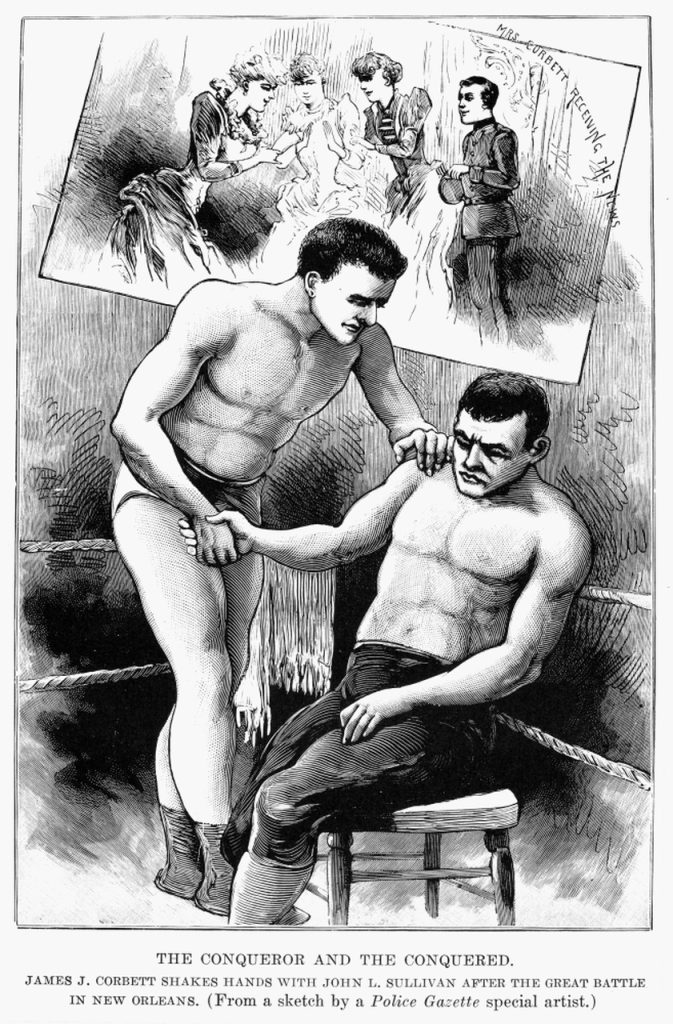
However, even in defeat, Sullivan added to his legacy for the graciousness he accepted, “Gentlemen, all I have to say is that I came into the ring once too often, and if I had to get licked, I’m glad it was by an American.” Sullivan’s grace in defeat, acknowledging Corbett’s victory as a passing of the torch to a fellow American, exemplified his character.
John L. Sullivan’s legacy is not merely confined to his boxing achievements; it is interwoven with the narrative of Irish-American struggle, perseverance, and success. His life story, from the streets of Roxbury to the heights of boxing fame, resonates with the spirit of a community that literally and metaphorically fought to carve out a place in America. Sullivan’s journey embodies the complexities of the American Dream, reminding us that heroes are not defined by their victories alone but by their ability to inspire, persevere, and stand with dignity and pride regardless of the outcome.
]]>
On April 24, 1832, 57 Irish immigrants from the counties of Derry, Donegal and Tyrone boarded the barque John Stamp at the port of Derry to begin their voyage to Philadelphia. They had all taken different roads to arrive at this literal and emotional departure. John Ruddy was just 18 when he hugged his parents goodbye, knowing it was unlikely that he would see them again in this life. Catherine Burns was 29 and had already experienced a lifetime of sadness; she was a widow and traveling with her Father-in-Law, hoping for a better life in America. What united them all was their desperation to leave a homeland that provided no opportunity but poverty for Irish Catholics.
After a three-month voyage, the ship sailed up the Delaware River and stopped at the first quarantine hospital in the United States, the Lazaretto. The deadly disease cholera was raging around the world. At the quarantine station, a doctor would board the ship and examine every passenger and crew member to confirm they were not ill before being cleared to enter Philadelphia; if anyone were sick, they would be quarantined. Despite these precautions, prejudice trumped science in the minds of nativist Americans, and Irish Catholics were frequently blamed for the disease when the origins were closer to home, the disease traveling from Canada down the Hudson to New York and then to Philadelphia. America gave cholera to the Irish, not the other way around.
The 57 Irish immigrants finally landed at Philadelphia’s Washington Avenue Immigration Station, where they were met by a labor contractor Phillip Duffy. To the newly arrived immigrants, Duffy, who himself had emigrated from Donegal, must have seemed the personification of the American dream they had come for. He offered them immediate employment as railroad laborers and Catherine a position as a cook and laundress to the work crew. The work was the hard, backbreaking work of helping to build one of America’s first railroads. Duffy held the contract for Mile 59 of the Philadelphia and Columbia Railroad near Malvern, Pennsylvania. It was one of the most challenging stretches of the route and offered Duffy one of the most lucrative contracts if completed. It was the backbreaking work of filling a natural valley by excavating and transporting rock and soil from an adjacent site, “the cut”; it was the work of moving a valley. It was the brutal work that only the Irish, the lowest rung on the socioeconomic ladder of the time, were willing to do out of financial desperation.
This arduous work was taking place in the heat of July and August. It was natural and inevitable that some of the workers would attempt to alleviate their thirst from the local streams. Soon some of the workers contracted cholera and began to die.
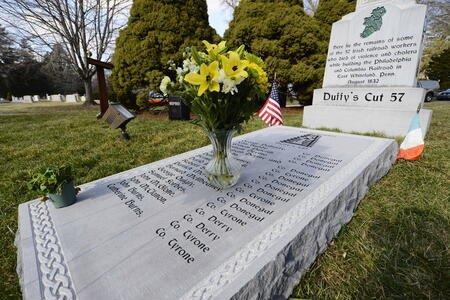
Panic soon gripped the area. Four nuns who were nurses from the Sisters of Charity in Philadelphia were sent to help. The locals turned on the Sisters driven by anti-Catholic sentiment and for fear they too were cholera carriers, forcing the nuns to walk back to Philadelphia. Local vigilantes descended on the camp and killed what remained of the 57 immigrants, the sick and the healthy alike, using clubs, axes, and guns. The bodies were then dumped in unmarked graves as part of the fill that trains would eventually pass over.
The American dream of the John Stamp immigrants ended after just six weeks. The railroad swiftly covered up the incident, burying the story along with the bodies, leaving families in Ireland to wonder about the fate of loved ones they would never hear from again.
In 2002, two brothers, Bill and Francis Watson were going through their late grandfather’s papers. Their grandfather had been an archivist of the Pennsylvania Railroad, the successor to the Philadelphia and Columbia Railroad. Thanks to their persistence and detective work, the site of the graves of the 57 immigrants was located, and their fate properly recorded. Sadly, many of the bodies still cannot be safely recovered as they are buried near active railroad tracks.
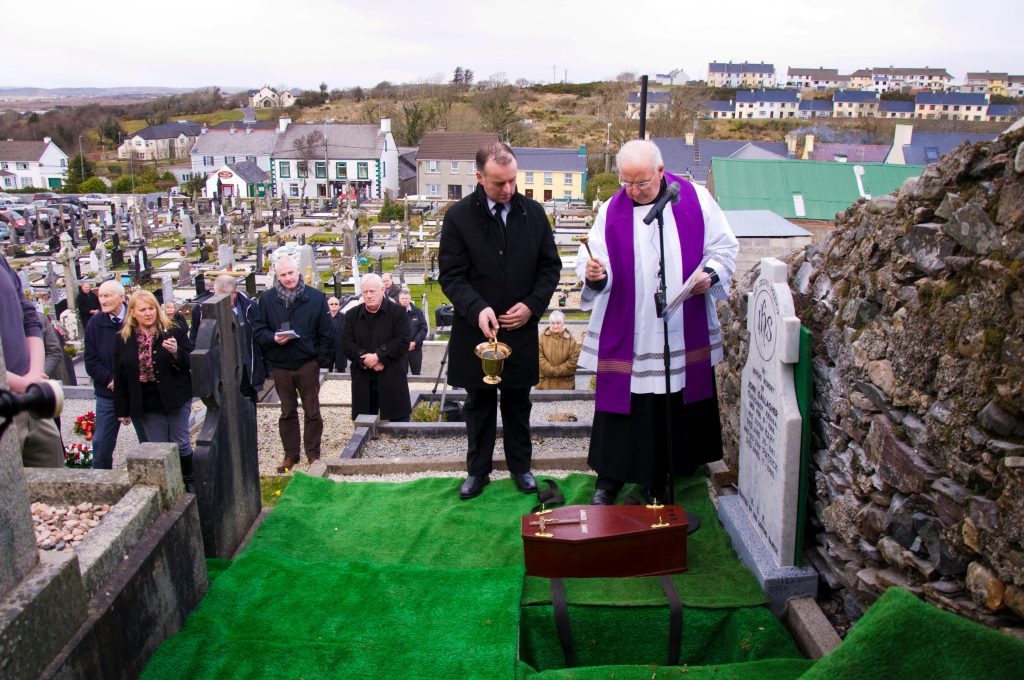
The remains of five men were reburied in West Laurel Hill Cemetery under a memorial that records the name of all 57 immigrants and the Irish County of their birth. Young John Duddy and the widow Catherine Burns’ remains were finally buried with a dignity in Donegal and Tyrone, respectively; they had returned home after 180 years.
It can be truly said that in the case of the 57 John Stamp immigrants, America was built on their sacrifices. Sadly, there are still those who wish to keep the story of what happen at Duffy’s Cut buried, as the struggle and prejudice that Irish immigrants faced is an inconvenient truth, running counter to their narrative that the Irish had it easy once they arrived in America. Their story and sacrifice should be recognized appropriately, elevating them from their current position of anonymous collateral damage to the industrial revolution.
]]>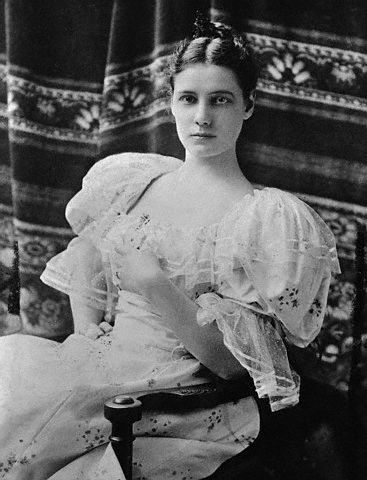
Nellie Bly was born Elizabeth Cochrane on May 5, 1864 in Cochran’s Mills, now part of Pittsburgh, Pennsylvania. Her father, Michael Cochran (Elizabeth would add the ‘e’ to the last name later), was the son of an immigrant from Derry who has started as a laborer and had prospered to the point of buying the local mill after which the town was named. Elizabeth was one of five children Michael had with his second wife, Mary Jane Kennedy. Michael Cochran had ten children by his first wife.
The young Elizabeth’s world suddenly collapsed when her father died when she was six years old without leaving a will. The court directed that his assets be sold and divided amongst the children of both marriages, putting her mother in precarious financial circumstances. Her mother remarried, but the second husband was abusive, resulting in a divorce that further strained the family’s finances, forcing Elizabeth to drop out of school where she had been studying to be a teacher.
Given the experiences she had so far endured in her young life, it was little wonder that a condescending article entitled “What Girls are Good For” in the Pittsburgh Dispatch provoked a fiery response from young Elizabeth, who penned a letter to the editor dramatically signed “Lonely Orphan Girl.” The editor was so impressed with the rebuttal that he ran an ad asking whoever wrote it to come forward and identify herself. Meeting Elizabeth Cochrane and impressed with her spirit, he offered her a job. It was customary for women reporters to write under a pseudonym; the editor suggested “Nelly Bly,” the subject of a popular Stephen Foster song. When it went to print, “Nelly” was accidentally changed to “Nellie” and stuck; Nellie Bly was born.
Showing her spirit for adventure, Bly traveled to Mexico, despite knowing no Spanish, and lived among the Mexican people, sending back reports on their daily lives and customs. However, her streak as a crusader also manifested itself, and she soon had to flee the country before being arrested for criticizing the government of dictator Porfirio Díaz. Her dispatches were later compiled into a book entitled “Six Months in Mexico.”
Despite proving herself as an investigative reporter, Bly soon found herself given nothing more than “domestic topics” to write on despite her protests. One day her editor came into the newsroom to find a note from Bly stating, “I am off for New York. Look out for me.”
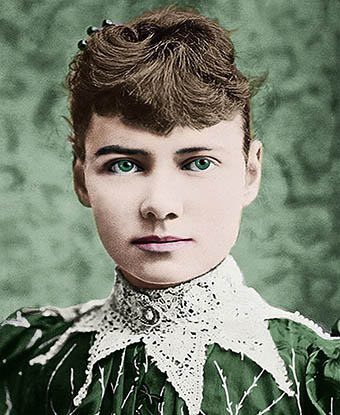
Despite being an experienced reporter, Bly found it nearly impossible to break into New York journalism. Bly eventually talked her way into Joseph Pulitzer’s The World newspaper offices with a proposal to do an investigative piece on New York City’s notorious Women’s Lunatic Asylum on Blackwell’s Island (now Roosevelt Island) by having herself committed as a patient. As events would later prove, this was a hazardous undertaking; it was later admitted that they were not clear on how they would get her out of the asylum at the time.
Bly got into her character with a vengeance. She practiced a “faraway expression in a mirror” and stopped practicing personal hygiene. She dressed in tattered second-hand clothes and checked herself into a boarding house for women, where she began looking for a non-existent trunk and ranting. Within 24 hours, her outbursts had the residents calling the police in fear of their lives. A judge remanded Bly to Bellevue Hospital’s psychiatric ward, where the chief doctor diagnosed her as “delusional and undoubtedly insane.” She was committed to Blackwell Island.
Bly would spend ten days in the hell of Blackwell’s asylum. She would later write of spoiled food, lack of warm clothing and a treatment of ice-cold baths that simulated drowning. The matrons were abusive; some were actually inmates from a penitentiary that shared the island, who regularly beat and choked the patients. Even worse were prolonged periods of social isolation. Bly wrote:
“Take a perfectly sane and healthy woman, shut her up and make her sit from 6 a.m. to 8 p.m. on straight-back benches, do not allow her to talk or move during these hours, give her no reading and let her know nothing of the world or its doings, give her bad food and harsh treatment, and see how long it will take to make her insane. Two months would make her a mental and physical wreck.“
More concerningly, Bly found that many of the women confined at the asylum were sane. One patient was a German woman whose only malady was that she had such a thick accent that she had been diagnosed as speaking gibberish. Some were inconvenient wives whom their husbands had put away. Ominously, Bly dropped her insane act once she had achieved her goal, yet found “the more sanely I talked and acted, the crazier I was thought to be.” It was clear that once a woman was committed, it was virtually impossible to be released.
After ten days, the lawyers for “The World” appeared with a court order for her release. Bly’s expose “Behind Asylum Bars,” which would later form the basis of a book, “Ten Days in a Madhouse,” became a nationwide sensation and Bly a national celebrity. The attention she raised resulted in the appropriation of an additional one million dollars (a tremendous sum in the late 19th century) to the annual budget for the treatment of the mentally ill in New York City.
Bly would not be out of the public consciousness for long. She proposed to Joseph Pulitzer recreating the fictional journey of Phineas Fogg in Jules Verne’s Around the World in Eighty Days and to complete the trip in even less time. Pulitzer resisted sending her. He told her that her gender would make the trip impossible. “Very well,” Bly replied, “Start the man, and I’ll start the same day for some other newspaper and beat him.” By this time, Pulitzer knew it was no idle threat and conceded.
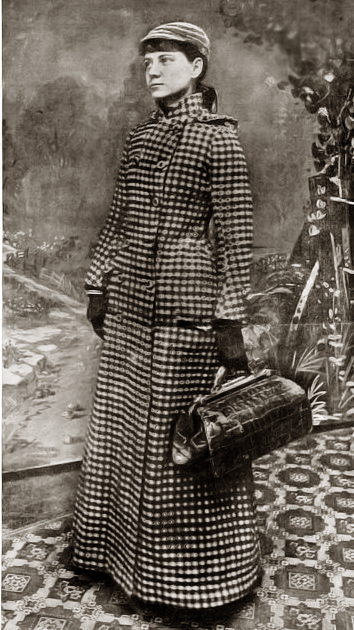
Bly began her trip with but a single carry-on bag. When she reached Paris, she had lunch with Jules Verne, who offered her his encouragement. When she left New York, Bly was unaware that a competing paper had dispatched their own woman reporter in an attempt to beat her; their reporter turned out to be no competition as while she wrote flowery prose about scenery and sunsets, Bly reported on people and their customs. The public followed her daily reports with fascination as she traveled lands they had never heard of.
When Bly arrived in California, she was behind schedule by two days due to storms in the Pacific but found that Pulitzer had chartered train waiting to bring her home. She arrived back in New Jersey on January 25, 1890 completing the trip in just over seventy-two days. Nellie Bly was a national sensation at the age of 25.
Bly continued to be a crusading reporter for several more years, but never equaled the fame of her earlier exploits. She married millionaire manufacturer Robert Seaman, a man forty-two years her senior, and left Journalism. Upon her husband’s death, she took over his Iron Clad Manufacturing Co., which made steel containers. As with all her endeavors, Bly threw all her energies behind it. She obtained several patents in her own name for designing new containers. However, as if coming full circle to her earlier life, finances proved her bane. As biographer Brooke Kroeger noted, “She ran her company as a model of social welfare, replete with health benefits and recreational facilities. But Bly was hopeless at understanding the financial aspects of her business and ultimately lost everything.”
Bly briefly returned to journalism, even covering WW I from the eastern front, before succumbing to pneumonia at the age of 57.
Nellie Bly was a trailblazer of fearless journalism — the kind we need now more than ever. Her story is one of courage, curiosity, and a refusal to be sidelined. An Irish American worth remembering — and emulating.
Neil F. Cosgrove ©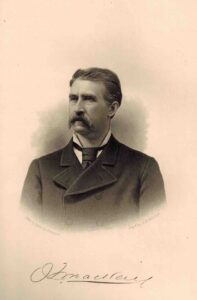
William Shakespeare observed, “The evil that men do lives after them; The good is oft interred with their bones.” It speaks to the ironic tendency for society to notarize, even glorify, the darkest aspects of humanity while ignoring the noble. Nowhere is this clearer than in the case of Irish American John Mackay, the “Bonanza King.”
John Mackay (pronounced Mackee) was born on November 28, 1831, on the outskirts of Dublin in the appalling poverty of pre-famine Ireland. In 1840, when Mackay was nine years old, the family emigrated to New York City, settling in the notorious Five Points section of the city. At first, it seemed that the family was prospering, they were able to scrape together enough that young John was able to attend school at a time when only half of the Irish children living in New York received any formal education. However, disaster struck in 1842 when Mackay’s father died suddenly, forcing young John to quit school to support his mother and sister. Mackay often would remark in later life that his greatest regret was not having completed a formal education.
Mackay started working as a newsboy, at the time a grueling and unsparing job. Newsboys had to buy their papers in advance and could not return any that went unsold, which could quickly erase a day’s work. Fighting for readers was often literal. It would have been particularly hard for Mackay who throughout his life fought a terrible stammer, but the boy developed a habit of letting his hard work speak for him. Mackay eventually secured a position as an apprentice ship’s carpenter; a testament to his determination as the New York shipbuilding industry of mid-19th century rarely employed the Irish.
The event that would change Mackay’s life occurred in 1848 with the discovery of gold in California. Despite the risks and hardships, prospecting for gold offered the chance to go from working for mere subsistence to improving one’s life. Like thousands of other young men of the time, Mackay left New York with nothing but a strong will supported by a strong back.

In the goldfields of California, Mackay developed a legendary reputation for hard work; a fellow miner would later reminisce, “Mackay worked like the devil and made me work the same way.” Nevertheless, after eight years in California Mackay had little to show for his efforts. Word filtered through the camps of a new strike in the Utah territories (present-day Nevada) of the vast silver and gold deposit that would be known as “The Comstock Lode.” With fellow Irishman and future partner Jack O’Brien, Mackay walked over one hundred miles and climbed over twenty-three hundred feet crossing the Sierra Nevada mountains to arrive in the mining camp without a nickel to his name to start again.
Mackay started as a common miner at $4 per day. For several years he crammed two days of backbreaking labor into a single day, working one full shift to earn the money he needed to survive and then a second shift in exchange for “feet,” a share in the mine’s ownership. Through his grueling toil and expertise in mining gained from hands-on experience and hours of study, Mackay gradually amassed some capital and acquired stakes in better and better mines. In 1865, MacKay acquired a majority share of an obscure mine called the Kentuck, which had been written off as unproductive. Mackay believed otherwise. Mackay invested his savings acquired through a life of grueling labor and every penny he could borrow in the Kentuck. After a year of mining the Kentuck with little to show, Mackay was teetering on the edge of bankruptcy, but on New Year’s Day, 1866, he hit a ten-foot-wide vein of gold and silver 250 feet below the surface. Over the next two years, the “unproductive Kentuck” would yield Mackay $1.6 million worth of gold and silver in the day’s currency, approximately $375 million in today’s dollars.
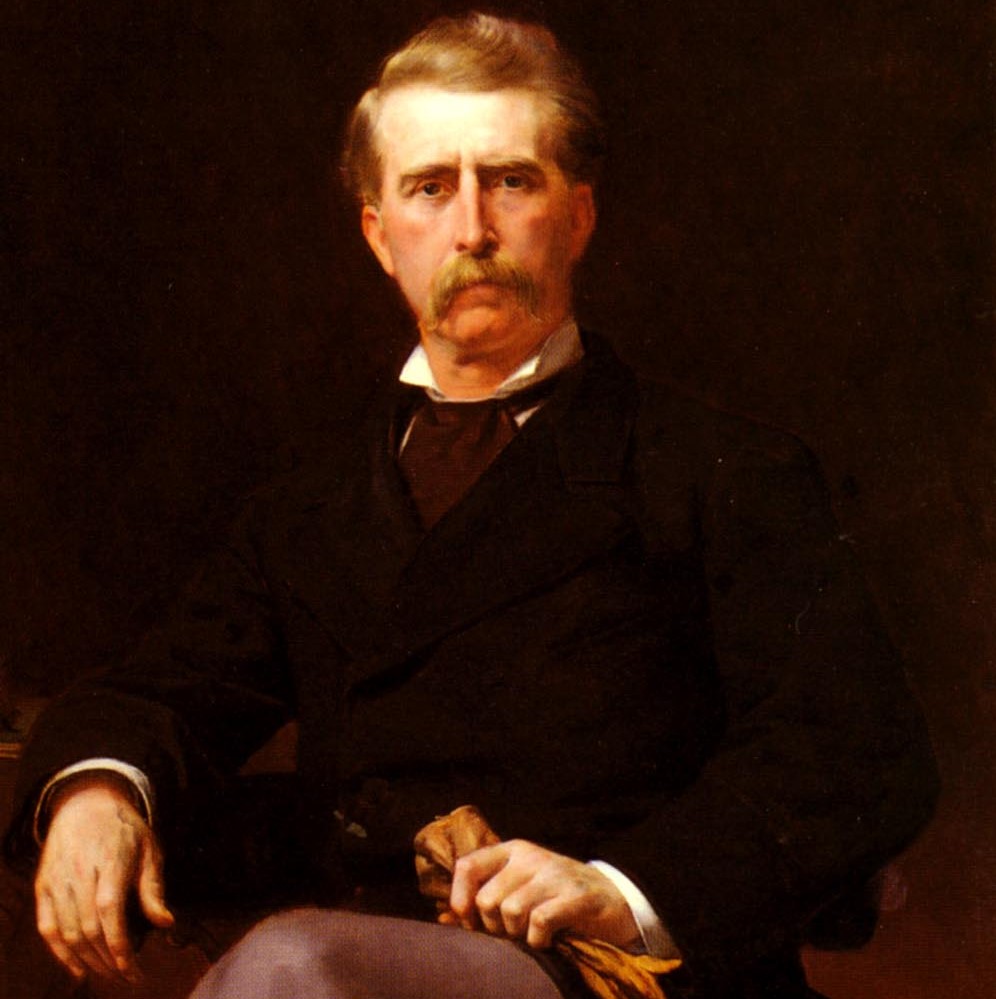
Despite having acquired more wealth than an improvised newsboy from the Five Points could dream of, Mackay still had a love of work and mining. In 1873, Mackay and his three fellow Irish American partners hit “the Big Bonanza” – a strike that still holds the record as the most concentrated ore body in history. In the silver and goldfields of Nevada, Mackay had gone from earning $4 a day to $450,000 per month, making Mackay and his partners the richest men in the world. Mackay was nicknamed “the Bonanza King,” a title the modest McKay shunned.
However, the accumulation of wealth was not an end in itself for Mackay. His miners were the best paid in the world, and he was renowned for always dealing fairly with them. When a depression created a surplus of labor, a consortium of mine owners attempted to exploit the situation by conspiring to reduce the miner’s wages to $3.50 an hour; McKay would have none of it. He stated, “I always received $4.00 when I worked in the mines and when I cannot pay that I will go out of business.” He would continue to drive himself to this mines in a simple one-horse wagon rather than an elegant coach, and in winter was never in too much of a hurry to stop to allow local children to hitch on their sleds so that he could give them a ride up a hill. In the slang of the Comstock miners when something was of exceptional quality it was referred to as “the John Mackay.”
Always a believer in free enterprise, in later life Mackay took on “the most hated man in America” Jay Gould, who had a monopoly on transatlantic telegraph communications for his Western Union company. Mackay broke his monopoly by forming the Commercial Cable Company and laying his own pair of rival transatlantic telegraph cables at tremendous cost. In the process, Mackay incentivized and aided in his employees’ purchase of company stock, one of the first business leaders to do so. When he built the office of his new cable company in New York City at the intersection of Murray Street and Broadway across from City Hall, he had his desk positioned so he could see his childhood home in the Five Points—a daily reminder of how far he’d come..

Mackay’s philanthropy and generosity were legendary, but in keeping with his character done quietly and without pretense. Mackay gave generously to the Catholic Church and endowed the Catholic orphan asylum in Virginia City, Nevada. When former President Grant was nearly penniless due to losing his investments in a Wall Street scandal, Mackay quietly helped him in the same way as he quietly helped so many old miners of his acquaintance. He endowed the school of mines at the University of Nevada
When Mackay died in 1902, The Salt Lake City Tribune said of this one-time improvised Irish immigrant that “of all the millionaires of this country, no one was more thoroughly American than Mr. Mackay, and no one among them derived his fortune more legitimately.”
It’s a grave injustice that the memory of John Mackay has faded—especially when his example is so badly needed today. Unlike the robber barons of his era—Rockefeller, Carnegie, Stanford, Huntington—Mackay didn’t need to endow libraries, universities, and foundations to atone for how his fortune was made. Mackay built his wealth honestly and treated people fairly his entire life. When asked for his advice on success, he always said: “Son, never lose your good name.” He never did.
And that’s worth remembering.
]]>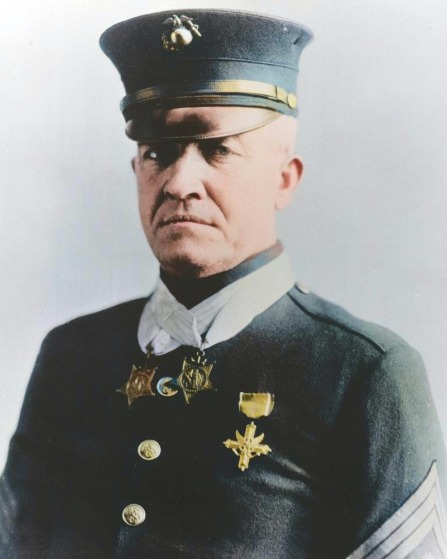
In the history of the Medal of Honor, the United States Highest award for “conspicuous gallantry and intrepidity at the risk of his life above and beyond the call of duty“, only 19 men have been awarded the medal twice. Among them is Marine Sergeant Major Daniel Daly, one of only two Marines to receive the Medal of Honor Twice for separate acts of heroism and nominated for a third.
Daly was born in Glen Cove, Long Island, New York, on 11 November 1873. He was slight of stature, only 5’ 6″ in height and weighing 132 lbs, yet as a youth had a reputation as a fighter, a reputation he would prove more than deserved.
Daly was part of the U.S. Embassy Guard in Peking when the Boxer Rebellion broke out in 1900. In one of the most memorable acts of that war, the Boxers surrounded the compound of the foreign legations in Peking and laid siege to it for 55 days. At one point, when German Marines of the German embassy were forced back, Daly by himself took a position in a bastion on the Tarter Wall and remained there throughout the night. Subjected to sniper fire and numerous attacks, when relieved in the morning Private Daly was still holding his position with the bodies of numerous attackers surrounding his position attesting to his bravery. For this he was awarded his first Medal of Honor.
“Had one squad failed, not one man of the party would have lived to tell the tale. Gunnery Sergeant Daly, 15th Company, during the operations was the most conspicuous figure among the enlisted men.”
Fifteen years later found now Gunnery Sergeant Daly in Haiti fighting against the Cacos. The reconnaissance company of 38 men that Daly belonged to was ambushed by over 400 of the enemy while attempting to ford a river at night. Among the casualties was the mule carrying the company’s machine gun. After getting his men to a secure position, Daly returned, alone and under enemy fire, to the river and searched for the gun. He found it, and was able to bring the gun and its ammunition back to the Marine position. Daly then took command of one part of a three pronged assault on the rebel position, killing 75 rebels and scattering the rest. As one of the two officers present noted, “Had one squad failed, not one man of the party would have lived to tell the tale. Gunnery Sergeant Daly, 15th Company, during the operations was the most conspicuous figure among the enlisted men.” Daly was awarded his second Medal of Honor.
Realizing that to stay where they were would lead to certain death, the now 44 year old Daly, led a counter-attack with a battle cry that has become Marines lore, “Come on, you sons of B——, do you want to live forever?!”
However, Daly was not finished yet; there was still the incident for which he is perhaps best remembered in the Marines. In June 1918, at the battle of Belleau Wood during World War I, the Marines were under a heavy artillery barrage and pinned down. Realizing that to stay where they were would lead to certain death, the now 44 year old Daly, led a counter-attack with a battle cry that has become Marines lore, “Come on, you sons of B——, do you want to live forever?!” Later in the battle, Daly single-handedly eliminated a machine gun nest with nothing more than his 45 pistol and grenades. In the course of the battle he was wounded three times.
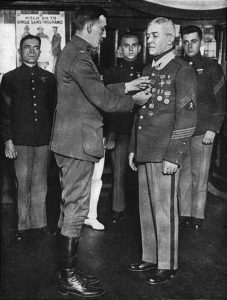
Daly was recommended for a third Medal of Honor, and the NY Times reported it as a certainty. However, petty bureaucratic politics came into play, and a capricious decision was made that the Medal of Honor could only be awarded twice, no matter how deserving subsequent acts of valor were. Daly’s third Medal of Honor was denied solely on this technicality; instead, he was awarded the Distinguished Service Cross, the Navy Cross, and France’s Médaille Militaire.
Perhaps the greatest tribute was paid by General Smedley D. Butler, the other Marine to be awarded two Congressional Medals of Honor for separate acts of valor, who called Daly “The fightinest Marine I ever knew.” Offered promotion several times, Daly once remarked “I would rather be an outstanding sergeant than just another officer“.
Neil F. Cosgrove ©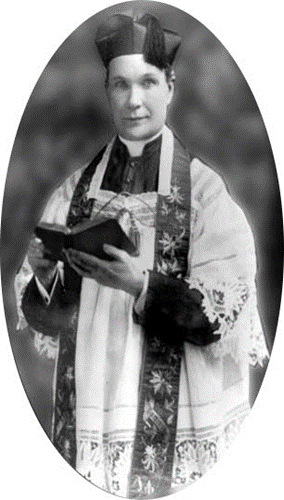
The 1920s marks one of the darkest and least discussed chapters in American history. During this period, the Ku Klux Klan experienced a resurgence, propelled by various factors, including D. W. Griffith’s controversial portrayal of the Klan in “Birth of a Nation” (originally titled “The Klansman”), a complex mix of patriotism and isolationism following World War I, and the adoption of modern marketing techniques. As a result, the Klan transcended its Southern roots, evolving into a nationwide movement with a staggering membership of six million. To sustain its rapid growth and appeal to a broader audience, the Klan expanded its platform of hate. Anti-Catholicism, along with racism, antisemitism and xenophobia, became central to its national identity.
Among the countless victims and perpetrators of this shameful campaign of bigotry and violence, two names stand out: Fr. James Coyle, a martyr for his faith, and Hugo Black, a man who would wear both the robes of a Klansman and a U.S. Supreme Court Justice.
Fr. James Coyle was born in Drum, County Roscommon. He attended Mungret College in Limerick and the Pontifical North American College in Rome and was ordained a priest at age 23 on May 30, 1896. Fr. Coyle would leave his homeland forever, sailing to Mobile, Alabama, whose mines and industry were fueling explosive growth and attracting many Catholic immigrants, including the Irish.
After an initial assignment as an instructor and rector at the McGill Institute for Boys, Fr. Coyle was appointed the pastor of St. Paul’s Church in Birmingham, where he became beloved by his congregation and respected by many of the non-Catholic community. Fr. Coyle quickly became known as a champion for fair treatment for the poor and marginalized of all communities; his personal mantra was “Give, give till it hurts- then and only then is there sacrifice.”
However, the growing Catholic community of Birmingham coincided with growing prejudice and the resurgence of the Klan. Fr. Coyle was quick to respond to newspaper attacks on Catholicism with his own letters deriding the misinformation and ignorance of bigots. Fr. Coyle was often the recipient of anonymous death threats, but that did not dissuade him from publicly defending and espousing his faith.
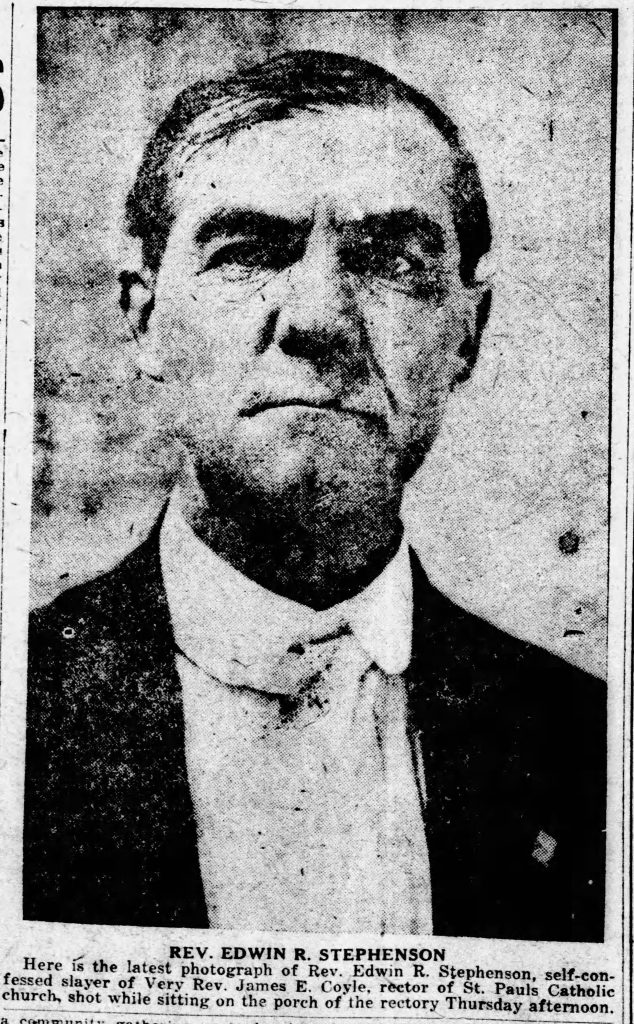
The Klan’s anti-Catholicism was epitomized by another local clergyman. Edwin Stephenson. Stephenson was an ordained Methodist deacon but styled himself as a minister for his occupation of being a “marrying parson” at the Jefferson County Courthouse, which was on the same block as Fr. Coyle’s St. Paul’s. Stephenson was also a member of Robert E. Lee Klavern No. 1, the first Alabama chapter of the Ku Klux Klan. Stephenson described Fr. Coyle as ‘one of humanity’s biggest enemies.’
Stephenson had a daughter, Ruth, who often rebelled against her Father’s rigid rules. Living merely a block from St. Paul’s, Ruth became fascinated by Catholic traditions despite her Father’s vehement criticisms of the faith. When she turned 18, she started secretly attending classes on the Catholic faith and was eventually baptized as a Catholic. When Edwin Stephenson discovered her conversion, he threatened to kill his daughter. Ruth fled her Father’s threat to live with a local Catholic couple. Stephenson went to the Birmingham police chief, a fellow Klansman, to report that Ruth had been “kidnapped by Catholics.” Still considered underage, the police returned her to her Father, where she was beaten with a leather strap after her mother stuffed a rag in her mouth to muffle her screams.
If Stephenson’s aim was breaking Ruth’s independent nature, it failed. Ruth had been hiding another secret: she was engaged to a Puerto Rico man named Pedro Gussman. The couple secretly obtained a marriage license in another town, but finding no priest there, they returned to Birmingham and Fr. Coyle. After carefully inspecting the license, Fr. Coyle performed the ceremony. After the ceremony, Fr. Coyle told Ruth that the first thing she must do is inform her parents.
Three hours after the ceremony, Fr. Coyle was sitting on the porch of his rectory praying his breviary; Edwin Stephenson calmly walked up to the porch, pulled a gun, and shot Fr. Coyle at point blank range in the head, killing him. Stephenson then walked calmly to the courthouse and surrendered to police, saying, ‘It’s all right, gentlemen, I know what I’m doing.‘
What followed was one of the greatest travesties of American justice. Despite the brutality of the murder and the clear evidence of Stephenson’s act, it took weeks for the state to indict him. In response, the Klan hired and paid for his lawyer – future U.S. Senator and Supreme Court Justice Hugo Black.
Stephenson’s original defense team had pleaded not guilty because of temporary insanity. Black entered an additional plea of self-defense even though it was clear that Stephenson had no gun. It soon became apparent that Black’s defense would rest on the Klan’s platform, that Catholics were a threat, and that Stephenson was defending his family. In doing so, Black transformed a murder case that had drawn national attention into a soapbox for the Klan’s anti-Catholic agenda.
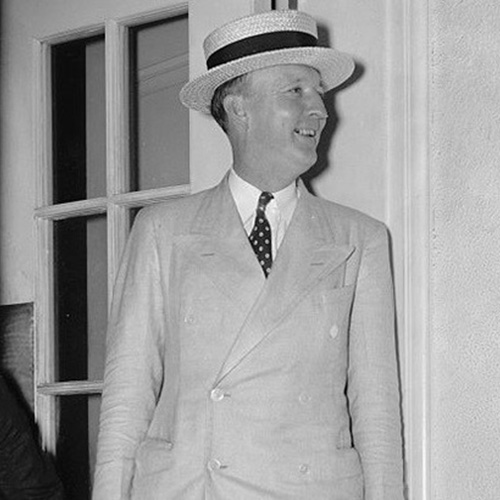
The resulting trial was a farce. The judge, the jury foreman, several jurors, and the key witness, the police chief, were all Klan members. Throughout the trial, Black and the defense team portrayed Gussman as African American, even going so far as to draw the blinds to make him appear darker. When the prosecution described Gussman as being of “proud Castilian descent,” the defense responded, “he has descended a long way.” Hugo Black attacked the only two witnesses that came forward for the prosecution, asking them if they were Catholic (they were) and then calling them “brothers in falsehood, as well as in faith,”
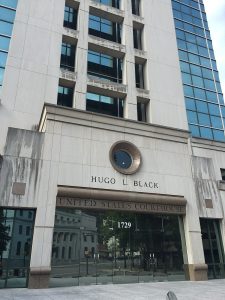
Stephenson was acquitted after the jury deliberated less than a day. For weeks after, he was toasted as a hero, and he lived as a free man in the Birmingham area for another 35 years before dying in 1956. The murder of Fr. Coyle, like the persecution of Catholics by the Ku Klux Klan, is little remembered. Hugo Black would later become a member of the Ku Klux Klan himself, only renouncing his membership when he aspired to a career as a U.S. Senator (but then thanked the Klan for their support when he was elected). Black was later appointed to the Supreme Court, where he is now lionized for his ‘support of civil rights,’ while his lifelong anti-Catholic bigotry is dismissed as ‘a sign of his times,’ his Klan membership as mere political pragmatism, and his bigotry-laden defense of a murderer airbrushed from history. In his biography of his father, Hugo Black Jr. confirmed that Justice Black never renounced his hostility toward the Catholic Church. Yet, a federal courthouse bearing Black’s name stands less than half a mile from where Fr. Coyle was murdered, and in 2022, a monument to Black was erected in his hometown of Ashland, Alabama, attended by many government officials.
The murder of Fr. Coyle is a story of compassion met with cruelty, and of justice denied. We must ask: Why do we continue to honor Hugo Black without reckoning with this history? What does it say about whose stories we remember—and whose we erase?
]]>
John Phillip Holland was born on February 24, 1841 in a small coastal town of Liscannor, County Clare. His mother was a native Irish speaker and young John himself would not learn English until he attended school. Holland’s father was a coastal patrolman for the British Coastguard Service and instilled in the young Holland a love of the sea. Holland aspired to go to sea and walked 5.5 miles each way to attend the Christian Brothers secondary school in Ennistymon, which offered a navigation course. However Holland’s dreams of maritime life were soon dashed by frail health which would plague him throughout his life and poor eyesight.
The family moved to Limerick, where Holland became a student of Brother Bernard O’Brien, a distinguished science teacher and excellent engineer who was a tremendous influence on him. With his father’s death, young Holland began a career as a teacher, and then decided to take his initial vows as a Christian Brother himself. It soon became apparent that young Brother Holland was an inveterate inventor, at one point building a mechanical duck that fascinated his students.
Holland’s poor health intervened again. Falling ill, Holland was sent to an Aunt for treatment and to recuperate. While recovering, Holland was taken by accounts of the ongoing Civil War in America and was particularly fascinated by reports of a revolution in Naval warfare: the battle between the ironclads USS Monitor and the CSS Virginia (Merrimack).
Holland realized that the age of wooden ships was gone forever and that ironclads were the future. As a child who had experienced the dark side of British rule during the Great Hunger, Holland was concerned that England’s industrial strength positioned her to dominate the new technology and increase her hold on the world. Holland wondered “how [other peoples of the world] would protect themselves against those designs.” The course of Holland’s life was set.
Holland returned briefly to the Christian Brothers, but before he could make his final vows illness struck him again causing him to withdraw from the order. Holland decided to follow his mother and brothers who had immigrated to America. Arriving in 1873, Holland took a lay teaching position at St. Joseph’s school Paterson and brought with him plans to counter England’s naval ambitions: a submarine.
Holland initially approached the U.S. Navy to sponsor development of his submarine, but his design was dismissed as impractical. However, Holland’s brother Michael soon found a sponsor for Holland’s work: Clan na Gael, the American branch of the Irish Republican Brotherhood, or Fenians who saw in it a weapon to fight for Ireland’s freedom. After a successful demonstration, the Fenians funded development of a full size submarine that would later be dubbed the ”Fenian Ram”. Holland’s submarine had many of the features that became fundamental to submarine design: it was driven by a combustion engine on the surface, but used battery power when submerged, it was fitted with both ballast and compressed air tanks. In an initial trial, the submarine made 3-1/2 knots on the surface and was able to stay submerged for over an hour and successfully return to the surface.
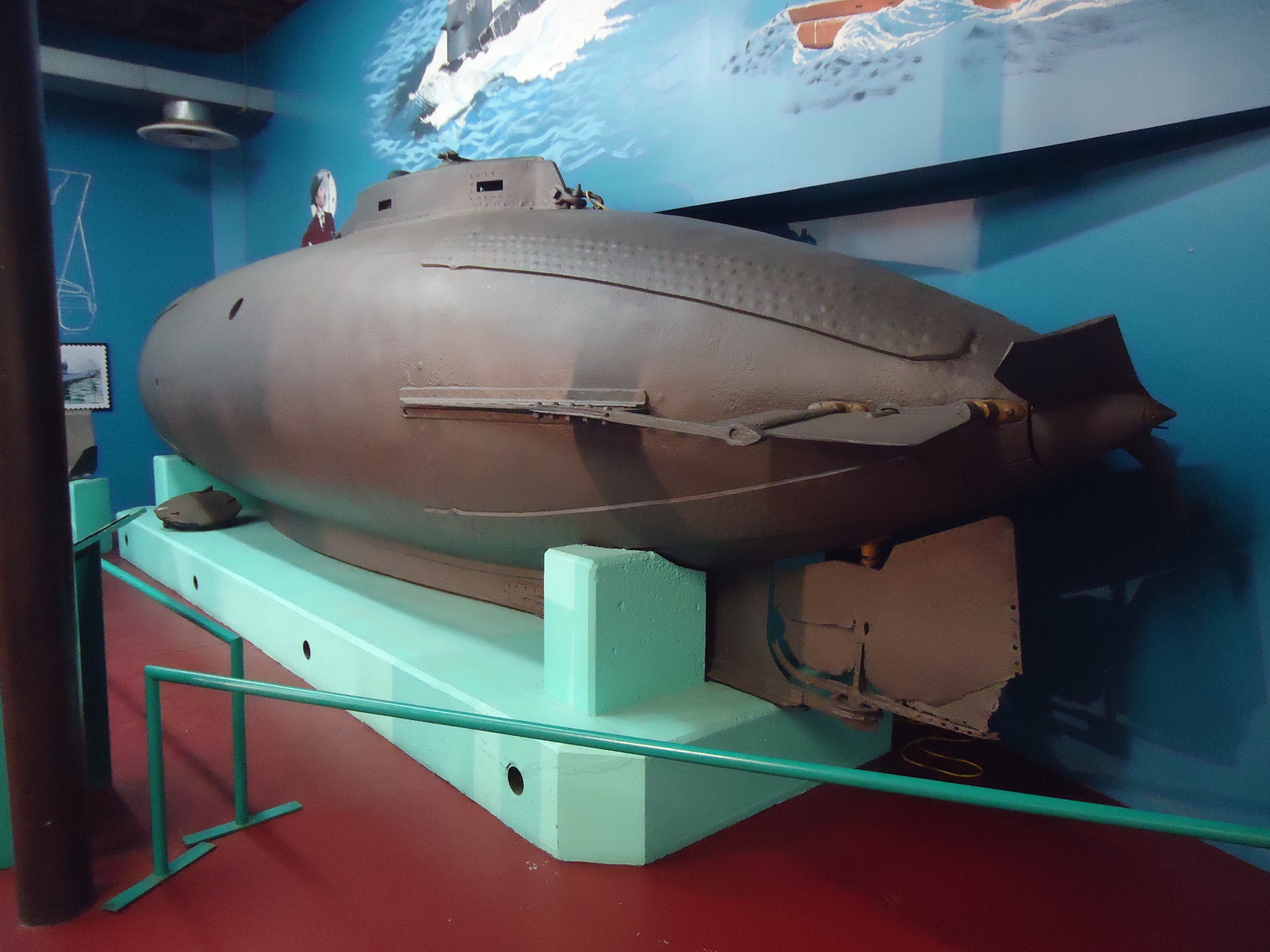
However, there was one challenge that Holland had not counted on: the classic “Irish split”. Internal fighting within the Fenians and allegations of inappropriate use of the “skirmish fund” resulted in cancellation of funding for Holland’s submarine development. A faction of the Fenians stole the “Fenian Ram” and another prototype. The prototype sank in transit while subsequent attempts by inexperienced crews to operate the “Fenian Ram” resulted in it being impounded as a menace to navigation.
Submarines however were finally gaining the attention of the U.S. Navy. Holland competed for and won a contract to develop a submarine to be named the USS Plunger for the Navy. However, Holland soon realized that the Navy’s shifting design requirements were dooming the project to failure. On his own Holland began developing his own design, the Holland VI. When sea trials came, the USS Plunger proved to be the disaster that Holland had predicted. Holland then demonstrated the Holland VI which in trials exceeded the Navy’s requirements. The Holland VI was commissioned into the U.S. Navy on April 11, 1900 as the USS Holland, the U.S. Navy’s first modern submarine and an order for an additional six more was placed.
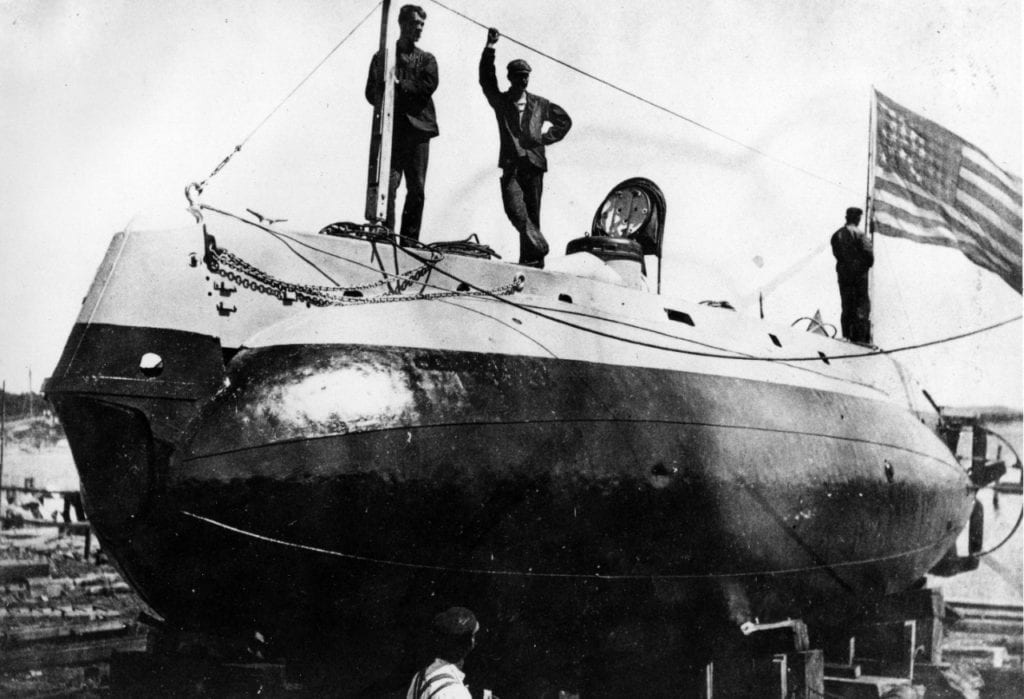
It would be nice if the story could conclude on this triumph as a happy ending, but it cannot. Holland’s vision always exceeded his meager pocketbook and he was near poverty. To continue his work Holland formed a partnership with Isaac L. Rice, a businessman who controlled the manufacture of the storage batteries that were integral to Holland’s design. Holland and Rice formed a new company, fittingly called Electric Boat, which is still in operation today as the leader in submarine design. Holland soon found that his partner began isolating him, forcing him into less and less significant roles within his own company while others took credit for Holland’s ideas as they now rapidly evolved with proper financial backing. Holland left Electric Boat to form his own company, only to be dragged through the courts by Electric Boat who claimed not only ownership of Holland’s patents but even Holland’s own name as applied to submarines. While Holland eventually won in court, the damage had been done, potential investors had been scared off. Holland, broken and bitter, was forced into retirement. John Phillip Holland died at his home in Patterson on August 12, 1914 just as World War I was breaking out in Europe, a war in which Holland’s vision of the submarine would be proven with devastating effectiveness.
The genius of Irish Immigrant John Phillip Holland deserves a kinder fate. Holland’s discoveries and his over twenty patents are still protecting our national security today in the shield that is the Navy’s submarine fleet.
Neil F. Cosgrove ©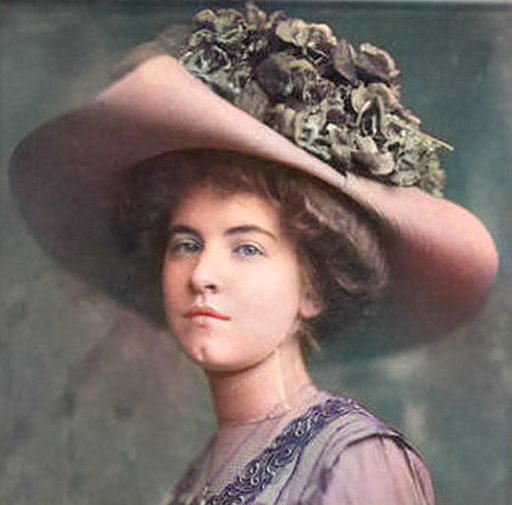
Margaret Tobin Brown, famously known as the “Unsinkable Molly Brown,” is often celebrated in popular culture for her flamboyant personality and heroic actions on the Titanic. However, this portrayal barely scratches the surface of her remarkable life and achievements. While she is invariably portrayed as an outspoken, humorous, flamboyant woman of America’s West, these depictions, though rooted in truth, do a disservice to the complexity and depth of her character and contributions. She is even known to history as “Molly”, a name she never used in life.
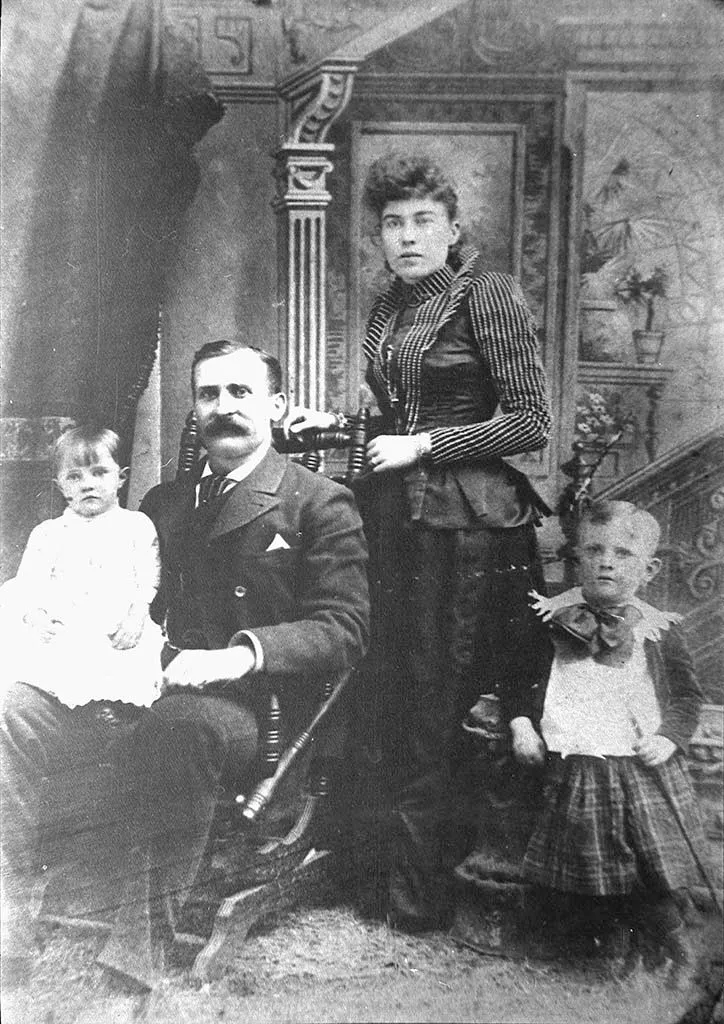
Born in 1867 in Hannibal, Missouri, to Irish immigrants John and Johanna Tobin, Margaret Tobin Brown was raised in a small Irish American community that deeply valued freedom, equality, and education. Uncommon for the time, Margaret attended school until the age of 13, receiving what would be considered a high school education by today’s standards.
Upon leaving school, Margaret directly experienced the hardships faced by the working class, enduring long hours, meager pay, and job insecurity in a factory. These challenges were all too familiar to her community and her father. Like many young people of her era, she was drawn westward in search of better opportunities. Yet, the values instilled in her by the Irish Catholic community of her childhood fueled a lifelong zeal for personal development and active engagement in societal issues.
Margaret traveled to Leadville, Colorado, where she met and married James Joseph (J.J.) Brown. J.J.’s journey mirrored Margaret’s own. Born of Irish immigrants, he taught himself geology through self-study and was recognized for his “special genius for practical and economic geology.” J.J. built a reputation for locating profitable mines. Utilizing his geological knowledge and innovating new mining methods, J.J. discovered vast quantities of high-grade copper and gold, making one of the most significant gold strikes ever recorded.
As multimillionaires, J.J. and Margaret bought a new, stately home in the rapidly developing city of Denver. However, their newfound wealth and Irish Catholic heritage did not smooth their entry into Denver’s social circles. The self-appointed gatekeeper of Denver society, Louise Hill, and her “Sacred Thirty-Six” never accepted Margaret, prompting her to label Hill as “the snobbiest woman in Denver.”
If Margaret Brown was stung by these elitists, it didn’t show for long. She founded the Denver Woman’s Club, which, instead of playing bridge like the “Sacred Thirty-Six,” advocated for education, suffrage, and human rights. In 1911, she raised funds to build the Cathedral of Immaculate Conception, St. Joseph’s Hospital, and several Catholic and public elementary schools. She also worked with Judge Ben Lindsey to establish the first juvenile court in America, a model that was adopted nationwide. Additionally, she became fluent in French, German, Italian, and Russian.
Sadly, J.J. did not share Margaret’s growing interests, and the couple drifted apart after 23 years of marriage. They signed a separation agreement, though they never divorced, and remained very close throughout their lives.
Margaret embarked on a tour of Egypt, Rome, and Paris. While on tour, she received news that her grandson had become seriously ill. She immediately booked passage on the first available ship, the Titanic.
The story of the tragedy of the Titanic need not be repeated here. Upon the collision with the iceberg, Margaret immediately began organizing and assisting her fellow passengers into the lifeboats until a crewman took hold of her and, with the words “you are going too,” was dropped four feet into the lowering lifeboat #6.
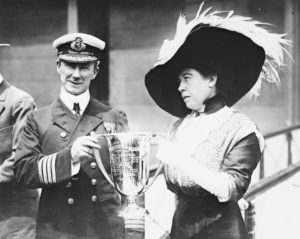
Despite Lifeboat #6’s capacity of 65, it departed from the Titanic with only 24 people aboard, including 21 women, two men, and a boy. Despite threatening the coxswain to “throw him overboard” if he did not turn around and pick up more survivors, her threat went unheeded as he feared the boat would capsize as those in the water tried to get in. Margaret and the rest rowed tirelessly for hours until rescued by the ship Carpathia. Exhausted yet undeterred, Margaret utilized her multilingual skills to comfort non-English speaking survivors and helped organize the distribution of essential supplies to those in need. Margaret spearheaded a fundraising campaign among the first-class passengers, amassing $10,000 to aid the less fortunate survivors before arriving in New York.
Margaret became an international celebrity. She was dubbed “The Unsinkable Molly Brown” by the press, though she had never used the name ‘Molly’ in her life. In character with her life, Margaret used her fame not for herself but for others. She was an advocate for striking miners fighting for better pay. She worked to secure the vote for women and even ran for the Senate, where several papers favored her chances, but she quit her campaign with the outbreak of WW I to focus on aiding the people of devastated France, earning the French Legion of Honor for her activities.
Margaret Brown died at the age of 65 in 1932 after experiencing enough to fill several lifetimes. It is very sad that this remarkable Irish American woman who lived a true rags-to-riches story but never forgot where she came from nor turned her back on those less fortunate is remembered chiefly on the basis of Hollywood caricatures. This is why we have Irish American Heritage Month, to learn the rest of the story.
]]>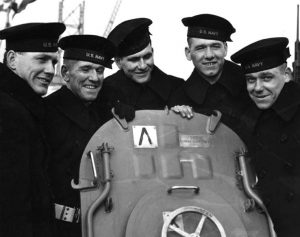
DID YOU KNOW that in the annals of America’s heroes, there is scarcely a brighter entry than that of the fighting Sullivan brothers? Born in Waterloo, Iowa to Railroad conductor Tom Sullivan and his wife Alleta, George, Francis, Albert, Joseph, and Madison grew up the best of friends in the closeness of an Irish family and matured into patriotic Americans. It was no surprise, therefore, that when Pearl Harbor was attacked, the Sullivan brothers headed straight for the nearest U.S. Navy recruiting office.
Navy policy discouraged family members from serving together, but the Sullivans were determined that nobody would split them up. If the Navy wouldn’t take them, they would try somewhere else. With the demand for recruitment high, and five healthy young Irish-Americans offering to serve, the request was granted, and on Jan 3, 1942, they enlisted. Later, George tried to explain their decision to their mother. His words were tragically prophetic; he said, If worse comes to worst, at least we’ll go down together. In less than a year the worst came to pass.
On the morning of Nov 13, 1942, during the battle of Guadalcanal, east of the Solomon Islands in the South Pacific, the Sullivans were aboard the USS Juneau when she was hit by a torpedo in her forward engine room. Minutes later another shot hit her weapons magazine. In a violent blinding flash, the ship erupted. In 42 seconds she sank in shark-infested waters; only 10 of her 711 crew members were rescued; the Sullivans were not among them! The sinking of the Juneau was one of the most tragic losses of the war, but the loss of the five brothers shocked the nation.
It was the greatest military loss by any one American family during World War II. The Waterloo Courier reported that, In the history of the Navy, no mother has received a blow as severe as that which has come to this mother. Mrs. Alleta Sullivan endured her sorrow by helping other families overcome their own personal tragedies. Helping others in sorrow kills your own sorrow, she told a reporter. Condolences poured in from every level of society, Presidential letters and visits and even Congressional resolutions could not ease the pain that the nation felt. Hollywood even immortalized the boys in a full-length feature film: The Fighting Sullivans that left those who saw it teary-eyed.
 The ultimate tribute, however, came in April 1943 when the Bethlehem Shipbuilding Company invited Mrs. Sullivan to christen the U.S. Navy’s new Fletcher-class destroyer, the USS Sullivans (DD537). It would be a fighting memorial to her sons. The USS Sullivans was the first ship ever commissioned to honor more than one person. The Sullivans were on the sea once more. The USS Sullivans received nine battle stars for service in World War II and two more for service in the Korean action.
On 7 January 1965, USS Sullivans was decommissioned but remained in reserve into the 1970s. In 1977, she was donated to the Buffalo and Erie County Naval & Military Park in Buffalo, NY as a public memorial. It was declared a National Historic Landmark in 1986 and today, the decommissioned USS Sullivans sits proudly at Buffalo’s Naval Park with her shamrock flag still waving from her mainmast and a brass plaque on her quarterdeck recalling the vow of the five Sullivan brothers – We stick together! However, that’s not the end of the story.
The USS The Sullivans (DDG-68), Arleigh Burke-class Aegis guided-missile destroyer was launched on 12 August 1995. She was christened by Kelly Ann Sullivan Loughren, the granddaughter of Albert Sullivan – one of the brothers. This newest ship to carry the Sullivans’ name was officially commissioned on 19 April 1997 and still carries the name of the five Sullivan brothers across the seas with her official motto: We Stick Together commemorating just a few of the Irish-Americans who made America Great!
Mike McCormack, National Historian (originally publish 2017)
Note:
Since this article was originally published two additional chapters to the Sullivans story have been added:
- Early in the morning of St. Patrick’s Day 2018, Research Vessel Petrel and their team of undersea explorers and archaeologists located Juneau’s wreck site and the death site of the five Irish sons of Waterloo, Iowa. Lying some 13,000 feet beneath the surface of the Pacific, Juneau’s wreck is scattered across a wide debris field. The evidence of the cataclysmic explosion that sank her is clearly evident in the images Petrel’s ROV provided. That the grave of the Sullivans should be found on St, Patrick’s Day would seem to speak to the hand of providence than mere coincidence.
 The original USS Sullivans that was decommissioned and donated to the Buffalo and Erie County Naval & Military Park in Buffalo, NY as a public memorial is in perilous condition, what service in two wars could not accomplish was achieved by the harsh Buffalo winters when the Sullivans partially sank at its birth, but the American flag at its stern still proudly waving. Despite being declared a National Historic Landmark and the unceasing and unselfish work of volunteers, the brave vessel succumbed to years of neglect from NY State and the Federal government. Government funds have now been allocated to restore the Sullivans, but the work still needs to be done. See Save the Sullivans
THIS IRISH AMERICAN HERITAGE MONTH PROFILE IS PRESENTED BY THE ANCIENT ORDER OF HIBERNIANS (AOH.COM)
#IrishAmericanHeritageMonth #EmbraceYourIrishHeritageAOH
]]>
 Each year around March 17, the name of St. Patrick appears in every major publication in the civilized world – sometimes with honor and sometimes with scorn – often due to the conduct of those who celebrate his memory at affairs which bear his name. Of the many things written about this holy man, some are true, some misleading, and some false. St. Patrick was Italian; St. Patrick drove the snakes from Ireland; St. Patrick was the first to bring Christianity to Ireland – all of these statements are false!
Let’s take them one at a time. Some claim St. Patrick to be Italian because he was born in Roman occupied territory, and his name was Patricius. Sadly, the mists of time have clouded the exact location of his birth, but what is concluded from available evidence is that he was born somewhere in Wales around 386 AD. Patrick himself wrote that the scene of his youth was Banavem Tiburniae (possibly the town of Tiburnia near Holyhead in western Wales), where his father was a member of the governing body. Other Welsh sources suggest southern Wales near the Bristol Channel at the mouth of the Severn River. Although Wales was part of the Roman Empire at that time, it was a Celtic country and its people were one race with the people of Ireland, Scotland, Brittany, Cornwall, and the Isle of Man. As for his Italian sounding name, it was given to him when he was consecrated Bishop and assigned to the mission in Ireland. Before that time, our patron Saint’s name was Succat, a Celtic name meaning victorious. There is, therefore, more evidence to suggest that Patrick was Celtic than any other nationality. He even identified himself as such in his letter to the British prince, Corocticus.
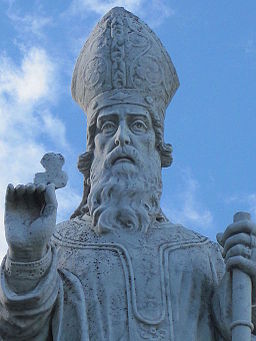
As for the snakes, although a popular legend, it is scientifically known that there never were any in Ireland, to begin with. His connection with that legend stems from the Viking misinterpretation of his name. Paud in the old Norse language meant a toad, and when the Vikings heard of a Saint called Paud-rig, who had lived in Ireland before their coming, they concluded it meant toad-expeller. That was only the beginning, because the legend was reinforced by the Church’s representation of the Devil in the form of a serpent, and statues of Patrick driving the Devil out of Ireland in that form. The fact that there were no snakes led to the question, “what happened to them,” and the answer was easily found in St Patrick’s traditional statue. However, Patrick is more revered for what he brought to Ireland than what he drove away. Yet he was not the first to bring Christianity . . . he was, however, the most effective.
The story began when Patrick was about 16 years old, and Ireland’s High King, Niall of the Nine Hostages, sent warriors to raid the coast of Wales for slaves. Among the hostages taken was the youth, Succat. According to tradition, he was taken to Mt. Slemish, Co. Antrim, where he tended the flocks of either a Druid or a Chieftain, according to Ludwig Beiler’s The Life and Legend of St. Patrick. After six years, Succat escaped following a voice that he heard in his dreams. He fled to Wexford, found passage, and eventually returned to his family. There he received his vocation for missionary work in Ireland in three separate dreams – the most notable was one in which the voice of the Irish called to him, “Holy youth, come again and walk among us.”
Succat received religious training at monastic settlements in Gaul, Italy, and the islands of the Tyrrhene Sea. He was ordained a Deacon by Amator, Bishop of Auxerre about 418 AD, and was consecrated Bishop – receiving the name Patricius – in 432 AD. At the time, there were a few Christians already in Ireland, but without a central authority and in such isolated areas as an island in Wexford harbor where St. Ibar had established his church and school.
In any case, it is certain that Patrick was in Auxerre in 431, when St. Germanus selected Palladius, a contemporary of Patrick’s, as the first Bishop of Ireland, but that mission was short-lived. According to the memoirs of Tirechan, a cleric in Meath about 690 AD, Palladius died or left within a year. Patrick was assigned to replace him in 432. Working to his advantage was the fact that Patrick knew Irish customs and language from his years in captivity and the fact that he was a Celt. Patrick never condemned the Irish as idolatrous pagans but appealed to their pride. He explained their traditions in terms of Christianity and was eventually accepted as one of their own. He converted key people among the nobility and recruited a native clergy.
He began his missionary work in Ulster, built his first Church at Saul, two miles from Downpatrick, and from there journeyed across the  land. Patrick’s own writings and the writings of his contemporaries show him to have been a missionary of extraordinary zeal, energy, and courage, careless of his own safety in his fervor to `spread the nets for God’. In his own writings, he mentions this `divine impatience’ as well as describing himself as one of the Irish. For 29 years, Patrick labored among his beloved Irish, converting and baptizing them by the thousands until his death on March 17, 461 AD. Tradition establishes that he was buried at Downpatrick where he shares the same grave with Saints Bridget and Columcille who were later interred with him to protect their remains from Viking raiders. He was recognized as a saint in the 17th century by the extension of his feast day to the universal Church calendar.
However, by all accounts, the most momentous part of his legacy is the form of Christianity he left in Ireland for it inspired a life of sacrifice for the sins of man. That sacrifice, which became known as ‘white martyrdom’ included prayerful solitude, fasting, tedious transcription of sacred documents, abstinence from worldly pleasures which to some meant dressing in coarse garments and sleeping on hard beds with stone pillows, and most importantly, missionary activity. It was this devotion which led to Ireland becoming the Isle of Saints and Scholars, the University of Europe and the Lamp of the West; and it was his fervor to spread the nets for God that led future generations of Irish monks to travel the continent as missionaries, bringing the light of learning back into the abyss after the Dark Ages and saving civilization.
This then is the man – the Saint – that we honor in March, and it our duty to see that nothing but praise and reverence are attached to his name. We may celebrate his memory with joy, but remember his love for the Irish, the tremendous gift of faith that he bestowed upon us and the inspiration he provided which benefitted civilization, and celebrate with reverent joy. We can begin by replacing all references to Paddy’s Day with the proper name of Saint Patrick’s Day for the difference between Paddy’s Day and St. Patrick’s Day is the same as the difference between the office Christmas Party and Midnight Mass.
Additional Misconception: “St. Patrick Was Not a Saint”
Since the publication of this article, a new misconception, often circulated for “mouse clicks”, suggests that St. Patrick was never made a saint. This claim is based on the fact that the formal canonization process as we know it today did not exist during St. Patrick’s time in the 5th century. However, as the author of this article Mike McCormack meticulously details in his other article “St. Patrick IS a Saint!“, his sainthood was recognized through the Solemn Translation of his relics in 1186, conducted under the authority of Pope Urban III. This act, equivalent to canonization at the time, affirmed St. Patrick’s status as a saint within the Church.
Thus, just as the myths of St. Patrick’s nationality and snake-banishing endure, so too does this modern revisionism—one that ignores the history of Ireland’s patron saint for sensationalism.
]]>
William G. Walsh was born on April 7, 1922, in Maine to a young mother who gave the child to her grandmother to raise. When the grandmother herself fell ill, she entrusted the baby to her friend Mary Walsh from Roxbury, Massachusetts. Mary, who had emigrated from Ireland in 1898, was no stranger to adversity. She had been married to Dennis Walsh, himself an Irish immigrant, who had been killed in a building collapse while fighting a fire as a Boston firefighter in 1915 just a few days before Christmas leaving her with two children and a third on the way. Mary Walsh provided for her family by working as a housekeeper, cook, waitress and by taking in borders, a model of Irish strength and grit. Despite Mary’s own struggles, she still took in the infant William and, when his grandmother died, adopted him.
Young William was quickly christened “Red” in the neighborhood due to his sandy red hair. He developed a reputation as both an athlete and a natural leader; in baseball, he was a catcher known for being able to manage his pitchers. When the Japanese attacked Pearl Harbor on Sunday, December 7, 1941, he and his entire baseball team went to the closed Federal Building in Boston and slept outside on benches to be first in line when the recruiting office opened Monday morning.
Enlisting in the Marines, William Walsh volunteered for the elite Marine Raiders and saw extensive service at Guadalcanal, Bougainville, Tarawa, and the Russell Islands. He was nominated for non-commissioned officers school, promoted to platoon sergeant and assigned to the G Company 27th Marines, 5th Marine Division, when his unit took part in the invasion of Iwo Jima.

On February 27, Sargent Walsh and his men were tasked to take a strategic ridge vital to the capture of Motoyama Airfield 2. Despite heavy shelling and bombing, as soon as the Marines moved forward, the Japanese defenders reoccupied defense which had been constructed to put any attacker in a murderous crossfire and was pre-sighted for artillery and mortars. Walsh’s unit was pinned. Realizing that to stay was to die, William shouted, “Hell, we can’t stay here! Let’s hit them again!” Walsh’s Marines charged again only to be met with machine guns and grenades. Men began to scramble back, but Walsh had taken cover in a crater with some wounded men and refused to leave them. A Japanese grenade was thrown into the hole and Walsh without hesitation, threw himself on the grenade giving his life for his men. William Walsh was awarded the Medal of Honor.

However, this would not be the last medal presented to the Walsh family. Dennis Walsh, the child that Mary Walsh had been carrying when her husband was killed as a Boston firefighter, had joined the Franciscan Order taking the religious name Cormac. When the Korean War broke out, Fr. Cormac Walsh joined the U.S. Army as a chaplain, where he was awarded four Silver Stars and a Presidential Citation for his care of the wounded while under fire; Fr. Walsh was the most decorated chaplain of the Korean War. After his career with the Army, Fr. Walsh served for eighteen years as the prison chaplain at the maximum-security Clinton Correctional Facility in Dannemora, New York. An inmate at the prison stated, “He created a legend of goodness and left us a legacy of love.“
In Boston, there is a memorial plaque with the name of Firefighter Dennis Walsh’s inscribed for his sacrifice as a firefighter. In Dorchester, there is a park named for Gunnery Sargent William Walsh, and there is a bridge named for Fr. Cormac Walsh. There should equally be a monument to Mary Walsh, who, like so many Irish women, silently lead a life of dedication and fortitude in the face of adversity while never losing her Christian Charity.
There are many, many stories like the Walsh’s; many of us have similar stories in our own families. As we celebrate St. Patrick’s Day, let’s do more than march—let’s share these stories and ensure their legacy endures.
Neil F. Cosgrove,
Note that with deep regret and despite best efforts, I was unable to locate a photo of Mary Walsh.
]]>
During its period of operation from 1892 till 1954, over 12 million immigrants entered through the immigration station at Ellis Island, a name that was to become synonymous with the “Golden Door” and the “American Dream”. It is estimated that today over forty percent of the United States population can trace their ancestry to an immigrant that entered Ellis Island.
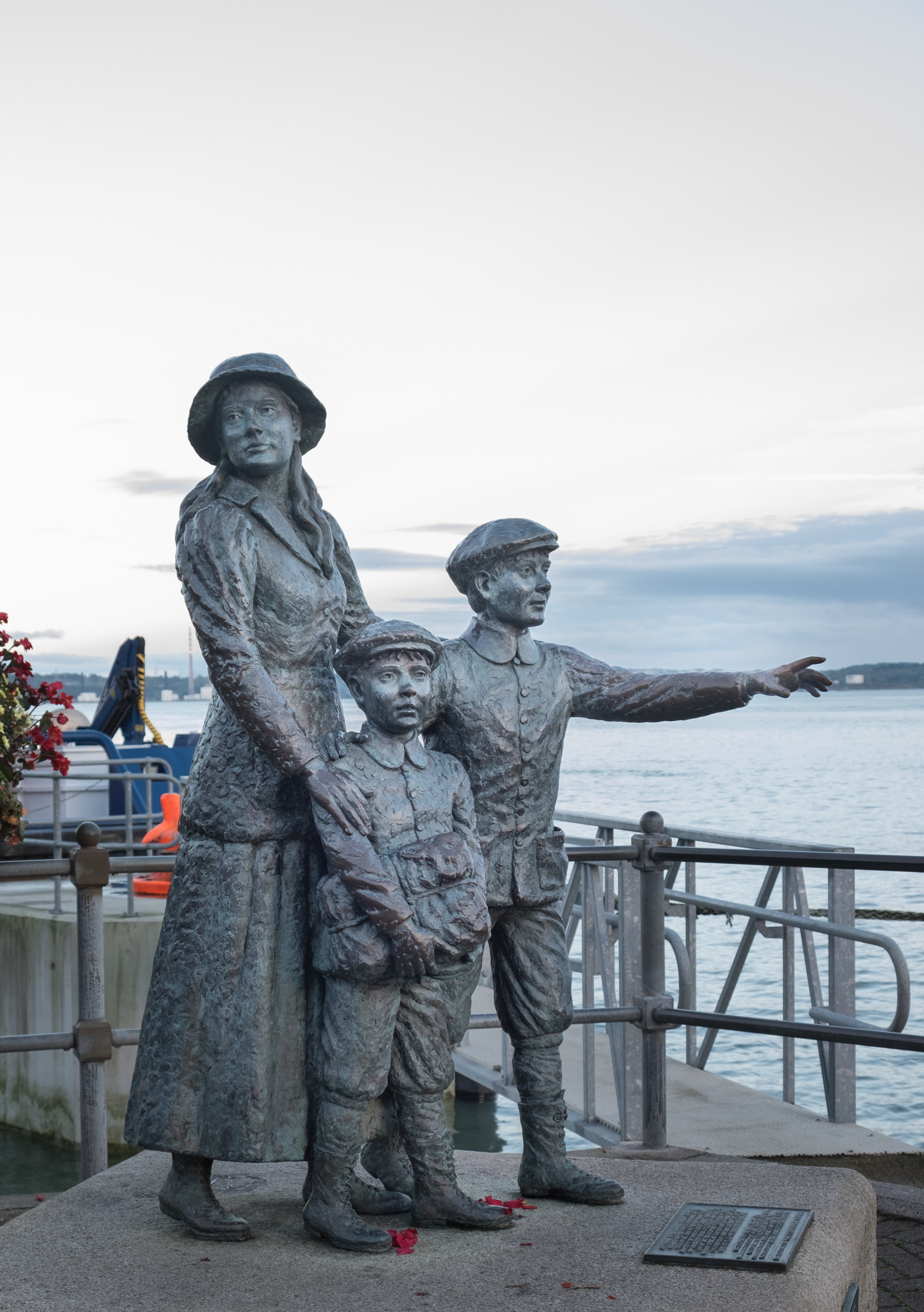
On New Year’s Day Morning 1892 on the deck of the steamship Nevada stood three adolescents, Annie Moore and her brothers Phillip and Anthony. They were perhaps staring at another recent immigrant from France, the Statue of Liberty. The children had made the twelve-day voyage from Cork in the claustrophobic conditions of steerage to be reunited with their parents and older siblings who had traveled on ahead to make a new life in America two years earlier. In addition to the natural apprehension of starting a new life in a strange land, the children had no doubt heard that they would be subject to a series of examinations at the immigration station; they would be checked to ensure they were healthy and then interrogated to ensure they were neither a threat or likely to become “a public charge”. A slight malady or a wrong answer could result in them being returned to the Nevada and a trip back to Ireland alone. It therefore must have been with some anxiety that Annie realized that she would be the first to go down the gangplank.
It must have been quite a shock when Annie found herself caught up in what we would now call a PR event surrounding the opening of the new immigration station. The New York Times was there and described Annie as “a little rosy-cheeked Irish girl… fifteen years of age.” (Actually, Annie was closer to seventeen years of age. The children’s ages were all misstated on the manifest, perhaps an attempt by their parents to save money on their passage.) Instead of an anonymous immigration agent, Annie was officially registered by the former private secretary to the secretary of the treasury. The Times continued “When the little voyager had been registered Col. Weber presented her with a ten-dollar gold piece and made a short address of congratulation and welcome. It was the first United States coin she had ever seen and the largest sum of money she ever possessed. She says she will never part with it.” This moment was later commemorated in the song “Isle of Hope, Isle of Tears” popularized by the Irish tenor Ronan Tynan.
Sadly, there would be no fairy tale ending to the life of Annie Moore, her brief moment of notoriety would be a shining moment in a hard and trying life. The statement that Annie would never part with the ten dollar gold piece was likely an invention of a romantic reporter; the coin probably never lasted the day when Annie was reunited with her family who was eking out an existence on her father’s longshoreman salary. She would spend the rest of her life living in a series of tenements near the Fulton Street Fish Market. She would marry the son of a German immigrant who was employed as a bakery clerk. They would have 11 children, but would bury five of them. Annie herself would die at the early age of 47 in 1924; burned out by a life of poverty and struggle.
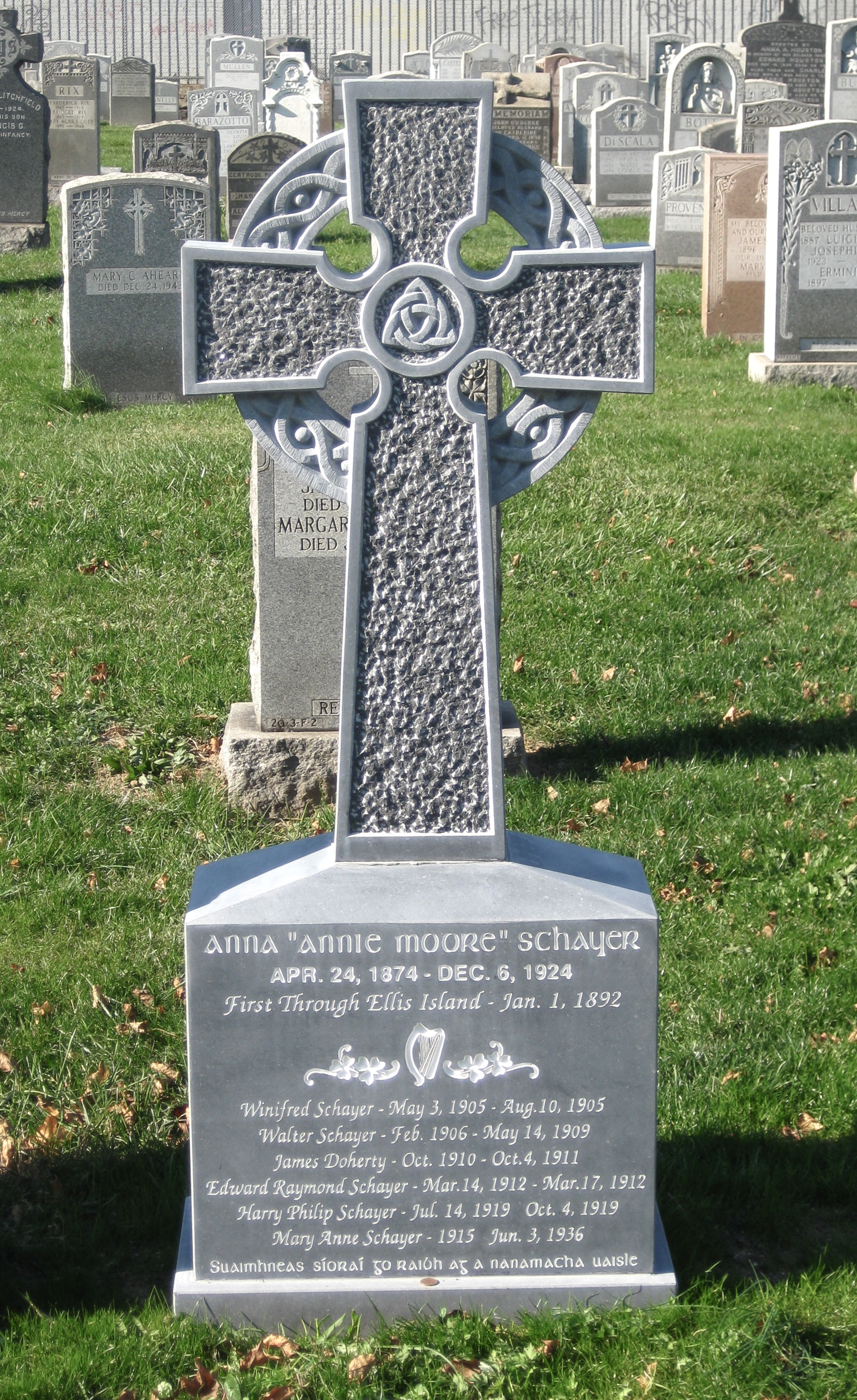
Annie Moore was initially buried in an unmarked grave in Calvary Cemetery, Queens until it was rediscovered in 2006. Through the efforts of the Irish American community, the grave was marked by a Celtic Cross of Irish Blue Limestone. Some cynics questioned the elaborateness of the memorial given the grim reality of Annie’s life. However, in honoring Annie Moore we honor all the other anonymous Irish men and women who came to this country and sacrificed their present for future generations’ tomorrow while at the same time building America. It is reported that many of the current descendants of Annie’s surviving children are successful and respected members of the community.
It is right and proper that we remember the many great Irish American men and women who gained well deserved distinction in government, the military, the arts and sciences. However in remembering Annie Moore we remember the countless other anonymous Irish Americans who loaded our ships as Annie’s father did, built our railroads, fought our fires, patrolled our streets and taught in our schools.
Annie Moore is a reminder that the success of Irish America comes from sweat, sacrifice, and tears and not “the luck of the Irish”. It is time we reclaimed the struggle and successes of Irish America from the unmarked grave where it currently lies buried in our school’s curricula. She is also a reminder that the “Golden Door” that she once walked through is now unjustly closed to Irish immigrants as it freely swings open to others; a challenge to complete her memorial by seeking a fair and just immigration policy for today’s Annie Moore’s.
Neil F. Cosgrove ©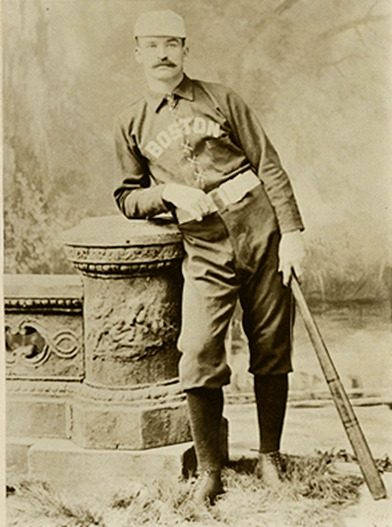
In the early days of baseball, Irish Americans dominated the sport and helped shape it into America’s national pastime. Many young men, hardened by the strenuous labor of the few jobs available to them, found solace in the new game. Their physical strength and competitive drive made them natural stars, and they soon became key innovators. Among them, none left a greater mark on the game’s formative years than Michael “King” Kelly.
Michael Joseph Kelly was born in Troy, New York, on December 31, 1857, to Irish immigrants. When the Civil War broke out, his father enlisted in the Union Army. The family followed him to Washington, where young Kelly may have first encountered baseball.
After the war, the Kellys moved to Paterson, New Jersey. When his father died in 1871, 13-year-old Kelly left school to work hauling coal and in a textile mill. But his passion remained baseball. Before long, professional teams took notice.
In 1878, Kelly made his major league debut with the Cincinnati Red Stockings (now the Reds). After two seasons, financial troubles forced the team to release its players, and Kelly was acquired by the Chicago White Stockings (now the Cubs). There, he became the game’s first true superstar, winning two batting titles, leading the league in runs for three seasons, and playing on four championship teams. Primarily a catcher and outfielder, he played every position during his career. At nearly six feet tall, with talent and striking good looks, Kelly became a household name in one of the country’s media capitals.
Following the 1886 season, Chicago sold Kelly to the Boston Beaneaters (now the Atlanta Braves) for a record $10,000. The fee earned him the nickname “$10,000 Beauty,” but in heavily Irish Boston, he was better known as “King Kelly” or simply “The Only.”
Kelly was both an innovator and a showman. He was among the first catchers to wear gloves, use a chest protector, and develop signs to communicate with pitchers. The Baseball Hall of Fame credits him with originating the hit-and-run, the double steal, and an early form of the infield shift. He also exploited the game’s one-umpire system, frequently cutting corners on the bases when the umpire’s attention was elsewhere. He was known to keep a spare baseball hidden in his jersey; during a late-game play as dusk fell, he made a dramatic dive for a ball, then proudly held one up. When his teammates praised the catch, Kelly laughed: “Not at all—it went a mile over my head.” Some claim his popularity also gave rise to the practice of autograph collecting, as young boys sought his signature as proof of meeting him.
Kelly’s greatest innovation was the hook slide. Before him, base stealers ran directly at the bag. Kelly perfected the technique of sliding wide of the base and reaching back with his hand. From 1886 to 1890, he stole at least 50 bases per season, peaking at 84 in 1887. He was among the first players to steal third base and home regularly—often in succession. A print of Kelly sliding became a fixture in Boston bars, and the crowd’s chant of “Slide, Kelly, Slide!” inspired a song that became the first American pop hit when recorded by Edison, at a time when recordings were primarily religious or operatic.
Despite his brilliance on the field, Kelly fell victim to the pitfalls of sudden fame and fortune, a pattern repeated by many athletes since. Known for his generosity and hard-partying lifestyle, he spent his earnings as fast as he made them. A teammate once said, “[Kelly] was a whole-souled, genial fellow with a host of friends and but one enemy—himself.”
A defining moment of Kelly’s character came in 1890, during a labor dispute between players and team owners. Kelly joined other ballplayers in forming the short-lived Players’ League, managing and playing for the Boston Reds. When the league struggled financially, baseball magnate Albert Spalding offered him $10,000 and a lucrative contract to return to the National League’s Beaneaters. Kelly asked for time to think. After taking a walk, he returned and said, “I’ve decided not to accept.” A shocked Spalding asked, “What? You don’t want $10,000?” Kelly replied, “I want it bad enough, but I’ve thought it over, and I can’t go back on the boys. And neither would you.” Spalding shook Kelly’s hand and, knowing he was in need, lent him $500. Kelly led his team to the Players’ League’s only championship before the league folded.
Years of hard playing and harder living took their toll. Kelly retired in 1894 after 16 seasons with little money left. In another first for a ballplayer, he wrote an autobiography and attempted a career on the vaudeville stage. While sailing from New York to Boston for a performance, he reportedly gave his coat to a fellow passenger who was cold. Soon after, he contracted pneumonia and died three days later on November 8, 1894, at just 36 years old.
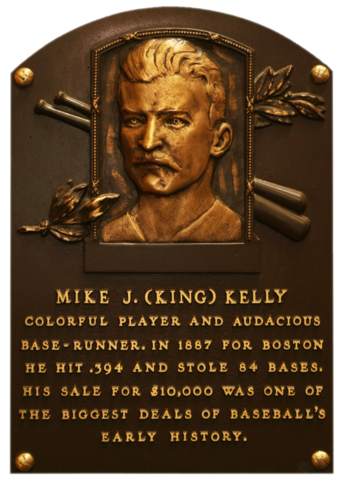
In 1945, Kelly was inducted into the National Baseball Hall of Fame by the Old-Timers’ Committee. The New York Times noted that his fellow inductees included Bresnahan, Brouthers, Clarke, Jim Collins, Delehanty, Duffy, Jennings, James O’Rourke, and Robinson—underscoring the deep Irish influence on baseball. Sadly, none of Kelly’s immediate family attended the ceremony; his only child had died young, and his wife had passed years before his induction.
Kelly played a pivotal role in popularizing and transforming professional baseball in the 19th century to the national pastime. His creativity on the field led to numerous changes in the rulebook, with many claiming that half of baseball’s rules were rewritten to close loopholes he exploited. His legacy as both a showman and an innovator remains a defining part of the game’s history.
– Neil F. Cosgrove ©
]]>
At the young age of 32, Thomas Foley was already an 11-year decorated veteran firefighter of the FDNY and a legend. He was a larger than life individual who embraced life to the fullest and seemed to excel at everything he tried from powerlifting to skydiving. Having learned to ride horses on visits to his grandfather’s farm, he even excelled as a competitor on the rodeo circuit. With boyish good looks, Thomas Foley was featured twice by People Magazine and appeared in the FDNY’s “2003 Calendar of Heroes.” At one awards ceremony where Thomas Foley was being honored, he responded to a question regarding the source of his drive and accomplishments by smiling and saying, “When anyone asks me, I just tell them ‘I’m Irish.’”
However, being a firefighter was Thomas Foley’s first passion; it was all he wanted to do since visiting the firehouse of a family friend as a boy “running around and getting filthy dirty.” Years later, young Tommy Foley’s dream was fulfilled; a fellow firefighter remembered Thomas Foley as “Coming out of a fire, filthy, coughing, covered in black soot and when he’d see you he’d have that big smile on his face.” On August 30, 1999, Thomas Foley gained national notoriety when he rappelled down a seventeen-story building to perform a daring rescue when a collapsed scaffold left two workmen hanging on for their lives. He was truly one of the Bravest of the Bravest.
Responding to the attack on 9/11 as a member of the elite Bronx Rescue Company 3, Thomas Foley rushed to the World Trade Center; he and his entire Company would be among the 343 FDNY firefighters killed on that day when the towers collapsed.
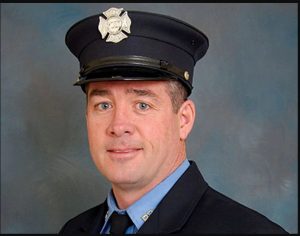
Dan Foley, Thomas Foley’s younger brother, had followed in his brother’s footsteps to join the FDNY. He was off duty on 9/11, but rushed to the site when it was reported that his brother Tommy was missing. When it became apparent that Tommy was gone, Dan Foley promised his parents he would not leave the site until he found his brother. Miraculously, amidst the tons of rubble and debris, it was Dan Foley who found his brother ten days later and carried his body from ground zero; Dan kept his word, he brought his brother home.
What Dan Foley and hundreds of other first responders engaged in the recovery efforts at ground zero did not realize was that they too would become casualties of 9/11. After a distinguished 21-year career with the FDNY as a member of his fallen brothers Rescue Company 3, Dan Foley passed away from 9/11 related cancer on February 22, 2020, leaving behind a wife and five children. He was forty-six. It is not surprising that days before the diagnosis of his illness, on what would be his last day as a firefighter, Dan Foley was credited with saving four young children from a burning apartment.
Tragically, the Foley family’s legacy of service and sacrifice did not end with the brothers. Four years before Dan’s passing, their father, Thomas Foley Sr., also died from a 9/11-related cancer Despite being a long-retired Sanitation worker and having himself lost a son, continued to return to ground zero to help other families. The first question the doctors asked after her dad’s diagnosis was whether he had been involved in the 9/11 rescue and recovery efforts.
Our Irish heritage seems to generate remarkable men and women with astonishing regularity. The story of the Foley Brothers is a story that our Irish heritage has so often produced; the story of the Foleys joins the story of the Sullivan and Niland brothers. Because of Irish Americans like Thomas, Dan and Thomas Foley Sr,, we too should never hesitate to say “I’m Irish” and never let being Irish be trivialized.
#IrishAmericanHeritageMonth
Neil F. Cosgrove ©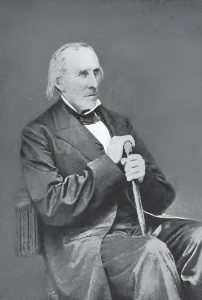
Whelan was born in 1802 in Loughnageer, County Wexford. Little is known about his early life before he attended Birchfield College in Kilkenny, where he studied classics and mathematics. He later emigrated to America, answering God’s call for priests to support the newly established Archdiocese of Charleston, where he was ordained in 1830.
Over the next thirty years Fr. Whelan was a tireless shepherd of a flock which, as a result of the waves of Irish immigration caused by the Great Hunger, was growing exponentially. He helped build the first Catholic Church in Charlestown and also the first in Georgia. In 1854, Fr. Whelan was transferred to the newly formed Archdiocese of Savannah to minister to that city’s growing Irish Catholic population. With only eleven priests, the archdiocese covered all of Georgia and Florida.
With the outbreak of the Civil War, the Confederacy established a garrison at Fort Pulaski located at the mouth of the Savannah River. Among the units assigned to the garrison were the Montgomery Rifles, which was almost entirely composed of Irish Catholic immigrants. Fr. Whelan quickly embraced the men of that remote and isolated outpost looking after both their spiritual and physical well being; he quickly became a favorite of the entire garrison. By a twist of fate, Fr. Whelan had the misfortune of being in Fort Pulaski when the Union forces isolated it and commenced a heavy shelling of the fort resulting in its surrender. While offered his liberty as a noncombatant, like the good shepherd, Fr. Whelan would not abandon his flock and went into captivity with them as a prisoner of war and was transferred to Governor’s Island, New York.
“When I give for Christ’s sake, I give the best.”
Believing the war would be over in a few months, neither side in the Civil War had given much thought to the capture and care of the large number of prisoners the war would produce. While at Governor’s Island Confederate officers were treated with a measure of professional courtesy by their Union counterparts, the enlisted men suffered terribly in improvised cells with scant rations and clothing. Fr. Whelan immediately began putting out appeals to his fellow priests and organized aid for his men. When Rev. William Quinn of St. Peter’s Parish became aware of Fr. Whelan’s confinement in the cold damp prison he feared for the aged priest’s health and launched a successful appeal to have Fr. Whelan paroled. However, except for occasional trips to the city to secure supplies, Fr. Whelan still insisted on staying with his men and sharing their privations while saying Mass and tending to the sick. The Confederate officers were impressed with Fr. Whelan’s ministrations to their men, and noting that the one suit of clothing he possessed was terribly threadbare, arranged the purchase of a new suit for the priest. A few days later, the senior officer noted that Fr. Whelan was still wearing his old clothes. Where was the new suit he asked? Fr. Whelan replied that he had given it to a newly arrived prisoner who had arrived almost naked. The Confederate officer attempted to reprimand the priest saying he should have kept the new suit and given the man his old one. Fr. Whelan replied, “When I give for Christ’s sake, I give the best.”
“Of all the ministers in Georgia accessible to Andersonville, only one could hear this sentence, ‘I was sick and in prison and you visited me,’ and that one is a Catholic.”

Fr. Whelan and his men would eventually be exchanged for Union prisoners, and the priest would return to his civilian religious duties in Savannah. However, new and disturbing reports were soon received about a Confederate prison camp: Andersonville. Prior to WW II, no prison camp was more infamous. Hastily built for 6,000, it would hold 45,000 Union POWs with no shelter, sanitation or clean water. It was literally a hell on earth for Union Prisoners and a place where 13,000 of them would die. Aware that many of the Union prisoners were likely to be Irish Catholics, and despite himself having been confined in the North as a Confederate POW, Fr. Whelan volunteered to go to the prison and tend to the men’s needs. Those needs were staggering with scores dying every day from starvation and disease. Several fellow priests attempted to assist Fr. Whelan, but none could stand the physical and emotional strain and each left within a few weeks. Yet, 62 year old Fr. Whelan stayed and his impact was noted in later years by surviving prisoners:
“By coming here he exposed himself to great danger of infection…His services were sought by all, for, in his kind and sympathizing looks, his meek but earnest appearance, the despairing prisoners read that all humanity had not forsaken mankind.”
Another remarked that,
“Of all the ministers in Georgia accessible to Andersonville, only one could hear this sentence, ‘I was sick and in prison and you visited me,’ and that one is a Catholic.”
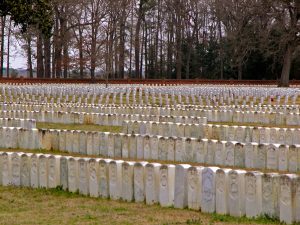
Fr. Whelan’s selfless sacrifice came with a price; he soon contracted ‘Congestion of the Lungs’, likely tuberculosis. With Georgia falling to the advancing forces of Union General Sherman, the Andersonville prisoners were transferred and Fr. Whelan would have to leave them. However, before they left he arranged a loan of $400 in gold to buy flour and have it baked into hundreds of loaves that became known to the prisoners as “Whelan’s bread”; it provided the men with rations for several months. One former prisoner later wrote, “Without a doubt (Fr. Whelan) was the means of saving hundreds of lives.”
After the war, his health permanently broken from his service to his fellow man, Fr. Whelan petitioned Union Secretary of War Stanton for the $400 that Fr. Whelan had borrowed so that the Union Prisoners could be fed. In an unmitigated display of callousness, ignoring the living evidence of hundreds of soldiers who had survived because of “Whelan bread,” Stanton asked the aged priest to provided receipts! Outraged, Fr. Whelan informed the callous Stanton to keep his money because he had, “Neither the health nor the strength to run over Georgia to hunt up vouchers and bills of purchase.” Instead the proud priest made one further sacrifice. Knowing of his ill health, friends of Fr. Whelan had raised funds to send the priest to a better climate where he might recover. Instead of using the funds to aid in recovering his health, Fr. Whelan used the money to repay the loan. After several years of ill health, Fr. Whelan died in 1872. His was the largest funeral that Savannah had ever seen.
Though overlooked in history, the story of Rev. Peter Whelan exemplifies the spirit of service and sacrifice that has long defined Irish Americans. An immigrant who made America his home, he devoted his life to ministering to those in need. Like the good Shepherd, he did not abandon his flock and shared in their captivity and suffering. He did not see enemies, only human beings in need of compassion. Even in his own poverty, he gave freely—parting with his last possessions to clothe the desperate and even borrowing money to feed the starving. His tireless efforts to bring comfort, dignity, and even bread to those who had none stand as a testament to the profound impact that one individual can have, even in the darkest of times.
Neil F. Cosgrove
]]>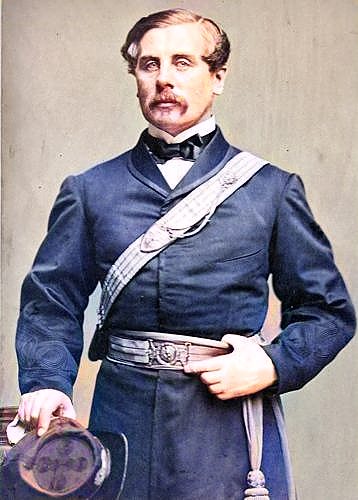
Thomas Francis Meagher’s life is a testament to the resilience, ambition, and dedication of the Irish people, both in their homeland and in America. Born in Waterford in 1823, Meagher was raised in an affluent household and received a classical education at Clongowes Wood College and Stonyhurst College in England. Here, he developed his skills in rhetoric, history, and philosophy—an education that would shape his later role as a statesman and orator.
Despite his privileged upbringing, he was drawn to the cause of Irish independence. A deep sense of history and justice fueled his passion for Irish freedom. Influenced by the ideals of the American and French Revolutions, he believed Ireland deserved the same right to self-governance. The injustices of British rule, particularly the oppressive response to the Great Hunger, further solidified his commitment to the cause.
As a leader of the Young Ireland movement, Meagher became a powerful voice for national self-determination. In 1846, at the ironically named Conciliation Hall in Dublin, Meagher delivered his fiery “Sword Speech.” While advocating for the repeal of the Act of Union, he rejected pacifism, arguing that armed struggle was sometimes necessary for freedom. This speech earned him the title “Meagher of the Sword.” In one section, Meagher cited the example of the American Revolution:
“Abhor the sword? Stigmatize the sword? No, my lord, for at its blow, and in the quivering of its crimson light, a giant nation sprang up from the waters of the Atlantic, and by its redeeming magic the fettered colony became a daring, free Republic.”
In 1848, Meagher unveiled the Irish tricolor of orange, white, and green (unlike the current Irish flag, the orange was closest to the staff). The flag’s green represented the native Irish Catholics and their nationalist aspirations, the orange symbolized the Protestant community, and the white in between stood for the hope of lasting peace between them. Later that year, after participating in a failed uprising, he was arrested and sentenced to death, which was commuted to exile to Van Diemen’s Land (modern-day Tasmania).
Refusing to accept a life in captivity, Meagher escaped in 1852 and made his way to the United States. He quickly established himself as a leader in the Irish American community, speaking on behalf of his fellow immigrants and advocating for their rights. As a lecturer, lawyer, and journalist, he became one of Irish Americas most prominent leaders, urging his compatriots to embrace their new country while never forgetting their heritage..
When the Civil War broke out, he recognized the opportunity to demonstrate the loyalty and valor of Irish Americans while also achieving training for men who could later be used to fight for Ireland’s cause. He formed the famed Irish Brigade, composed of Irish immigrants, which became one of the most celebrated units of the Union Army. The Brigade fought in some of the war’s most grueling battles, including Antietam, where they played a crucial role in the Union assault on the Sunken Road, later known as Bloody Lane. The Brigade’s valor at Antietam cemented its reputation as one of the most tenacious units in the Union Army, though the cost in lives was immense. Meagher himself was injured and had to be carried from the field.
The Brigade continued to fight in the most perilous engagements, suffering immense casualties at the disastrous battle of Fredericksburg. Meagher resigned his command shortly thereafter in 1863, citing frustration with the way the Brigade had been irresponsibly used and being denied permission to recruit to replace the Brigade’s severe losses, leading some in the Irish community to believe that the Brigade was being used as cannon fodder on account of being Irish. This sense of ingratitude after the loss of so much Irish blood led to Meagher’s disillusionment and eventual resignation.
After the war, Meagher was appointed acting Governor of the Montana Territory. It was a turbulent period, and he struggled to maintain order in a rapidly growing and often lawless frontier. Meagher’s efforts to impose federal authority put him in direct conflict with the Montana Vigilantes; a powerful and extralegal group that had taken justice into their own hands and was also anti-Catholic. In one particular incident, a fellow Irishman, James Daniels, had shot and killed a gambler in the town of Helena. He was tried and found guilty of second-degree murder and sentenced to 15 years in jail. Daniels maintained he had shot in self-defense and appealed his case to the Acting Governor. As a former lawyer, Meagher personally reviewed the case and ordered Daniels’ release. Daniels returned to Helena, and on the day of his return, the vigilantes hanged him and pinned a note on his body that read: “If the Governor does this again, we’ll hang him.”
On July 1, 1867, Meagher was traveling by the steamboat G. A. Thompson after traveling to Fort Benton, Montana, to receive a shipment of guns and ammunition for use by the Montana Militia. The weather was extremely hot, and for several days, Meagher had been extremely ill, suffering from dysentery and dehydration. Sometime in the early evening, Meagher fell overboard from the steamboat into the Missouri River. The boat’s pilot later described that section of the river as “instant death – water twelve feet deep and rushing at the rate of ten miles an hour.” Meagher’s body was never recovered. Rumors and theories abounded—some believed that political rivals had assassinated him, while others speculated that his injuries from the war or his declining health had played a role in his fall while on the deck trying to escape a hot night.
Thomas Francis Meagher remains an enduring figure in Irish American history. His legacy lives on in the Irish tricolor and the legend of the Irish Brigade. His life was emblematic of the dual identity but never divided loyalties of Irish America—a people who, though forced to leave their homeland, carried its spirit with them across the Atlantic, determined to prove their worth and shape their own destiny and that of a new country while never forgetting where they came from.
As we honor Meagher’s legacy this Irish American Heritage Month, we are reminded that the fight for justice and identity is ongoing. His story is not a relic of the past, it is a call to uphold the values of courage, unity, and resilience in our own time.
Neil F. Cosgrove
#IrishAmericanHeritgeMonth
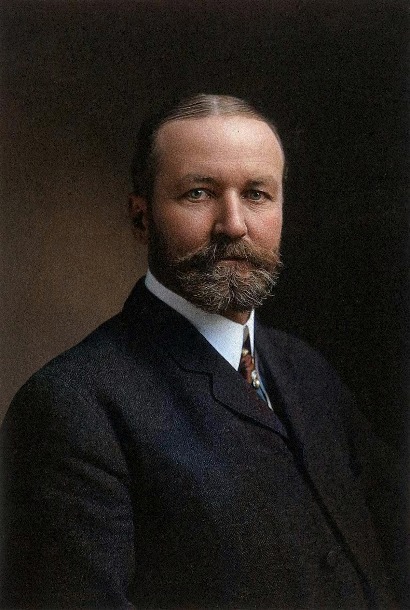
Dr. John B. Murphy, known throughout his life as “J.B.,” was a renowned American surgeon and medical pioneer who made significant contributions to the field of medicine during his lifetime. He was born in a log cabin in Appleton, Wisconsin, on December 21, 1857. Murphy was the son of impoverished Irish immigrants Michael Murphy and Ann (née Grimes) Murphy, who had emigrated from Ireland during the Great Hunger. Murphy grew up in a large family with six siblings. His parents strongly emphasized education and encouraged their children to pursue academic and professional success.
Murphy often quoted his mother: “If you are educated, there is no man’s achievements which you cannot equal or excel, provided you have industry, integrity, and are temperate.” Murphy’s parents also instilled in their son a strong Catholic faith which he carried throughout his life.
Murphy was introduced to the idea of a medical career while working as an assistant to the local druggist, sweeping out the store, running errands, and filling prescriptions for the local physician, Dr. H. W. Reilly. One day, Dr. Reilly needed JB’s help to resuscitate a man bleeding from an extensive injury to his leg. The young Murphy, fascinated and unperturbed by the sight of the horrific injury, decided to become a doctor. JB saved money to become the doctor’s trainee and assistant. He slept in the office, kept it clean, accompanied the doctor on calls, and studied in his spare time, while paying the doctor a $200 honorarium.
After a year, Dr. Reilly told Murphy he had nothing more to teach him and that he should attend medical school. At the age of twenty, Murphy was admitted to Chicago’s Rush Medical College. Murphy graduated in 1879 and, unusually for the time, pursued an 18-month internship at Cook County Hospital in Chicago, placing first in their placement examination. Upon graduation and briefly practicing medicine, Murphy began a tour of Europe, where he studied under some of the prominent surgeons of the time.
Murphy returned to Chicago and the United States. Unafraid of controversy, he drew the ire of the established medical establishment when he pushed for the early removal of the appendix in cases of appendicitis (the accepted practice at the time was to wait until the appendix ruptured), developing a new and less invasive process to perform the operation. He gained national attention as one of the doctors to attend to the injured from Chicago’s Haymarket riots and later for being the attending physician to former President Theodore Roosevelt after an unsuccessful assassination attempt.
Dr. J.B. Murphy was a medical pioneer. Among his innovations:
- Murphy’s Sign: A diagnostic technique utilized to identify gallbladder disease.
- The Murphy Button: A device designed to close openings in the intestine following surgery, this innovation significantly reduced recovery times and marked a breakthrough improvement over the traditional suture method.
- The Murphy-Davis Splint: Developed by Dr. J.B. Murphy and Dr. Frank Davis, this device was used to immobilize the hip following surgery, representing a significant improvement over existing devices and was widely adopted by surgeons.
- The Murphy Technique: Dr. Murphy performed the first successful removal of the gall bladder using an innovative surgical technique that remains in use today.
- The Murphy Drip: Used for hydration and replenishment of electrolytes.
- The First Use of Rubber Gloves in Surgery: Murphy recognized the importance of sterile technique and began wearing rubber gloves to reduce the risk of infection during surgery.
- The First Use of an X-Ray Machine in Surgery: In 1896, Dr. Murphy became the first surgeon to use an X-ray machine during surgery, quickly locating a bullet in a patient’s abdomen, enabling him to perform surgery without damaging any vital organs.
- Murphy became the first surgeon to successfully resect a major artery in a human being.
.Murphy was recognized not only as an innovative surgeon but also as a great teacher who was quick to pass on his techniques to his colleagues. He founded several medical publications that are still printed today. J.B. Murphy ran teaching clinics four days a week at Mercy Hospital in Chicago. At these clinics, he demonstrated to 150 visitors daily the various approaches to multiple surgical problems
Yet, his brilliance as a doctor never eclipsed the Catholic values that Murphy’s parents had instilled in him as a child. Murphy established several hospitals and clinics throughout his career. He believed that all people, regardless of their economic status and ability to pay, should have access to quality medical care. He worked tirelessly to establish new institutions that provided affordable care to Chicago’s poor and underserved populations. In 1892, with the help of the Alexian Brothers religious order, Murphy established the Alexian Brothers Hospital, which soon established a reputation as a modern and well-equipped medical facility that would provide high-quality care to patients from all walks of life. Murphy was a strong advocate for the importance of accessible healthcare and worked tirelessly to ensure that the hospital remained true to its mission of serving the community’s needs.
After accomplishments that could fill several lifetimes, Murphy fell ill in 1916. A doctor till the end, two days before his death, J.B. Murphy told the attending physician, “I think the autopsy will show plaques in my aorta.” After his death, Murphy’s final diagnosis was confirmed.
Neil F. Cosgrove
#IrishAmericanHeritageMonth
]]>
Philip Fitzpatrick was born in Aughavas, Co. Leitrim in 1892. Like so many of his generation, he emigrated to the United States and settled in New York City. He joined the NYPD in 1926 and was assigned to Mounted Squad 1 in Manhattan. He would serve with distinction for over 21 years as one of ‘New York’s Finest’ and would prove more than worthy of the title.
However, in addition to protecting the streets of New York, Patrolman Fitzpatrick had another talent that few realized until many years after his death; he was a talented poet. Fitzpatrick came from a family having a long musical tradition going back through the generations. His best-known poem was a tribute to the County of his birth, “Lovely Leitrim,”; the story of an immigrant dreaming of returning to his homeland and seeing once again the sights he once knew and now cherishes in his heart. In another moving poem he wrote about his experience as a father saying goodbye to his son Charles as he leaves to join the Marines in WW II.
Fitzpatrick also wrote a poem to honor his fellow police officers, whom he described as “Soldiers of Peace.” In the poem, he describes the fear well known to all police families that when he “kisses his wife and children goodbye, there’s a chance he will see them no more.” Sadly, for Officer Phillip Fitzpatrick, the line was prophetic.
On Tuesday, May 20, 1947, Patrolman Fitzpatrick was off duty and having lunch with his friend Patrolman George H. Dammeyer at a tavern located at 1703 Third Avenue and East 96th Street on the Upper East Side of Manhattan. While they were dining, two career criminals armed with pistols entered the tavern after having just robbed another location nearby, where they pistol-whipped their victims. The criminals proceeded to demand money and valuables from everyone in the tavern, pointing their pistols at both the customers and staff.
Despite the great risk to their own safety, Patrolman Fitzpatrick and Patrolman Dammeyer bravely attempted to apprehend the criminals. During the altercation, Fitzpatrick was shot twice in the stomach and suffered grievous wounds while struggling with one of the perpetrators. However, Patrolman Dammeyer managed to shoot and kill both of the criminals.
Phillip Fitzpatrick succumbed to his wounds and passed away on May 26, 1947, leaving behind his wife Mary and five sons. In recognition of his bravery and sacrifice, Patrolman Fitzpatrick was given an Inspector’s funeral and was posthumously awarded the NYPD Medal of Honor. His son Charles, whose leaving for the Marines he had memorialized, was now himself a police officer and was given his father’s Shield, No. 15348. Phillip Fitzpatrick had never made it back to his home County of Leitrim except in his dreams and poetry. He was remembered as a proud Irishman and a devout Catholic who was a member of the Holy Name Society and a committed member of the Ancient Order of Hibernians.
It would not be until twenty years after his death that Phillip Fitzpatrick’s poem “Lovely Leitrim” gained notoriety by singer Larry Cunningham. Despite admiring the song, Cunningham released it as a ‘B-Side’ because he knew that RTÉ (Ireland’s dominant radio station) would never play it. While Cunningham was correct, the hand of radio producers was forced when the song was frequently requested. “Lovely Leitrim” would go on to be a number-one record, displacing the Beatles’ “Day Tripper,” selling over a million copies. The song has become an unofficial anthem for County Leitrim.
Sadly, many do not know that behind the ballad “Lovely Leitrim” stands a heroic son of Leitrim who is memorialized on the walls of NYPD headquarters at One Police Plaza.
To his County and the People of New York, he was ‘faithful unto death”, the motto of the NYPD.
Neil F. Cosgrove
#MarchIsIrishAmericanHeritagerMonth
]]>
Hercules Mulligan, an Irish immigrant, became an unsung hero of the American Revolution. Though the musical ‘Hamilton’, whose chief goal is to entertain, has introduced his name to a broader audience, Mulligan’s real contributions as a spy and hero of American independence are far more compelling than the play suggests.
Mulligan was born in Coleraine, Co Derry, in 1740 and emigrated with his family to North America at the age of 6, settling in New York City. He attended King’s College (now Columbia University). Mulligan opened an upscale tailor shop. While he had several tailors on staff, the charismatic Hercules made it a point to serve and fit every customer personally. The level of service soon made Mulligan’s shop a favorite of New York’s elite, particularly British officers who would have Mulligan tailor their uniforms.
While comfortably placed in Colonial British social circles, it did not reflect Mulligan’s beliefs as an ardent proponent of American independence. Mulligan was a founding member of the New York Sons of Liberty, a clandestine group established to defend the colonists’ freedoms from increasingly restrictive British regulation. He was a New York Committee of Correspondence member, which attempted to unify and coordinate opposition to British rule throughout the colonies.
It was about this time that Hercules’ brother Hugh, who ran a shipping firm, introduced him to Alexander Hamilton, a young man who had recently arrived from the West Indies. Hercules took the young Alexander in as a border and soon developed a close friendship; Mulligan arranged for Hamilton to attend his alma matta Kings College/Columbia. Conversations at the Mulligan table persuaded Alexander Hamilton to make the rebel cause his own.
When Washington’s army evacuated the city of New York, Mulligan was initially detained, though released, and found himself an American patriot in one of the strongest areas of loyalty to the Crown in the colonies. Mulligan returned to continue his business at his tailor shop until he received word that on the recommendation of Alexander Hamilton, now an officer on Washington’s staff, Washington was asking him to take on the dangerous role of spy. Mulligan accepted at once.
Mulligan proved extremely successful as a spy. In his shop’s relaxed, unoffensive atmosphere, British officers frequently let their guard down with the charming Irishman and reveal more than they should. When multiple officers came into his shop saying they needed delivery on the same date, Mulligan would communicate that troop movements were imminent. His brother Hugh, whose shipping company was now delivering supplies for the British, was also a valuable source of information. Mulligan would send these messages across enemy lines using his servant Cato as a courier, playing on the fact that as an enslaved person, the British would ignore him.
On two separate occasions, information supplied by Mulligan is credited in saving Washington’s life. In one incident, a British soldier came rushing into Mulligan’s shop after hours to buy a new watch cloak. When Mulligan asked why the late hour and rush, the officer couldn’t contain himself, he told him excitedly that he was part of a mission to kidnap Washington. Mulligan quickly sent word to Washington, and the kidnapping plan was thwarted. The second incident occurred in 1781 when his brother’s import-export firm received a large rush order that revealed plans to capture Washington in Connecticut while traveling to Rhode Island to meet with the French. Again, Mulligan’s intelligence warned Washington to change his route.
Mulligan’s activities were not without risk. He had already been interrogated twice on suspicion of spying but had been able to charm his way out of it. However, he was directly betrayed by Benedict Arnold. However, Arnold’s lack of hard evidence and the likely general disdain amongst the British Officers for the word of a traitor allowed Mulligan to escape prison, but his usefulness as a spy was over.
However, Mulligan’s greatest threat was from his fellow New York Patriots, who thought he was a British collaborator and, ironically, a spy for the British. The fear of reprisals against himself and his family could not have been far from Mulligan’s mind as the British evacuated and Washington’s troops marched into the city. However, Washington did not forget Mulligan or his service; as soon as he accepted the British surrender of the city, Washington made a very public visit to Mulligan to have breakfast at his home, sending a clear message that Mulligan was a patriot.
Washington continued to repay Mulligan, placing several orders with him, allowing Mulligan to promote himself as “the official tailor to General Washington” and later “President Washington.” Mulligan became one of the 19 founding members of the New York Manumission Society, an early American organization that promoted the abolition of slavery.
The real Hercules Mulligan deserved to be better known. Sadly, while the play “Hamilton” has made his name known, the man and his deed remain hidden. In perhaps an ultimate indignity, in response to the notoriety the play had given Mulligan, a story on an internet website showed a painting purporting to be Mulligan. This image of “Hercules Mulligan” has spread across the internet as other articles, even historical sites, have mindlessly parroted. The only problem: it is a painting of Charles Carroll, the Irish American signer of the Declaration of Independence.
March is Irish American Heritage Month #IrishAmericanHeritage Month
Neil F. Cosgrove ©
]]>
As the first female police officer in the United States, Marie Connolly Owens should be remembered and celebrated as a pioneer. Yet, her legacy has been largely forgotten—her achievements erased from history until modern researchers unearthed her remarkable story. She worked tirelessly to enforce child labor laws, tracked down absent fathers who abandoned their families, and often reached into her own meager pockets to help struggling mothers and children. Despite all of this, when she passed away in 1927, her obituary made no mention of her groundbreaking career, a stark reminder of how even pioneers can be forgotten.
Born on December 21, 1853, in Ottawa, Canada, Marie Connolly was the daughter of Irish immigrants who had fled the Great Hunger. Marie married Thomas Owens, and they moved to Chicago in search of a better future. But in 1888, tragedy struck: Thomas succumbed to typhoid fever, leaving Marie a widow with five children to support. Forced into the workforce at a time when job opportunities for women were scarce, she sought a position that would provide stability.
Her opportunity came in 1889 when Chicago passed an ordinance prohibiting the employment of children under 14. Believing that women inspectors could better handle matters related to children and families, the city appointed five female sanitary inspectors, including Marie Owens.
Marie approached her new role with equal measures of determination and compassion. Walking through the grimy factories of Chicago, she encountered children toiling in horrific conditions:
“The suffering due to the inability of the older members of the family to work is, indeed, pitiable. Children were found working in factories all over the city, the frail little things in many cases being under 7. The pittance of 75 cents or $1 a week, however, helped to buy food for a sick mother, though it was at the cost of health and education.”
Many children were forced to enter the workforce because their fathers had abandoned their families and refused to provide support. With ardent resolve, Owens relentlessly ferreted these men out and turned them in to the police, ensuring they were held accountable for their children’s well-being.
Marie personally assisted families in finding work, sometimes even helping them financially from her own pocket. Owens earned a reputation for her genuine care for children, tempered by a diplomatic approach toward parents and business owners that made her as respected and popular as one in her challenging role could be.
Owens’s dedication did not go unnoticed. In 1891, the newly appointed Chief of Police, Major Robert Wilson McClaughrey—himself a reformer interested in rehabilitating juvenile offenders—recognized her work. She was transferred to the Chicago Police Department, where she was granted full arrest powers and appointed Detective Sergeant No. 97: the first female police officer in U.S. history.
Marie continued to enforce child labor and compulsory education laws. But her work extended beyond enforcement. She built relationships with factory owners, persuading them to fund education programs for young workers.
As noted in a 1901 Chicago Tribune article, Owens was known for her gentle yet firm approach:
“Sergeant No. 97′ (Owens) never invokes the strong arm that is back of her unless all gentler methods have been proved inefficient.”
Captain John O’Brien, one of her superiors, was so impressed by Marie’s effectiveness that he remarked:
“Give me men like she is a woman,” he said, “and we will have the model detective bureau of the whole world.”
Owens retired from the Chicago Police Department in 1923 at age 69 after serving the public for 32 years. But when she passed away in 1927, her obituary made no mention of her groundbreaking contributions.
The story of Marie Owens was lost for nearly a hundred years until Rick Barrett, a former Drug Enforcement Administration agent and amateur historian, rediscovered her. Barrett spent over three years researching Owens. Explaining her disappearance from history, he noted:
“She wasn’t wealthy. She was Irish. She was Catholic…She had all of these strikes against her, and so they just wrote her off.”
For Irish Americans, Owens’s story is a powerful testament to determination, compassion, and courage—and a reminder of the need for Irish American Heritage Month.
]]>