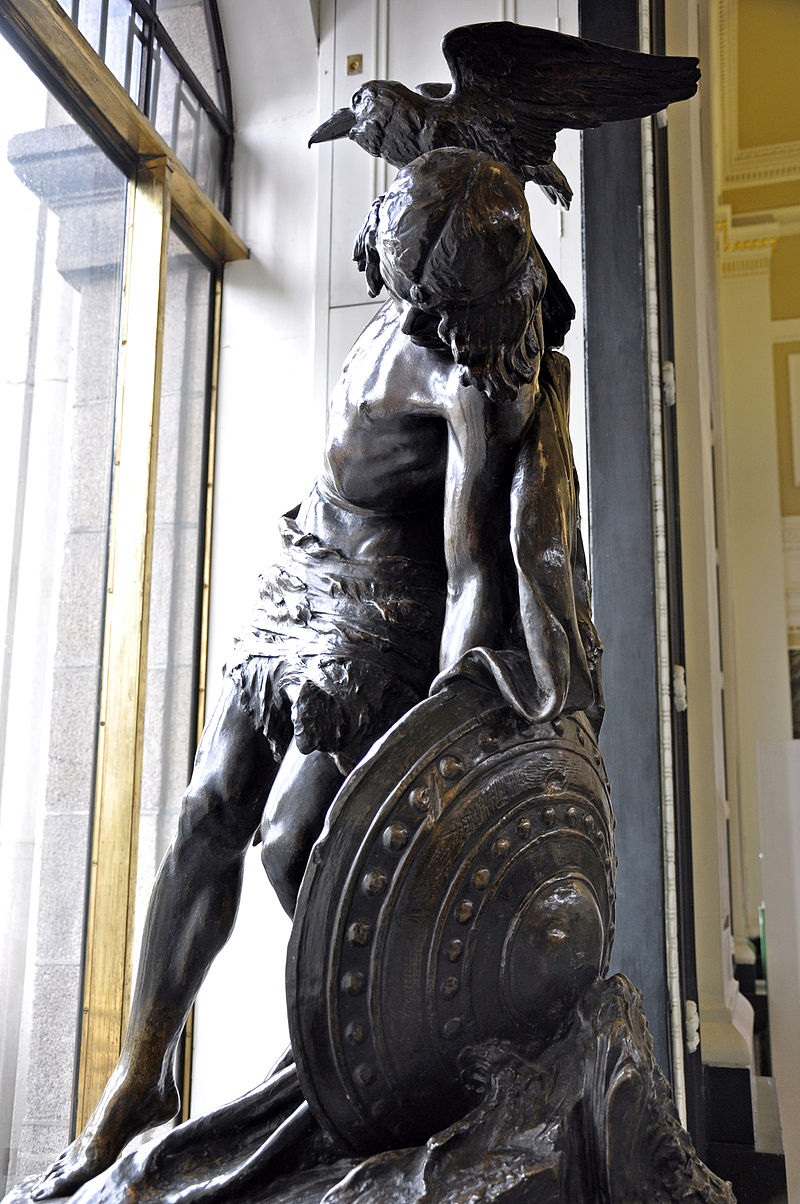
The Dying Cuchulainn
Oliver Sheppard was a respected Irish sculptor now remembered mostly for his 1911 work, The Dying Cuchulain. Sheppard, of Protestant background, was active in the Celtic Revival movement and sculpted The Dying Cuchulain in 1911, inspired at least in some respect by Lady Gregory’s work. In 1905 he sculpted a statute of a Wexford pikeman, recalling the United Irishmen Rising of 1798.
Eamon DeValera chose The Dying Cuchulainn to be placed in the GPO in 1935, in advance of the 20th anniversary of the Rising, describing the work as “a creation of Irish genius, symbolizing the dauntless courage and abiding constancy of our people.”
Stepping gingerly into the crisp mid-Atlantic surf earlier this month, I was met and abruptly bowled over by one of those inordinately strong breakers that one sometimes encounters at the beach. Getting up and advancing once again in the face of the relentless waves, I was reminded of Cū Chulainn, (sometimes “Cūhulain” or “Cūchulainn”) the great hero of Bardic Ireland, and his fight with the invincible sea, as depicted by William Butler Yeats in his 1925 Poem, Cuchulainn’s Fight with the Sea. While Cū Chulainn may not be a historical figure, his depiction in the pre-written, oral tradition of Ireland, as preserved in surviving monastic manuscripts and as revived and adapted during the Irish Literary Revival, is the subject of this month’s bulletin.
The oldest surviving written account of Cū Chulainn is found in the Book of the Dun Cow, (Lebor na hUuidre), currently in the possession of the Royal Irish Academy, which dates to the eleventh century. The manuscript was compiled at the monastery of Clonmacnoise, founded by St. Ciaran in 545. The manuscript contains a partial version of The Cattle Raid of Cooley, (Táin Bo Cuailngr) the most famous of the Cu Chulaiin tales, another partial recitation of which is found in the Yellow Book of Lecan (Leabhar Buide Leacain) compiled between 1391 and 1401 by the Mac Fhirbhisigh historians of Lecan (today Lackan) in County Sligo.
The Táin is an epic poem describing a first century war between Connacht, led by Queen Mebd (Anglicized as Maeve) and Ulster, led by Mebd’s ex-husband, King Conochbar. Mebd had her eyes on a prized bull of great renown, Donn Cuailnge, owned by one of Conochbar’s vassals, and there the trouble began. Most importantly for our purposes, the forces of Connacht, owing to a curse afflicting the army of Ulster, found that they were opposed in battle only by a teenaged Cū Chuliann, who as it turned out was opposition aplenty.
Cū Chuliann, originally named Setanta, was the son of King Conochbar’s sister and is perhaps the son of Lugh, Celtic god of the sun. Setanta, when still a boy, was invited by his Uncle Conochbar to a feast at the house of Culann, whose house was guarded by a fearsome hound. Arriving late, Setanta was set upon by the dog and killed it, despite his tender age. Being a lad of great honor, Sentana offered to take the place of the dog, and was thereafter known as Cū Chulainn (“hound of Culann”). Cū Chulainn is trained as a warrior and then engages in many great feats of strength and valor in the Táin and other tales, ultimately meeting his end years later when, in mortally wounded, he lashed himself to a great stone to be able to face his oncoming enemies.
Cū Chuliann as a character figured prominently in the Irish Literary Revival of the late 19th and early 209th century.
Yeats alone published works featuring Cū Chulainn no less than seven times, beginning with The Death of Cuchulainn in 1892 and ending with Cuchulain Comforted, in 1939. Lady Gregory, Co-founder of the Abbey Theater with Yeats, published Cuchulainn of Muirthemme: The History of the Men of the Red Branch of Ulster, in 1902. In his preface to Lady Gregory’s translation, Yeats wrote: “I think this book is the best that has …ever come out of Ireland: for the stories which it tells are a chief part of Ireland’s gift to the imagination of world.”
The notion that Ireland had a rich and ancient literary tradition of its own contributed to the sense of national identity that informed and inspired the men and women of 1916 and Cū Chuliann soon became a symbol of Irish Nationalism. Yeats, writing in the preface to Lady Gregory’s 1904 publication, Gods and Fighting Men, explicitly made the connection: “One remembers indeed that when the farming people and the labourers of the town made their last attempt to cast England out by force of arms they named themselves after the companions of Finn.” (Fenians). In one of his own works, a poem entitled The Statues, Yeats cements the association with the lines: “When Pearse summoned Cuchulain to his side / What stalked through the Post Office? What intellect, / What calculation, number, measure, replied?”
During Easter Week, 1935, as noted elsewhere in this Bulletin, Oliver Sheppard’s sculpture, The Dying Cuchulain, was unveiled at the GPO as a memorial to the men and women of 1916
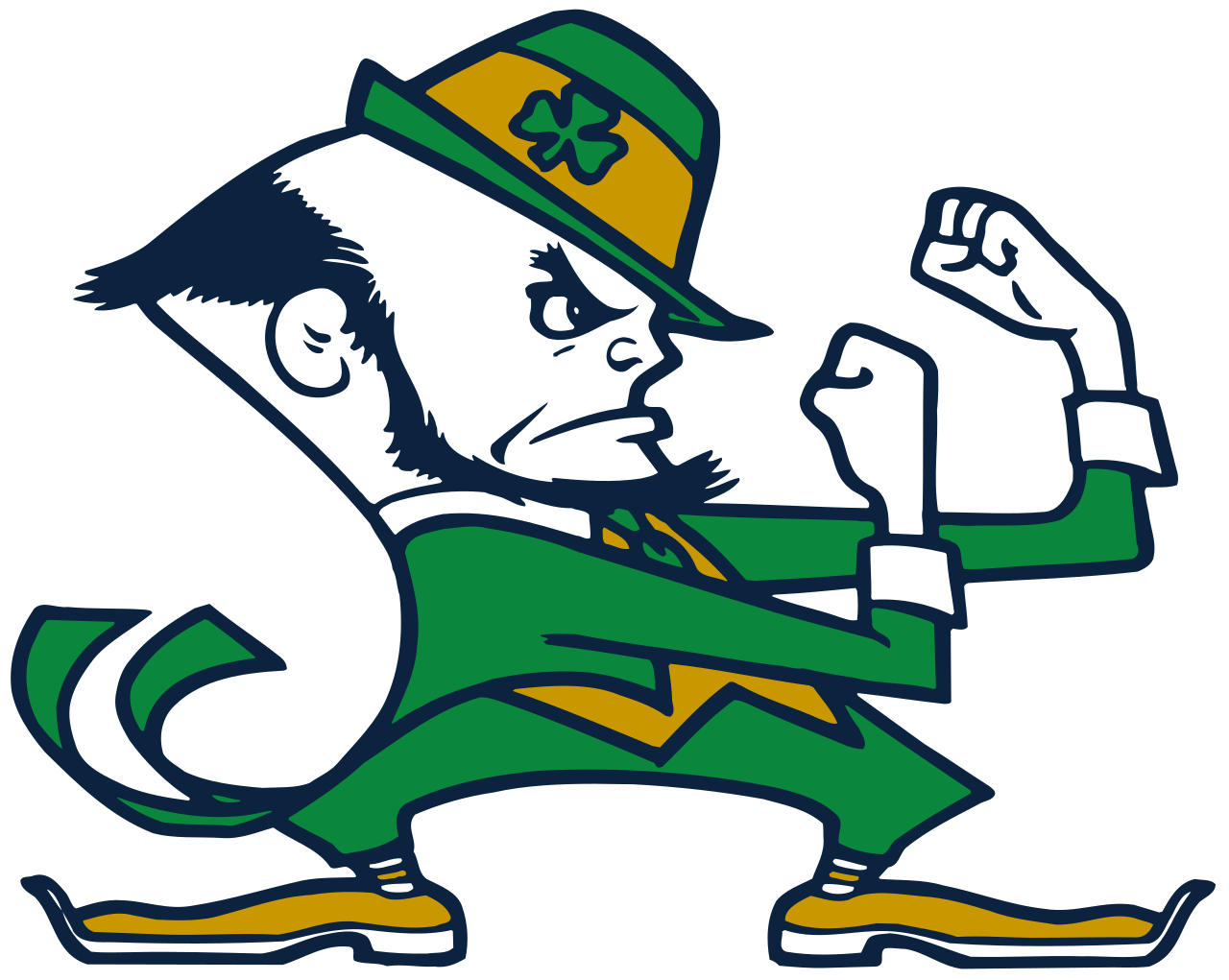
The country is again in the midst of a movement aimed at retiring team names and mascots deemed to be offensive. As with prior such movements, the “Fighting Irish” moniker and leprechaun mascot, with his classic “fisticuffs stance”, have entered the discussion. Those objecting to the nickname are presumably well-intentioned. But is “Fighting Irish” a slur? Or does the term have an origin of which the University, its students, alumni and the countless “subway alumni” can rightfully be proud?
Long before Notre Dame was established, the Irish soldier had a reputation for military prowess among the nations of Europe . The Treaty of Limerick in 1691 provided for the “Flight of the Wild Geese” in 1691 as Patrick Sarsfield and his Irish army of 14,000 joined Mountcashel’s Irish Brigade in the service of France . The Crowned heads of Europe (excluding England) enjoyed the service of generations of military leaders and intrepid Irish units who proved their worth time and time again. These Irish units in European service soon earned a reputation for their dependability and valor, leading continental armies to recruit in Ireland until the British made the practice illegal in 1745.
Irish emigration in the aftermath of the Great Hunger brought large numbers to our shores, just as the simmering conflict between the north and south was preparing to boil over. Anti-Catholic Nativists saw the Irish masses disembarking at American ports as a threat. Catholics, especially Irish Catholics, were considered to be dirty, immoral and “Un-American,” more loyal to Rome than Washington.
The Irish enlisted in the Union Army in great numbers and readers of this column are well aware of the gallant exploits of Irish Brigade. The penchant of the Brigade’s commanders for headlong charges and the willingness of the Irish troops soon caught the attention of other combatants, newspapers and the American people. The steady advance of the Brigade against murderous fire at Marye’s Heights on December 11, 1862 amazed the most battle-hardened observers. George Pickett famously wrote to his fiancé: “Your soldier’s heart almost stood still as he watched those sons of Erin fearlessly rush to their deaths. The brilliant assault on Marye’s Heights of their Irish Brigade was beyond description. We forgot they were fighting us and cheer after cheer at their fearlessness went up all along our lines.”
What does any of this have to do with Notre Dame? The exploits of Irish troops reported in the papers could not have been more different than Nativist depictions of the Irish. “Fighting Irish” referred not to drunken brawlers, but loyal American soldiers, the bravest of the brave. Notably, one of the Chaplains of the Brigade was Father William Corby, who later became the President of Notre Dame.
Of the competing genesis stories of the “Fighting Irish” name, the connection between the Brigade, Father Corby and Notre Dame perhaps rings most true. Unlike Indian names adopted by non-Native Americans, the name “Fighting Irish” was adopted by Notre Dame President, Mathew J. Walsh, C.S.C., son of an immigrant from County Cork, in 1927. As for the pugilistic leprechaun, the Irish had dominated the sport of boxing for decades. The stance of the leprechaun (search “John L. Sullivan” and look at the image) says it all – he is pure boxer, not barroom brawler. Certainly no one thinks that the “Fighting Illini” name of the occasional Notre Dame opponent is a slur. Come what may, it seems likely that the Fighting Irish of Notre Dame will continue to “ fight in every game, Strong of heart and true to her name.”
]]>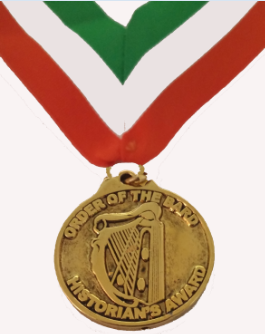 National History Day (NHD) is an annual program for elementary and secondary school students across the United States and participating international affiliates. Hundreds of thousands of entries in the form of exhibits, websites, essays, slide presentations, video documentaries and performances are created each year by individuals or groups in grades six through twelve. The AOH and LAOH are proud sponsors of NHD and annually present a First and Second Place award to the best entries on a topic related to Irish or Irish American history that fits the annual theme set by NHD each year. The First Prize, awarded by the AOH, consists of a Certificate, a Gold ‘Order of the Bard’ medallion and two round-trip tickets to Ireland valued at $2,000. The LAOH Award consists of a certificate, a Silver ‘Order of the Bard’ medallion and a $1,500. Scholarship Assist.
Each year, more than half a million students participate in the NHD competition beginning at the local school level; they move to a regional competition, then a State competition and ultimately to the National Finals at the University of Maryland in College Park, MD. The National finals will be held June 14-18, 2020. Adjudicators are teaching professionals and historians and, in addition to the Irish Awards sponsored by the AOH/LAOH, there are awards sponsored by many other organizations and it is possible to win more than one. Those wishing to participate can find rules, regulations and contacts on the NHD Website: https://www.nhd.org. This year’s theme is Breaking Barriers in History and the following topics are suggested as entries for the Irish Awards:
-
Daniel O’Connell – How did he begin to break the barriers established by the Penal Laws?
Wolfe Tone – how did he break the barriers against segregation and unite Catholics and Protestants in a unity that became the nationalist theme of all future revolutions?
Charles Stewart Parnell – How did he and the Land League break the barriers of landlordism and begin the process of returning property to the native Irish?
The Irish Brigade – How did the bravery of the Irish in Union blue during the American Civil War break the barriers of bigotry against the Irish in America?
Douglas Hyde – What barriers did he break to save the Irish language from extinction?
Women’s Suffrage – How did the women’s service in the various units of early 19th century Ireland, such as Inghinidhe na hEireann, Cumann na mBan, Sinn Fein and the Gaelic League help to break down barriers in their efforts toward equality?
John F, Kennedy – What barriers did he break in his run to become the first Irish Catholic President of the United States?
Civil Rights – What were the barriers that the Irish Civil Rights movement of the 1960’s sought to break and to what extent did they succeed?
Good Friday Agreement – How did the Good Friday Agreement break the barriers of a 30-year armed conflict to bring a peace agreement to Ireland?

On 4 July 1776, the Philadelphia State House was packed, despite a sweltering heat, as Secretary Charles Thomson of Derry read a Declaration that Adams, Jefferson, Franklin and Livingston had composed and that he, Thomson, had drafted. It was a declaration explaining why their revolutionary action was justified. After a full day of debate, modifying copy and amendments, Secretary Thomson recorded the changes and America’s Declaration of Independence was complete! The formal copy would not be ready for signature until August, but the public first heard that document read on 8 July 1776 by Col. John Nixon, son of a Wexford immigrant. Philadelphia printer Charles Dunlap of Tyrone rolled out copies that were snatched up before the ink was dry. Among the courageous men who signed that Declaration of Independence were eight Irish Americans, three of whom were Irish born. To sign this momentous document was an act of high treason against the British Crown. All the signers could be executed and their estates confiscated, thereby impoverishing their families. But, they hated monarchy and their spirit of independence is at the heart of the Republic they would crucially help to form. Their brand of defiance saw through British imperialism and used Enlightenment ideas to create a nation of free people. Those Irish signers were:
Thomas McKean was born in Pennsylvania on 19 March 1734 to William McKean from County Antrim and Letitia Finney McKean whose family also emigrated from Ireland. He became an American lawyer and politician, serving as President of Delaware, Chief Justice and then Governor of Pennsylvania. During the American Revolution, he was a delegate to the Continental Congress where he signed the Declaration of Independence and served as a President of Congress. Thomas McKean led the movement in Delaware for American independence and served as commander of a patriot militia group known as the Pennsylvania Associators. He died on 24 June 1817.
Charles Carroll of Carrollton in Maryland was born on 19 September 1737 and was the only Catholic and the longest-living signatory of the Declaration of Independence, dying at age 95 on 14 November 1832. He was held up by Catholic Americans as proof of their patriotism in an America largely run by a WASP establishment until JFK’s election. He is descended from the Tipperary clan Ó Cearbhail who trace their origin to The Cianachta, a tribe recorded to the third century AD. At the time, Maryland was the only colony tolerant of Catholic immigration, thanks to Lord Baltimore.
James Smith was born in Ireland about 1719 and his family was forced to emigrate to the American colonies due to abuse by landlords. Smith emerged as a leading lawyer of his day and wrote legal opinions denying the constitutional power of Great Britain over the American colonies. He also urged an end to the import of British goods. He raised a militia group in York, PA and joined the American Continental Congress in July 1775, a year before the Declaration was ratified. Smith would become a member of the Continental Congress in 1776 and serve in the War of Independence as a Colonel of Pennsylvania Militia. He died 11 July 1806.
George Taylor was born in Antrim in 1716 and emigrated to the American colonies in 1736. Taylor operated a furnace and was an iron manufacturer in Pennsylvania. He was a member of the Committee of Correspondence from 1774 to 1776 and of the Continental Congress in 1776 and 1777. Taylor is a name common in Ireland since the fourteenth century.
Matthew Thornton was born in Limerick on St. Patrick’s Day, 1713 and came out to America as a four-year-old child in the passage of five ships carrying 120 Irish families from the Bann Valley. He would practice medicine and become active in pre-revolutionary agitation before being elected to become a member of the Continental Congress in 1776. He was a Colonel of New Hampshire Militia from 1775 to 1783. He died on 24 June 1803.
Edward Rutledge was born in Charleston, South Carolina on 23 November 1749 and was the youngest signer of the Declaration of Independence. His father Dr. John Rutledge left Tyrone in 1735 and his sons, John and Edward were elected to the Continental Congress in July 1774. John was later Governor of South Carolina. Edward died on 23 January 1800.
Thomas Lynch Jr. Was the grandson of Jonas Lynch of Galway who was exiled after the defeats at Aughrim and the Boyne. Thomas Jr. was born on 5 August 1749 and named by South Carolina to the Continental Congress as its sixth delegate on 23 March 1776. Although ill, he traveled to Philadelphia to sign the Declaration of Independence. Thomas Lynch Sr. and Thomas Lynch Jr. were the only father and son to serve in the Continental Congress. After signing the Declaration, an ill Thomas Lynch Jr. set out for home with his ailing father. On the way, his father died in Annapolis, MD. Thomas Lynch Jr. retired in early 1777 and after two more years of illness, he sailed for respite to the West Indies in late 1779. The ship disappeared and he was presumed to have died at sea. At the age of 30, he was the youngest signer of the Declaration to die.
George Read was born in Maryland in 1733. He was the son of John Read and Mary Howell Read. John Read was a wealthy resident of Dublin who emigrated to Maryland. When George Read was an infant the family moved to Delaware. As he grew up, Read joined Thomas McKean at an Academy in Pennsylvania and then studied law. In 1763 John Penn, the Proprietary Governor, appointed Read as Crown Attorney General for the three Delaware counties and he served in that position until leaving for the Continental Congress in 1774.
All the 56 signers were brave and daring men and put their lives on the line to give their sons and future Americans the country we have today. Remember them and keep America the way they envisioned it could be.
]]>